
In the jewelry industry, a brand is only as credible as the mark it leaves on its product. Every hallmark, logo, serial number, and traceability code is a statement of authenticity — a permanent signal that the piece is genuine, compliant, and traceable back to its origin.
For decades, traditional engraving tools and hand-stamping methods have handled this work. They still exist in many workshops, but they carry real limitations: mechanical force that distorts fine metalwork, inconsistent mark depth and geometry, inability to reproduce complex logos at small scale, and no practical path to the machine-readable Data Matrix codes and QR marks that modern traceability systems require.
That is why luxury brands, hallmarking centers, and production jewelers are adopting the laser marking machine for jewelry as their standard marking technology. It is faster, more precise, non-contact, and produces permanent marks that survive every condition a piece of jewelry encounters — without touching, stressing, or altering the surface finish of the metal around the mark.
This blog explains exactly why laser marking has become essential for modern jewelry manufacturing — from brand identity and hallmarking compliance to counterfeit prevention, traceability, and the premium finishing standards that luxury brands demand.
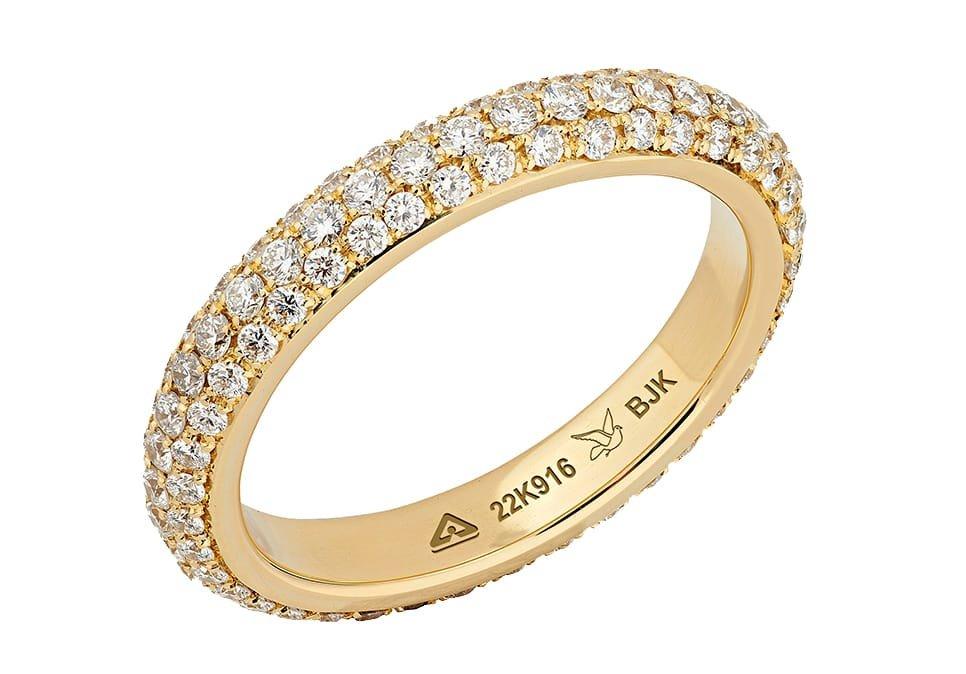
Why Permanent Jewelry Marking Matters
Before exploring the technology, it is worth understanding exactly what is at stake when a jewelry brand places a mark on its products.
Brand Identity and Counterfeit Protection
A logo mark is not just a design element — it is a legal claim of origin. For luxury jewelry brands, an inconsistently applied or easily replicated logo is a direct vulnerability to counterfeiting. Laser marking produces logos with sub-millimeter line accuracy, reproduced identically on every piece in a production run. The mark geometry is defined digitally and cannot be casually replicated with hand tools.
When applied as a micro-engraving at a scale invisible to the naked eye — a hidden authentication mark — laser marking creates a counterfeit barrier that protects both the brand and the customer.
Hallmarking Compliance
In most markets, jewelry sold commercially must carry a hallmark confirming the metal purity, the maker’s mark, and the assay of office identification. These requirements are legal obligations, not optional branding choices.
Traditional hand-stamping applies to the hallmark under mechanical force. On fine jewelry — thin shanks, delicate settings, lightweight earrings — that force distorts the piece. Laser hallmarking applies the same legally compliant mark without any mechanical contact, preserving the piece’s geometry and surface finish.
Luxury Product Authentication and Customer Trust
High-value jewelry buyers increasingly expect to be able to verify the authenticity and provenance of what they purchase. A serialized laser mark — unique per piece, machine-readable, linked to a product database — turns each item into a verifiable asset. It supports warranty programmed, insurance valuation, and resale authentication in a way that a hand-stamped hallmark alone cannot.
Traceability Through the Supply Chain
For jewelry manufacturers supplying retailers and OEM brands, component-level traceability — knowing exactly which material lot, production batch, and operator produced each piece — is increasingly a supply chain requirement. Laser marking at the component level makes this traceability practical at production volume.
How Laser Marking Works in Jewelry Manufacturing
A laser marking machine directs a focused beam of laser light onto the metal surface. Depending on the laser type and parameter settings, the beam produces a controlled change in the surface microstructure — annealed mark, a color change through oxidation, or a fine ablation — without mechanically contacting the metal.
The result is a permanent mark formed in the material itself, not applied on top of it. It does not flake, fade, wear off, or react to cleaning chemicals, ultrasonic baths, polishing compounds, or body chemistry.
Non-Contact, No Surface Damage
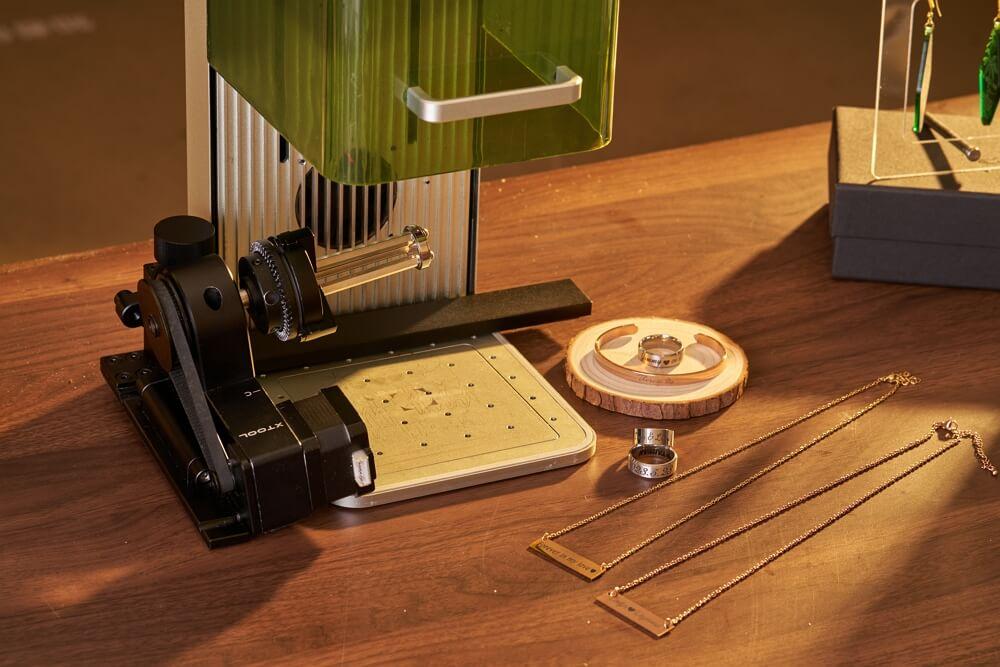
Because the beam never touches the workpiece, there is no mechanical stress, no distortion, and no surface scratching beyond the mark itself. The finish immediately adjacent to a laser mark is unchanged — the hallmark sits cleanly inside an otherwise pristine surface.
This is the critical advantage of high-value jewelry where the surface finish is part of the product’s perceived quality. A handstamp that slips, or a rotary engraving tool that vibrates, damages the finish. A laser mark does not.
High Precision at Small Scale
Laser marking systems used in jewelry operate with spot sizes typically between 0.02 and 0.1 mm. At this scale, it is possible to engrave brand logos, micro-text, and Data Matrix codes at sizes that remain sharp and readable under magnification but are nearly invisible to the naked eye.
For brands that mark ring interiors with logos, serial numbers, and hallmarks — often in a space of 5–8 mm width — laser marking is the only technology that can reliably fit all three marks in the available space without compromising readability.
Minimal Heat Impact
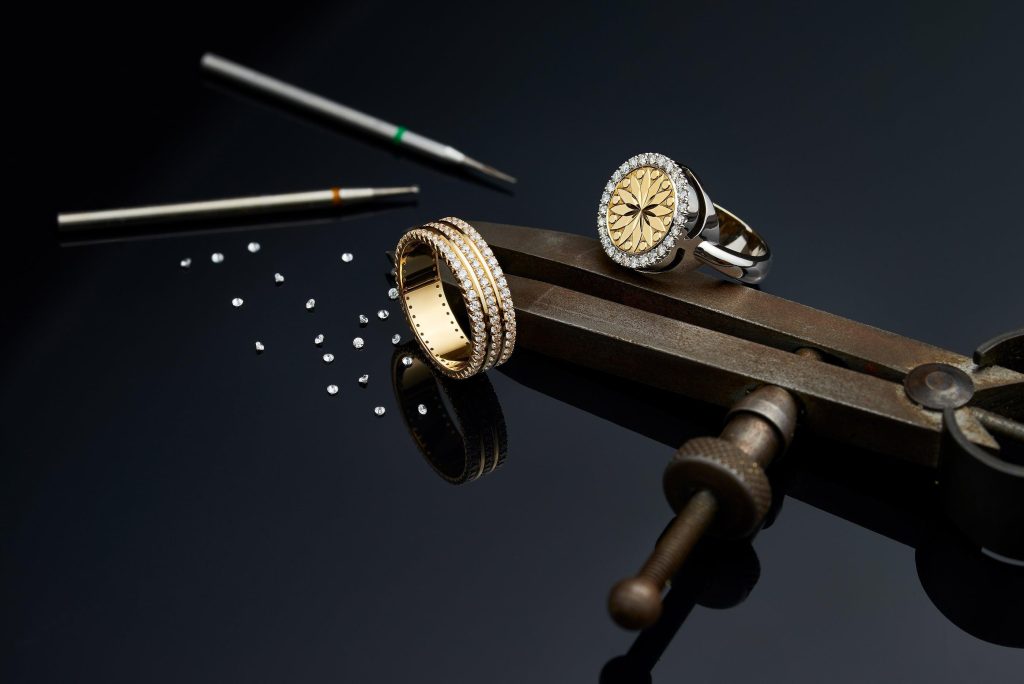
The laser pulse duration in jewelry marking is typically measured in nanoseconds to microseconds. The energy is deposited and dissipated so quickly that surrounding metal reaches no meaningful temperature rise. Mounted gemstones, adjacent surface treatments, and plated finishes remain unaffected.
This is the specific advantage of pieces with temperature-sensitive stones — emeralds, opals, treated diamonds — where any process that generates sustained heat carries risk.
Material Compatibility
Laser marking works across every precious metal used in jewelry production:
- Yellow gold, white gold, rose gold — annealing marks and logo engraving
- Silver — high-contrast black marks for hallmarking and branding
- Platinum — fine line engraving and serial number marking
- Stainless steel — annealing marks and full-color oxidation marking
- Titanium — full-spectrum color marking through controlled oxidation
Parameter settings — power, pulse duration, frequency, scan speed — are adjusted per material. Once established for a given metal and mark type, they are saved digitally and recalled for every production run.
What Laser Marking Produces on Jewelry
Serial number engraving — unique per-piece numbers applied inside ring shanks, pendant backs, and earring posts, readable under magnification and linkable to production databases.
QR code and Data Matrix marking — machine-readable codes carrying full provenance data: metal purity, manufacturer, production date, assay record. Applied at scales as small as 3 mm × 3 mm while remaining scannable.
Hallmarking — legally compliant purity marks, maker marks, and assay stamps applied without mechanical force.
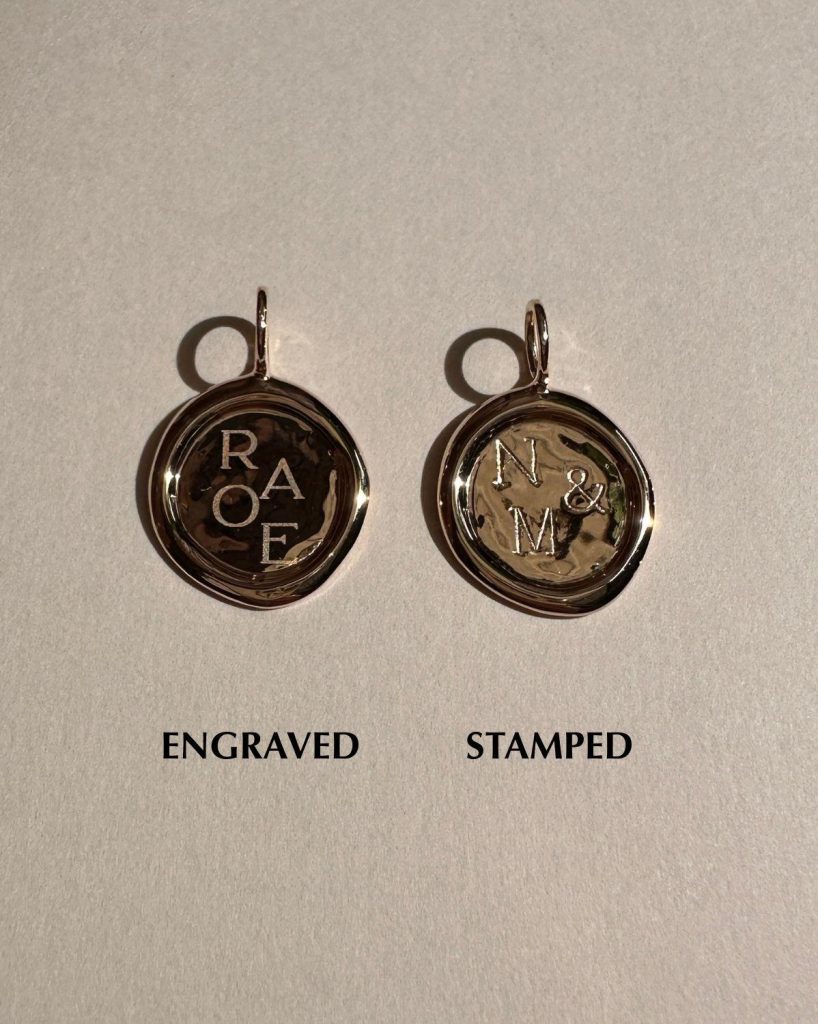
Micro-text engraving — brand names, certifications, and authentication text at scales below 0.5 mm character height.
Logo marking — brand marks, designer signatures, and collection identifiers reproduced with consistent geometry at production volume.
Applications of Laser Marking in Jewelry: Where It Delivers
Ring Marking
Ring interiors are the primary marking location for most jewelry pieces — and the most geometrically challenging. The curved inner surface of a shank requires a marking system that can maintain focus and consistent beam delivery on a cylindrical surface.
SLTL’s jewelry laser marking systems handle ring interiors through rotary fixtures that index the ring under the beam, maintaining consistent focal distance and mark quality around the full circumference. Logo, hallmark, and serial number are applied in a single fixturing operation.
Logo and Brand Marking
Brand logos are the highest-visibility marking application. Every piece in a collection carries the same logo mark — same size, same position, same depth. Laser marking delivers this consistency at production volume that hand engraving simply cannot match.
For collections with fine-line logo artwork — luxury brands with complex monograms or detailed design marks — laser marking reproduces the geometry accurately at scales where rotary engraving tools lose definition.
Name Plate Marking
Custom name plates, dedication plates, and personalisation engraving are growing applications as jewelry brands expand into personalised product lines. Laser marking handles variable text — different names, dates, or messages on each piece — from a digital file without any tooling change. Each piece in a personalised batch is marked uniquely without any interruption to production flow.
Hallmark Engraving
Hallmarking compliance is non-negotiable in regulated jewelry markets. Laser hallmarking produces legally compliant marks — purity indicators, maker’s marks, assay office stamps — at consistent depth and geometry without the mechanical distortion risk of hand stamping. Marks are produced from a digital template and reproduced identically on every piece across the production run.
Barcode, QR Code, and Traceability Marking
DataMatrix and QR codes applied to jewelry pieces link each item to a digital record — material certificate, production data, assay result, ownership history. These machine-readable codes can be applied at 3–5 mm scale on ring interiors or pendant backs and remain scannable throughout the product’s life.
For brands building connected product ecosystems — authentication apps, warranty registration, resale verification — laser-marked traceability codes are the enabling technology at the product level.
Color Marking Samples
On stainless steel and titanium jewelry, laser marking through controlled oxidation produces permanent full-color marks — blues, gold, purples, and reds — without ink or coating. These color marks open design possibilities for decorative branding elements, logo backgrounds, and visual differentiation between collection lines that conventional surface treatments cannot replicate at this scale or precision.
It is worth noting that laser marking in jewelry does not operate in isolation. Integrated with laser welding for jewelry repair and component assembly and laser cutting for fine component manufacture, marking becomes part of a complete laser processing workflow — cut, weld, and mark — that covers the full production cycle from raw sheet to finished, traceable, branded piece. The broader context for this integrated approach is covered in How Laser Welding Improves Jewelry Repair and Production Quality.
SLTL Laser Solutions for Jewelry Marking, Cutting, and Welding
SLTL Group provides a full range of laser systems for jewelry manufacturers — covering marking, cutting, and welding from a single solution provider with direct application engineering support.
Laser Marking Solutions
REX — Diode Laser Marking System
The REX is a diode laser marking system designed for traceability marking applications in jewelry production. Its compact form and reliable diode source make it an accessible entry point for workshops, adding laser traceability marking to an existing production line.
ELITE — Fiber Laser System for Hallmarking
The ELITE is SLTL’s fiber laser marking system optimized for hallmarking applications. It produces the precise, consistent mark geometry that legally compliant hallmarking requires, across all precious metal substrates. For hallmarking centers processing high volumes of pieces per day, the ELITE delivers the throughput and mark consistency that manual stamping cannot approach.
Explore SLTL’s range of jewelry laser marking machines for hallmarking and branding applications.
Flexy — Movable Diode Laser Marking Machine
The Flexy is a portable diode laser marking machine designed for marking difficult jewelry parts — large assembled pieces, items that cannot be easily fixtured on a standard marking table, and workshop environments where the marking station needs to move to the workpiece rather than the other way around. Its movable configuration makes it uniquely practical for repair workshops and custom jewelry studios.
NEO — Fiber Laser Marking Machine (20–60W)
The NEO is a multipurpose high-power fiber laser marking system covering the 20–60W range. It handles a broad range of jewelry marking applications — logo marking, serial number engraving, Data Matrix codes, and hallmarking — on all precious metal substrates. Its higher power range delivers faster marking speeds on applications where throughput matters.
Ultra — Fiber Laser Marking Machine (20–120W)
The Ultra covers the 20–120W range, making it SLTL’s most versatile fiber laser marking platform for jewelry production. It handles both the fine precision work of micro-text and logo marking and higher-power applications where deep engraving or fast production marking is required. A single platform covers the full range of marking requirements across a jewelry production facility.
Discover how SLTL’s industrial laser engraving systems support luxury jewelry branding and traceability programmed.
OptiFly — CO2 Laser Marking Machine
The OptiFly is a CO2 laser marking system suited to plastic marking in jewelry packaging, display, and accessory applications — branded boxes, inserts, display cards, and mass-production plastic components. It completes the marking capability across all materials in the jewelry product and packaging ecosystem.
Carbon — CO2 Laser Marking Machine
The Carbon handles CO2-based marking applications where the OptiFly’s configuration is not suited — alternative material types, different power requirements, or specific production line integration needs. Like the OptiFly, it extends SLTL’s marking capability beyond precious metals to the full range of materials in a jewelry production environment.
Laser Cutting Solutions for Jewelry
Future X — Advanced Laser Cutting Machine
SLTL’s most advanced laser cutting platform, the Future X brings smart automation and precision cutting to premium jewelry production. For manufacturers producing complex component geometries — intricate pendant shapes, precision-cut settings, filigree panels — the Future X delivers the accuracy and repeatability that luxury production standards demand.
Infinity F1 — High Power Laser Cutting Machine
The Infinity F1 is built for heavy-duty metal processing and high-speed production. For jewelry manufacturers processing larger volumes of sheet metal stock or working with thicker base materials, the Infinity F1 provides the sustained cutting power that high-throughput production requires.
IntegreX — Affordable Laser Cutting Machine
The IntegreX makes laser cutting accessible for small and medium jewelry manufacturers who need to improve production efficiency without significant capital outlay. It processes jewelry-grade sheet thicknesses — gold, silver, stainless, and platinum — with genuine production capability at an accessible price point.
X5 — 3D Laser Cutting Machine
The X5 specializes in three-dimensional cutting for complex jewelry patterns and designs — curved components, formed settings, and any application where cutting happens on a non-flat surface that a standard flat-bed machine cannot handle. It is the specialist platform for jewelry manufacturers pushing into more complex three-dimensional component geometries.
Upgrade Your Jewelry Production with SLTL Laser Technology
The jewelry industry is moving toward laser-based production — not as a future aspiration, but as a current competitive requirement. Brands that mark with precision, trace with reliability, and finish with consistency are the brands that retain customer trust, meet regulatory requirements, and protect their identity in a market where counterfeiting is a real commercial threat.
SLTL’s laser marking, cutting, and welding solutions give jewelry manufacturers the tools to achieve all of this — at production volume, with the mark quality that luxury products demand.
What SLTL laser marking delivers for your brand:
- Premium-quality marking — sharp logos, fine hallmarks, and micro-text at consistent quality across every piece
- Permanent engraving — marks that survive cleaning, polishing, chemical exposure, and daily wear
- Better traceability — machine-readable codes linking every piece to its complete production record
- Luxury finish preservation — non-contact marking with zero impact on surrounding surface quality
- Faster production — digital programmed recalled instantly, no tooling change between mark types
- Smart manufacturing — marking systems that integrate with production databases and ERP systems
- High precision branding — consistent logo geometry at scales down to 0.02 mm line width
Contact SLTL today to discuss your jewelry marking application, request a sample marking trial on your metal, or specify the right system for your production volume and marking requirements.
Conclusion
For modern jewelry brands, permanent and precise marking is not an operational detail — it is a core part of the product. Hallmarks establish compliance. Serial numbers enable traceability. Logos protect brand identity. Traceability codes authenticate value. And every one of these marks reflects the quality and credibility of the brand behind the piece.
The laser marking machine for jewelry delivers all of this — without mechanical force, without surface damage, without the inconsistency of hand tools — at the production speed and mark quality that luxury jewelry manufacturing demands.
Combined with laser cutting for component production and laser welding for precision assembly and repair, laser marking completes an integrated production toolkit that covers every phase of the jewelry manufacturing cycle. That integrated approach — cut, weld, mark — is the direction that progressive jewelry manufacturers are moving, and SLTL’s range of cutting, welding, and marking systems are built to support it.
The future of jewelry manufacturing is laser-enabled, traceable, and brand-consistent at every scale of production. SLTL helps you get there.
Frequently Asked Questions
Q1: Will laser marking damage the surface finish of gold or platinum jewelry?
No. Laser marking is a non-contact process — the beam never physically touches the metal surface. The mark is formed by a controlled change in the surface microstructure at the focal point only. The surrounding finish is unaffected. On polished gold and platinum, the unaffected area immediately adjacent to the mark retains its original polish.
Q2: Is laser hallmarking legally compliant in regulated jewelry markets?
Yes, in most regulated markets. Laser-applied hallmarks meet the mark of permanence, depth, and readability requirements of standard hallmarking regulations when applied with calibrated, certified equipment. Specific compliance requirements vary by jurisdiction and assay authority — SLTL recommends confirming local regulatory requirements before deploying laser hallmarking for compliance purposes.
Q3: How durable is a laser mark on jewelry worn daily?
Laser marks on precious metals are permanent in the functional sense — they are formed by a change in the metal surface microstructure, not a coating or ink. They survive daily wear, cleaning agents, ultrasonic baths, polishing, and chemical exposure without fading or wearing off. Ring interior marks applied 10–15 years ago remain clearly legible under normal conditions.
Q4: Can laser marking handle variable data — different names or serial numbers on each piece?
Yes. Laser marking systems accept variable data directly from digital files or database connections. Each piece in a batch receives its unique serial number, name, or code from a data file without any manual setup or tooling to change between pieces. This makes personalization and serialization practical at production volume.
Q5: What is the production speed of a laser marking machine on jewelry pieces? Marking cycle time depends on mark complexity, size, and metal type. A standard hallmark and serial number on a ring interior typically marks in 3–8 seconds per piece. A complex logo mark at 5 mm size marks in 5–15 seconds. A full traceability DataMatrix code marks in under 10 seconds. These speeds are consistent and do not degrade over time — unlike hand stamping, which slows with operator fatigue.

