
Fine jewelry production has always demanded extreme precision. Every pendant outline, every filigree cutout, and every ring profile must be exact — not approximately right, but perfectly right. Luxury buyers notice imperfect edges. Gemstone settings demand dimensional accuracy that hand tools cannot consistently deliver. And as the market for customized and personalized jewelry grows, manufacturers need cutting technology that handles complex design variations without tooling changes or quality compromise.
A laser cutting machine for jewelry addresses all of these demands directly. It delivers precision cutting on gold, silver, platinum, titanium, and stainless-steel sheet with edge quality and geometric accuracy that conventional mechanical cutting cannot match. For luxury jewelry manufacturing, the laser is not a high-tech option — it is the practical standard for any production environment where quality and consistency are non-negotiable.
This blog explains how laser cutting technology works for fine jewelry components. It covers the key advantages, the most important applications, and the SLTL systems purpose-built for jewelry production environments.
Why a Laser Cutting Machine for Jewelry Is Important in Modern Manufacturing
Jewelry manufacturing is moving in two directions simultaneously. On one side, luxury buyers demand more intricate designs, finer detailing, and unique customised pieces. On the other hand, production managers need faster throughput, lower material waste, and consistent quality across every piece in a collection run.
Conventional cutting methods cannot satisfy both demands at once. They force a choice between precision and speed. Laser cutting removes that trade-off.
Traditional Cutting Falls Short on Fine Jewelry
Mechanical cutting tools — jeweler saws, die punches, and rotary burrs — rely on direct physical contact with the metal. On thin jewelry sheet, this contact introduces flex, vibration, and edge tearing. On intricate patterns with tight internal cutouts, saw blades cannot follow curves accurately at consistent speed.
Furthermore, tool wear affects cut quality progressively across a production run. The first piece of a batch and the hundredth piece are not dimensionally identical when mechanical tools are involved. For luxury collections where every pendant must match the product’s photography exactly, that inconsistency is a quality problem.
Precision Is Non-Negotiable in Luxury Jewelry
A pendant with a 0.3 mm positioning error on its stone seat is not a luxury product — it is a rework piece. A ring profile that varies by 0.5 mm across a collection run creates visible inconsistency when pieces are displayed together.
A laser cutting machine for jewelry operates from a digital CNC programme. Every cut follows the exact same path at the same speed and power. The ten-thousandth piece is dimensionally identical to the first. This is the consistency that luxury jewelry production requires — and that mechanical cutting cannot reliably deliver at volume.
Design Complexity Is Growing
Modern jewelry design embraces complexity. Geometric open-work pendants, interlocking ring structures, laser-cut lace patterns in fine metal, and multi-element layered pieces all depend on cutting technology that handles internal cutouts, tight corner radii, and fine bridges between design elements.
Laser cutting handles all of these. The beam follows the programmed path regardless of geometric complexity — there are no tool-size limitations on minimum internal radius, and no mechanical deflection on tight corners. Therefore, the design file is the only constraint on what can be produced.
Benefits of Using a Laser Cutting Machine for Jewelry Designs
Contactless Cutting — No Surface Damage
The laser beam never contacts the metal surface. It delivers focused energy to the cut line and removes material through a controlled melting and vaporisation process. Consequently, there is no mechanical stress, no surface scratching, and no tool marks on the jewelry metal surface adjacent to the cut.
On a polished or pre-finished sheet, this means the cut edge and the surrounding surface finish are both preserved — significantly reducing post-cut polishing requirements.
Clean Edge Finishing
Laser cutting on jewelry-grade metals produces smooth, clean edges with minimal burr formation on optimized parameters. On gold and silver sheet in typical jewelry thicknesses (0.3 mm–2.5 mm), edge roughness is typically low enough for direct use in polished jewelry without additional edge dressing.
Moreover, internal cutouts — the negative spaces that define filigree patterns and open-work designs — are produced with the same edge quality as outer profiles. The result is a finished cut component that requires minimal post-processing before setting or assembly.
Minimal Heat-Affected Zone
The focused laser beam and fast cutting speed limit the heat-affected zone (HAZ) to a very narrow band along the cut line. On gold and platinum, this means the surrounding metal retains its original hardness and color — critical on alloys where heat exposure can affect color or surface oxidation state.
Furthermore, the minimal HAZ reduces the risk of warping on thin, large-format sheet sections. Consequently, flat pendants and earring blanks maintain their geometry after cutting without requiring a flattening step.
Precision at Micro Scale
A laser cutting machine for jewelry achieves cutting widths (kerf) as narrow as 0.05–0.15 mm on fine jewelry sheet. This enables design details — bridges, internal lattice elements, fine text cutouts — that are simply not achievable with any mechanical cutting method.
For designers working with elaborate geometric or organic patterns, this micro-precision level is the enabling technology. It turns design concepts that were previously too fine for production into manufacturable products.
Better Material Utilisation
Laser cutting software optimises the cut layout across each sheet, positioning multiple components to minimise off-cut waste between parts. On precious metal sheet — particularly gold and platinum — this material efficiency translates directly into significant cost savings per production run.
Additionally, the narrow laser kerf means less material is removed per cut than with mechanical saws — a further material saving that accumulates meaningfully over high-volume production.
Fast Changeover for Custom and Collection Production
Switching between component designs requires only a programme change — no physical tooling change, no fixture reset. A collection of 20 different pendant designs can be run sequentially on a single sheet layout, with each design change taking under 60 seconds. Therefore, custom and short-run production becomes economically practical alongside volume collection work.
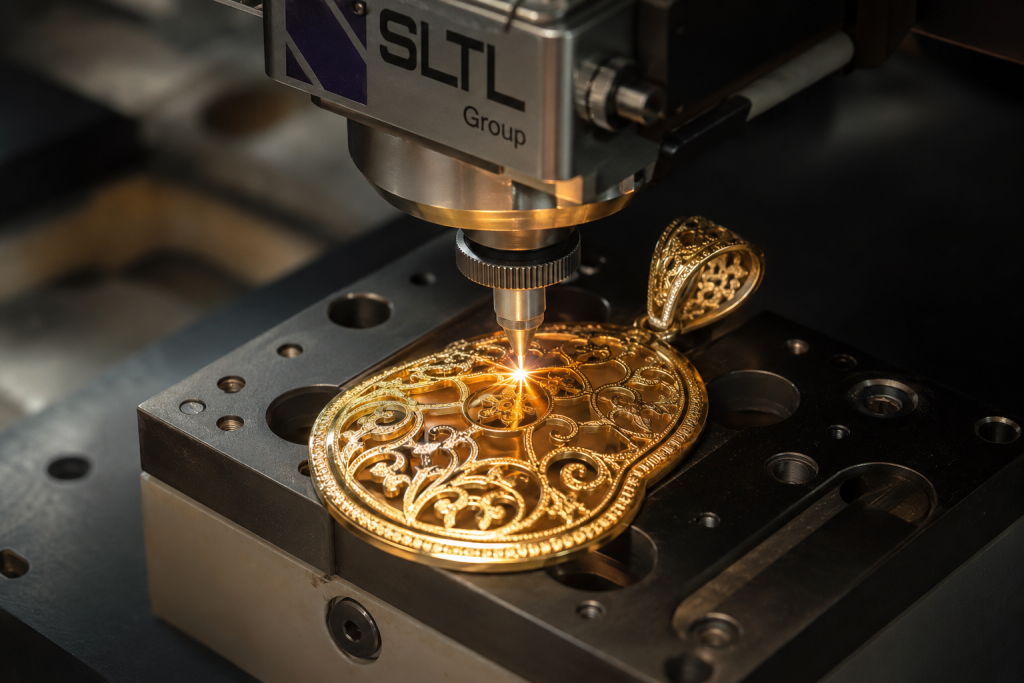
Suggested image here: Laser cutting machine for jewelry processing a precision gold pendant — showing clean cutout geometry, fine internal detail, and smooth edge quality. Image format: WEBP ALT text: Laser cutting machine for jewelry used for precision gold pendant manufacturing
How Precision Jewelry Cutting Improves Luxury Product Quality
The relationship between laser cutting quality and finished jewelry quality is direct. Every dimension the laser holds translates into a fit, a finish, or a visual consistency that the end customer perceives as premium quality.
Precision Cutting for Delicate Jewelry Patterns
Open-work jewelry — patterns where the design is defined by what is removed from the metal — depends entirely on the precision of the cutting process. A filigree pendant with 0.4 mm bridges between design elements can only be produced reliably with a cutting process that holds those dimensions accurately across a full collection run.
Laser cutting delivers this. The CNC programme defines every element of the design. The laser follows it without deviation. As a result, every piece in the collection matches the design file — and matches every other piece in the run.
Jewelry Cutting for Gold, Silver, and Platinum
Each precious metal has specific laser cutting parameters. Gold alloys — yellow, white, and rose — cut cleanly with optimised power and speed settings that vary by karat and alloy composition. Silver cuts at higher speeds due to its thermal properties. Platinum requires higher laser power due to its melting point, but produces exceptionally clean cut edges.
These parameter sets are established during initial process development and saved digitally. Therefore, switching between gold and silver production requires only a parameter file change — no physical setup modification.
Compatible materials for a laser cutting machine for jewelry include:
- Yellow, white, and rose gold (9ct, 14ct, 18ct, 22ct, 24ct)
- Sterling and fine silver
- Platinum and palladium alloys
- Titanium — for contemporary and men’s jewelry
- Stainless steel — for fashion and entry-level jewelry lines
High Repeatability for Collection Production
A luxury collection of 200 matching pendants must be dimensionally identical — otherwise, the collection photographs inconsistently, setting stones becomes harder on out-of-spec pieces, and quality inspection rejects create rework costs.
Laser cutting produces every component in a batch to the same dimensional standard. The CNC programme does not drift, the beam position does not wander, and the process does not fatigue. Consequently, collection production on laser becomes a reliable, predictable manufacturing step.
Faster Production for Custom Jewelry
Custom and personalised jewelry — pieces with unique names, dates, or design elements for individual customers — represents a growing market segment. A laser cutting machine for jewelry handles variable design data directly from digital files. Each unique piece is cut from the same digital workflow as a standard collection piece, without any additional setup time.
Therefore, a workshop handling both collection production and custom orders can manage both on the same laser platform, without compromising throughput on either.
Applications of a Laser Cutting Machine for Jewelry Components
Ring Profiles and Shanks
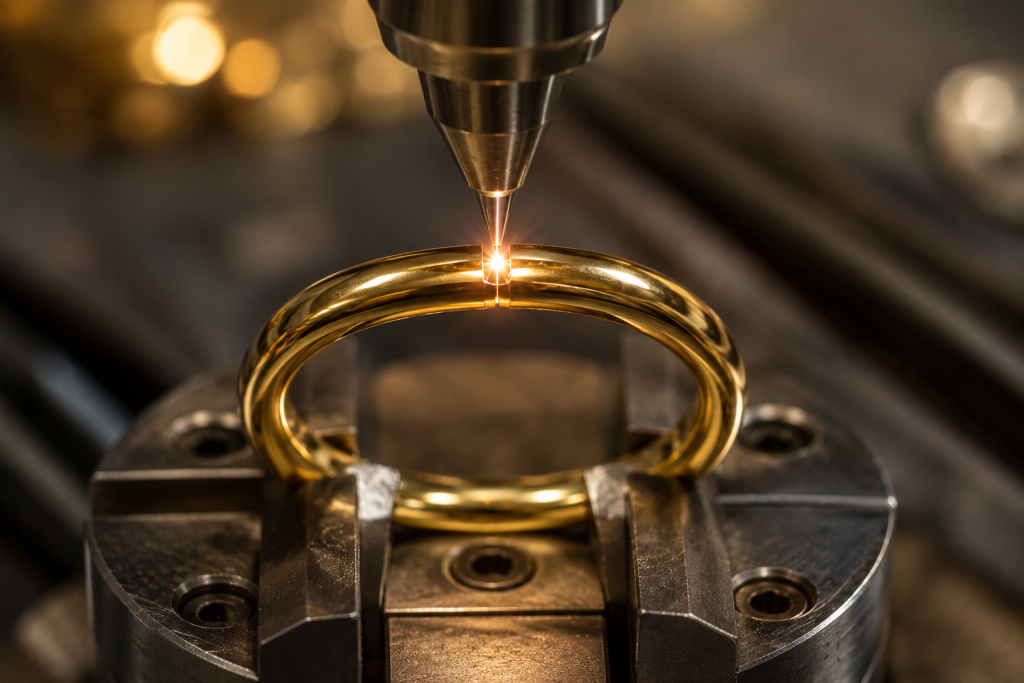
Laser cutting produces ring shank blanks and profile elements from sheet metal with consistent geometry and clean edges. Furthermore, decorative ring elements — engraved band sections cut from sheet and then formed — are a natural laser cutting application.
For ring manufacturing overall, laser cutting works alongside laser welding for shank assembly and laser marking for hallmark and serial number application. Together, these technologies cover the full ring production workflow. The welding side of this integrated production approach is explored in How Laser Welding Improves Jewelry Repair and Production Quality — a detailed look at how precision welding complements precision cutting in fine jewelry manufacturing.
Pendants and Charms
Pendant production is the highest-volume application for jewelry laser cutting. Complex geometric shapes, open-work patterns, layered designs, and organic forms are all produced from digital design files with no tooling investment. Moreover, multiple pendant designs nest on a single sheet for maximum material efficiency.
Earring Components
Fine earring production — particularly drop earrings with open-work or geometric elements — requires the same cutting precision as pendant work, often at smaller scales. Laser cutting handles earring components at production volume with consistent dimensional quality across left and right matching pairs.
Name Plates and Personalisation Pieces
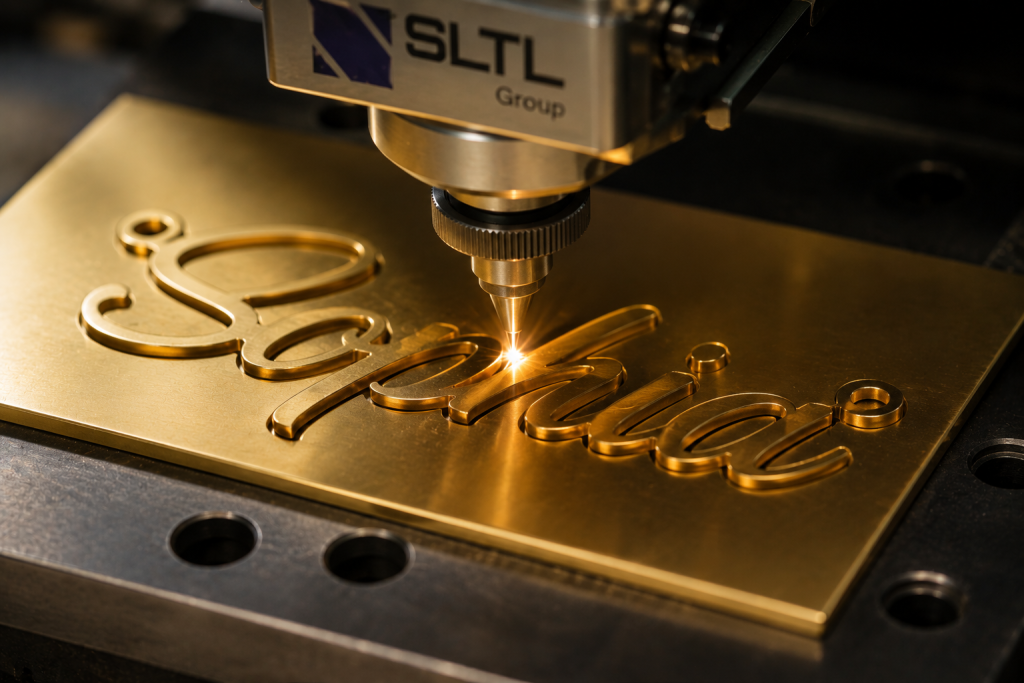
Name plate cutting — producing personalised name jewelry from sheet metal — is a direct-to-digital production workflow. The customer name is converted to a cutting programme, and the laser cuts it from precious metal sheet. There is no tooling, no setup delay, and no minimum batch size. As a result, personalised name jewelry becomes as efficient to produce as standard collection pieces.
Decorative Components and Branding Elements
Brand logo cutouts, decorative collection motifs, and structural jewelry elements — bails, gallery rails, frame pieces — are all laser cutting applications. Additionally, pre-cut blanks for setting preparation, where material is removed around a stone seat to precise dimensions, benefit from laser accuracy.
Integrated Cutting, Welding, and Marking in Jewelry Production
Laser cutting is most effective as part of an integrated production system. Cut components move to laser welding for assembly — joining pendant bails, ring shanks, and earring posts with the precision that laser hallmarking and traceability marking then records for every finished piece.
Marking applications — ring interior logo marking, name plate personalisation, colour marking samples on stainless and titanium — complete the production picture. These three technologies together cover the complete jewelry production cycle, from raw sheet to finished, branded, traceable luxury product.
Suggested video embed here: A reel showing laser cutting on a luxury gold pendant — open-work pattern cutting, internal cutout detail, and finished edge quality before polishing. “Checkout the reels made by interns for posting on your blogs.”
SLTL Solutions for Jewelry Laser Cutting and Manufacturing
SLTL Group provides a complete range of laser cutting platforms for jewelry manufacturers — from accessible workshop systems to advanced production platforms for high-volume luxury manufacturing.
Future X — Advanced Laser Cutting Machine
The Future X is SLTL’s most advanced laser cutting system. It brings smart automation, precision cutting capability, and the production flexibility required for complex luxury jewelry design. Furthermore, it handles the full range of precious metal sheet thicknesses — from ultra-thin decorative sheet to heavier structural elements — with parameter sets optimised per material.
For jewelry manufacturers producing complex collections with tight dimensional standards and high production volumes, the Future X delivers the competitive manufacturing edge that premium brands require. Explore SLTL’s laser cutting machine for jewelry range.
Infinity F1 — High Power Laser Cutting Machine
The Infinity F1 is built for heavy-duty manufacturing and high-volume production. For jewelry manufacturers processing thicker precious metal sections — heavy gold bracelets, substantial ring shanks, structural platinum components — the Infinity F1 delivers the sustained cutting power and throughput that volume production requires.
Additionally, it supports manufacturers running mixed production: jewelry components alongside other metal fabrication work, on a single high-power platform.
IntegreX — Affordable Laser Cutting Machine
The IntegreX makes precision jewelry laser cutting accessible for independent jewelry studios, custom workshops, and smaller production houses. It processes gold, silver, and platinum sheet in standard jewelry thicknesses efficiently. Furthermore, it delivers the clean edge quality and design precision of laser cutting at an acquisition cost that smaller businesses can justify.
For workshops currently using mechanical saws and hand tools for precision cutting, the IntegreX is the practical upgrade path into laser-based jewelry fabrication. Discover SLTL’s precision jewelry cutting solutions for your production scale.
X5 — 3D Laser Cutting Machine
The X5 specialises in three-dimensional cutting on complex jewelry components — formed ring shanks, curved pendant surfaces, and any jewelry element where the cut path follows a three-dimensional surface rather than a flat sheet plane.
Moreover, the X5 handles post-forming trimming on jewelry components that are cut after shaping — producing final profile geometry on formed pieces without the fixturing costs of hard tooling.
Upgrade Your Jewelry Production with SLTL Laser Technology
The jewelry manufacturing market rewards precision, consistency, and the ability to deliver complex designs at production speed. Conventional cutting methods create constraints on all three. Laser cutting removes them.
SLTL’s integrated laser cutting, welding, and marking solutions give jewelry manufacturers the complete production toolkit for modern luxury manufacturing.
What SLTL laser cutting delivers for your jewelry production:
- Precision jewelry cutting — sub-millimetre accuracy on gold, silver, and platinum sheet
- Faster production — high cutting speeds with rapid design changeover
- Luxury finishing — clean edges and minimal HAZ reduce post-processing requirements
- Reduced material wastage — optimised nesting on precious metal sheet saves significant material cost
- Better customisation — variable design data enables personalised production at no additional setup cost
- Smart manufacturing — digital workflow from design file to finished component
- High-quality production consistency — identical dimensional quality from first piece to last
Contact SLTL today to discuss your jewelry cutting application, request a sample cut on your specific precious metal, or specify the right system for your production volume and design requirements.
Conclusion
Precision, consistency, and design freedom are the three qualities that fine jewelry manufacturing demands — and that conventional cutting methods cannot deliver simultaneously at production volume. A laser cutting machine for jewelry satisfies all three. It cuts gold, silver, and platinum to exact digital specifications, batch after batch, with edge quality that reduces post-processing and design capability that removes the geometric constraints of mechanical tooling.
Furthermore, laser cutting is most powerful as part of a complete production system. Combined with laser welding for precise component assembly and laser marking for hallmarking and brand identity, it supports the integrated, quality-controlled workflow that modern luxury jewelry manufacturing requires.
The jewelry manufacturers who adopt laser cutting technology today are not just improving their current production — they are building the manufacturing capability that the growing demand for precision, customisation, and luxury quality will continue to require. SLTL’s laser solutions are built to support that ambition.
Frequently Asked Questions
Q1: What precious metals can a laser cutting machine for jewelry process?
A laser cutting machine for jewelry handles all standard precious metals used in jewelry production. These include yellow, white, and rose gold in all karat grades, sterling and fine silver, platinum, palladium, and titanium. Additionally, it processes stainless steel for fashion and contemporary jewelry lines. Parameter settings are adjusted per metal type and saved digitally for instant recall.
Q2: What is the minimum detail size that laser cutting can achieve on jewelry sheet?
On standard jewelry sheet thicknesses, laser cutting achieves kerf widths as narrow as 0.05–0.15 mm. This enables internal cutouts, bridges, and design elements as fine as 0.3–0.5 mm width — detail levels that mechanical saws and die tools cannot reproduce reliably. Furthermore, this precision is maintained consistently across the full production run.
Q3: Does laser cutting damage the surface finish of polished precious metal sheet?
No. Laser cutting is a non-contact process. The beam removes material at the cut line only. The surrounding surface finish is unaffected beyond a very narrow HAZ along the immediate cut edge. On polished sheet, this means the surrounding surface retains its mirror finish — significantly reducing post-cut polishing requirements compared to mechanical cutting.
Q4: How quickly can a laser cutting machine switch between different jewelry designs?
Design changeover on a laser cutting system requires only a programme file change — under 60 seconds. For custom jewelry production where each piece has a unique design element, variable data is loaded directly from a digital file. Consequently, custom and collection production run on the same platform with no meaningful changeover delay between design variants.
Q5: Is laser cutting cost-effective for small jewelry workshops and independent designers?
Yes. The IntegreX from SLTL provides an accessible entry point into laser cutting for smaller jewelry businesses. Furthermore, laser cutting eliminates tooling costs — there are no dies or blades to buy per design. This makes laser cutting cost-effective for short production runs and custom work where tooling investment would make conventional cutting uneconomical.

