
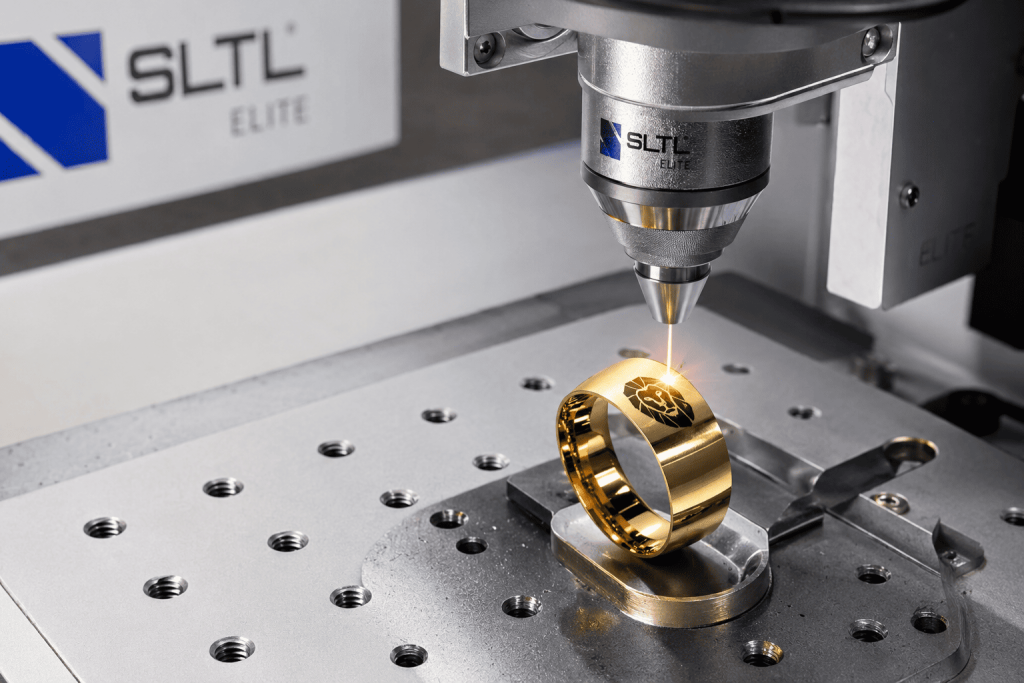
The jewelry industry is evolving fast. Luxury branding now demands more than just beautiful designs. It demands precision, permanence, and authentication. Black and white laser marking jewelry has become the industry standard for achieving all three — simultaneously. Whether it is logo engraving on gold rings or hallmarking on platinum pendants, jewelry laser marking delivers the high-contrast identification that modern luxury branding requires.
Traditional engraving methods are losing ground. They are slow, imprecise, and difficult to scale. Moreover, they often damage delicate surfaces. Laser marking, by contrast, is non-contact, highly controllable, and produces permanent results without compromising the integrity of the piece.
This guide is written for jewelry manufacturers, luxury brands, goldsmiths, and industrial buyers who want to understand contrast laser marking — how it works, why it matters, and which machines deliver the best results.
Why Black and White Laser Marking Jewelry Is Growing in Demand
The global luxury jewelry market is more competitive than ever. Therefore, brand differentiation is no longer optional. It is a commercial necessity.
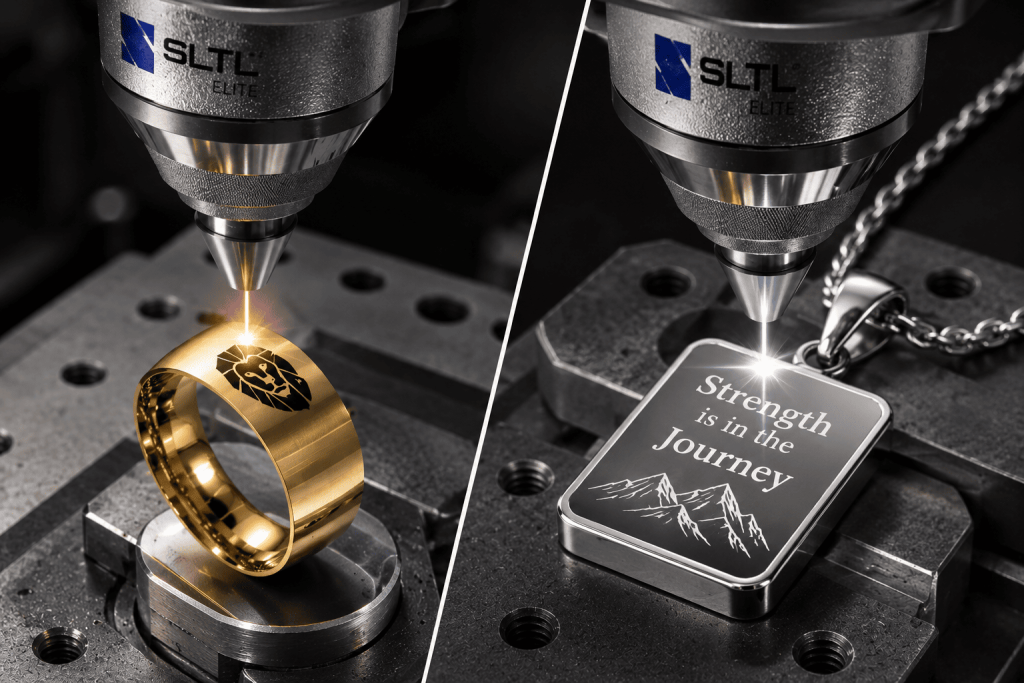
Black and white laser marking jewelry addresses this challenge directly. It allows manufacturers and brands to apply permanent, high-contrast logos, serial numbers, hallmarks, and custom text — at scale — without slowing production.
Brand Differentiation and Authentication
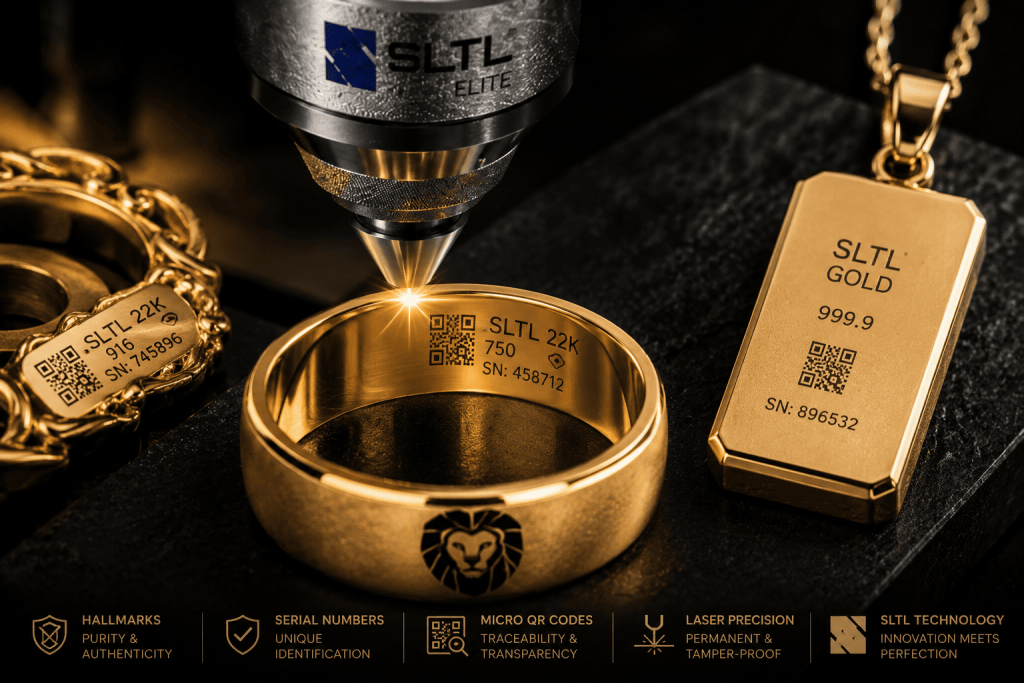
Counterfeit jewelry is a serious problem for luxury brands. Additionally, buyers increasingly demand proof of authenticity. Laser-marked QR codes and serial numbers allow instant verification. Furthermore, the marks cannot be removed or duplicated without damaging the piece.
Traditional acid etching and mechanical engraving lack this level of security. Consequently, most premium manufacturers have already switched to laser-based identification.
Hallmarking Requirements
Many countries require mandatory hallmarking for precious metals. For example, gold and silver sold in regulated markets must carry certified purity marks. Laser marking fulfills these requirements with far greater accuracy than stamping. Moreover, it supports automated hallmarking workflows — critical for high-volume production centers.
Customer Trust and Premium Presentation
A clean, precise mark elevates the perceived value of a piece. Buyers associate sharp, readable branding with quality craftsmanship. Therefore, investing in laser marking is also investing in customer trust.
Benefits of Black and White Laser Marking Jewelry Applications
There are many reasons why black and white laser marking jewelry applications are expanding across the industry. Here are the most important ones.
High-Contrast Visibility
Laser marking creates either a dark oxidized mark (black marking) or a bright annealed surface (white marking) against the base metal. Both produce excellent contrast. As a result, logos, serial codes, and hallmarks remain easily readable — even on reflective surfaces like polished gold.
Permanent and Durable Marking
Laser marks are chemically bonded to the metal surface. They do not fade, peel, or wear off with regular use. Therefore, marked jewelry retains its identification throughout its lifetime.
Precision and Fine Detail
Laser systems can engrave at resolutions below 25 microns. This means even the smallest text, finest logo details, and most complex QR codes are reproduced accurately. Additionally, consistent precision supports automated quality checks.
Minimal Surface Damage
Black marking does not remove material. White marking uses controlled annealing. Neither process cuts deeply into the metal. Consequently, the structural integrity of the piece is preserved — a critical factor for fine jewelry.
Faster Production and Automation Compatibility
Modern laser marking machines complete a full mark in seconds. Furthermore, they integrate easily with CNC systems and automated production lines. This dramatically reduces cycle time. Additionally, software control enables rapid design changes without retooling.
Reduced Material Wastage
Because laser marking is a non-contact process, there is no tool wear. There is no abrasive or chemical involved. As a result, waste is near zero — lowering operational costs for manufacturers.
Smart Manufacturing Support
Jewelry laser marking fits naturally into smart manufacturing workflows. Machines can receive job data from ERP or MES systems, execute marks automatically, and log results for traceability. This level of automation is simply not possible with traditional methods.
How Jewelry Laser Marking Creates High-Contrast Identification
Understanding the science behind black and white laser marking jewelry helps buyers make informed decisions about machine selection and application design.
The Laser-Metal Interaction
When a focused laser beam strikes a metal surface, it delivers precise energy. Depending on the laser parameters — power, speed, pulse duration, and frequency — the surface reacts differently. This controlled reaction produces either black or white marks.
Black Marking Technology
Black marking uses a high-energy, fast-pulse laser to oxidize the metal surface. The oxidized layer absorbs light and appears dark — almost black. This technique works particularly well on gold, stainless steel, and titanium. Moreover, the mark has excellent readability and contrast.
White Marking Technology
White marking uses a lower-energy pulse to anneal the metal surface. The annealed layer reflects light differently than the surrounding material. This creates a bright, white-appearing mark against a darker background. White marking is ideal for creating subtle, premium-looking identification on jewelry pieces.
Heat-Controlled and Non-Contact Process
Both processes are fully heat-controlled. The laser energy is calibrated precisely to achieve the desired effect without damaging the surrounding material. Furthermore, because the laser never physically touches the piece, there is no mechanical stress, no deformation, and no tool contamination.
Fine-Detail Engraving for All Jewelry Types
Laser marking systems are ideal for a wide range of jewelry items:
- Rings — Inner band marking, hallmarks, serial numbers
- Pendants — Logo engraving, brand names, decorative patterns
- Bracelets — Traceability codes, customization marks
- Earrings — Purity marks, brand logos on small surfaces
- Name plates — Personalized text, custom fonts, calligraphy-style engraving
- Hallmarking — Regulatory compliance marks for gold, silver, and platinum
Compatible Materials
Laser marking for jewelry is compatible with a broad range of precious and non-precious metals:
- Gold (yellow, white, rose)
- Silver (sterling and fine)
- Platinum
- Titanium
- Stainless Steel
Each material responds differently to laser energy. Therefore, machine settings must be calibrated per material and finish. Modern systems include pre-set profiles for common jewelry materials.
Applications of Black and White Laser Marking in Jewelry Manufacturing
Jewelry laser marking serves multiple functions across the manufacturing workflow. Each application adds value — from production floor to retail counter.
Logo Marking
Brand logos are the most visible identification element on luxury jewelry. Laser marking produces sharp, detailed logos at any size — from a 2mm hallmark badge to a 15mm brand stamp. Moreover, consistent reproduction across thousands of units ensures brand uniformity.
Hallmarking
Regulatory hallmarks indicate metal purity and origin. Laser hallmarking supports BIS, ASSAY, and international hallmarking standards. Additionally, digital integration allows batch data to be recorded automatically for compliance documentation.
Ring Marking
Inside-band marking is one of the most common applications. Manufacturers engrave ring sizes, purity marks, date codes, and custom messages inside rings. Because the laser beam is precisely focused, even 2mm-wide bands can be marked without error.
Name Plate Marking
Name plates require fine text, often in custom fonts or scripts. Laser marking reproduces calligraphy, serif fonts, and custom lettering with consistent quality. Furthermore, no physical tool change is needed between designs — software controls everything.
QR Code Engraving
QR codes enable buyers to instantly verify authenticity using a smartphone. Laser-engraved QR codes are permanent and machine-readable. As a result, they are becoming standard on luxury jewelry for anti-counterfeiting purposes.
Decorative Branding
Beyond identification, laser marking creates decorative surface textures, patterns, and effects. Black and white contrast marking can simulate engraved designs, geometric patterns, and artistic finishes. Consequently, manufacturers can offer greater customization without additional tooling investment.
Traceability Marking
Industrial buyers and hallmarking centers need full traceability across large production batches. Laser systems can engrave unique serial numbers, batch codes, and data matrix codes on every individual piece. This data links back to production records — supporting both quality control and regulatory compliance.
Integration with Cutting and Welding Technologies
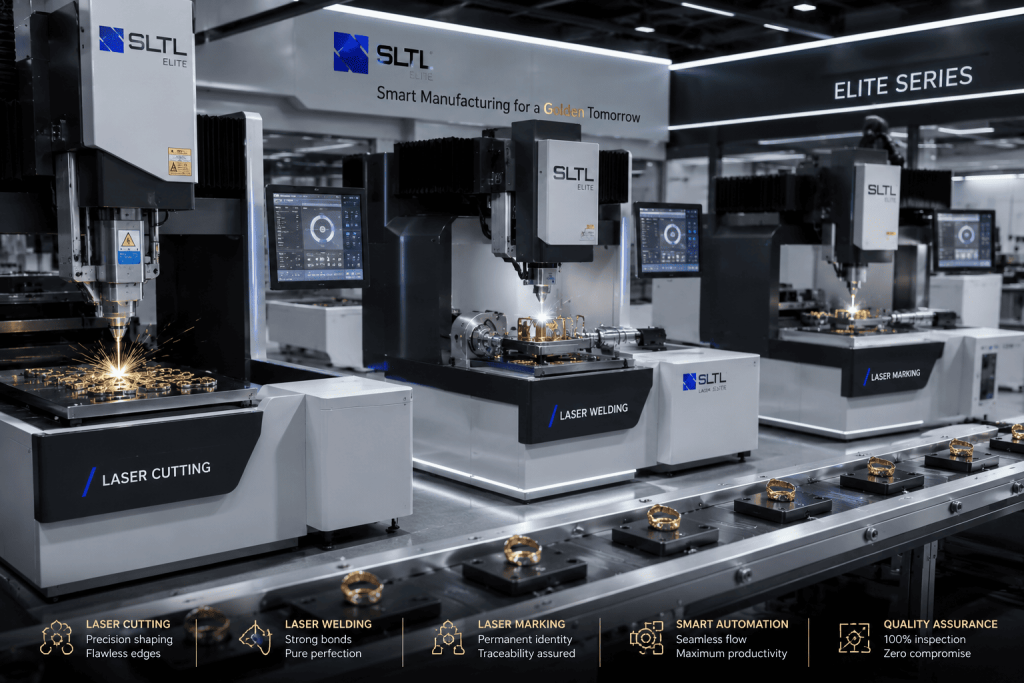
Modern jewelry manufacturing is increasingly integrated. Laser cutting, laser welding, and marking are used together to fabricate, assemble, and brand jewelry in a single streamlined workflow. For example, laser-cut gold components are assembled using fine laser welding before final identification marks are applied. This integrated approach reduces handling time, minimizes errors, and improves overall quality.
To learn more about precision engraving and jewelry laser engraving solutions, explore how laser systems support end-to-end jewelry production.
SLTL Laser Marking Solutions for Jewelry Manufacturing
SLTL Group offers a comprehensive range of black and white laser marking jewelry solutions designed specifically for jewelry manufacturers, hallmarking centers, and luxury brands. Each system is engineered for precision, reliability, and production efficiency.
REX — Diode Laser Marking System
The REX is a compact diode laser system. It is particularly suited for traceability marking applications in jewelry production. Its small footprint makes it ideal for bench-top deployment in goldsmith workshops and small-scale manufacturing units.
ELITE — Fiber Laser Marking System
The ELITE is a professional-grade fiber laser system optimized for hallmarking applications. It delivers consistent, high-contrast marks on gold, silver, and platinum. Furthermore, its fiber laser source ensures long operational life with minimal maintenance.
Flexy — Movable Diode Laser Marking Machine
The Flexy is a flexible, portable laser marking system. It is ideal for marking difficult jewelry parts — such as complex 3D shapes, curved surfaces, and assembled pieces that cannot be easily positioned on a fixed marking table. Additionally, its mobility makes it suitable for field marking applications at exhibitions or retail events.
NEO — Fiber Laser Marking Machine (20–60W)
The NEO is a high-power multipurpose fiber laser system. It supports a wide range of marking applications — from deep engraving to surface annealing. Its power range makes it effective for both black and white contrast marking. Moreover, it handles high-volume production with consistent throughput.
Ultra — Fiber Laser Marking Machine (20–120W)
The Ultra is a precision fiber laser system covering a broad power range. It is optimized for low-power precision marking applications where fine detail and surface integrity are critical. As a result, it is particularly well-suited for delicate luxury jewelry pieces where surface finish must be preserved.
OptiFly — CO2 Laser Marking Machine
The OptiFly is a CO2 laser marking system designed for plastic and non-metal marking in mass production environments. It is valuable for marking jewelry packaging, display materials, and branded accessories at high speed.
Carbon — CO2 Laser Marking System
The Carbon is a professional CO2 marking system for CO2-based marking applications. It complements the fiber laser systems in SLTL’s product range — supporting a complete solution for manufacturers who handle both metal jewelry and mixed-material products.
Upgrade Your Jewelry Production with SLTL Laser Technologies
Modern jewelry manufacturing demands precision, speed, and permanent quality. SLTL’s industrial jewelry laser marking systems deliver all of these — and more.
Why choose SLTL?
- Premium-quality black and white contrast marking
- High-resolution logo, hallmark, and QR code engraving
- Faster production with automated marking workflows
- Full traceability support for regulatory compliance
- Luxury finish preservation — no surface damage
- Smart manufacturing integration with ERP and MES systems
- Precision branding at any scale — from single pieces to mass production
SLTL also offers advanced laser cutting and laser welding solutions for jewelry manufacturers. Together, these technologies form a complete production ecosystem — from raw material cutting, through assembly welding, to final identification marking.
Ready to modernize your jewelry production? Contact the SLTL team today to discuss your marking requirements and request a live demonstration.
Conclusion
Black and white laser marking jewelry is no longer a niche technology. It is now a fundamental requirement for any brand that takes quality, authentication, and luxury presentation seriously. The ability to produce permanent, high-contrast marks — at scale, on any precious metal, with software-controlled precision — sets laser marking apart from every traditional alternative.
As traceability regulations tighten and consumer expectations rise, jewelry manufacturers that invest in contrast laser marking will have a clear competitive advantage. Moreover, integrated laser cutting, welding, and marking workflows will define the next generation of precision jewelry manufacturing.
The time to upgrade is now. SLTL’s range of precision laser engraving technology gives your business the tools to lead — not follow.
Frequently Asked Questions (FAQs)
Q1. What is the cost of a jewelry laser marking machine?
Jewelry laser marking machine prices vary by laser type, power, and features. Entry-level diode systems start at a lower price point, while advanced fiber laser systems for hallmarking and industrial production are priced higher. Contact SLTL for a customized quote based on your production volume and marking requirements.
Q2. Which metals are compatible with black and white laser marking?
Laser marking is compatible with gold, silver, platinum, titanium, and stainless steel. Each metal responds differently to laser energy. Therefore, machine parameters must be configured specifically for each material and surface finish to achieve optimal contrast.
Q3. How durable are laser marks on jewelry?
Laser marks are permanent. They are chemically bonded to the metal surface and will not fade, peel, or wear off with regular use or cleaning. This makes laser marking far more durable than printed labels, ink-based marking, or mechanical stamping.
Q4. Can laser marking be used for regulatory hallmarking?
Yes. Laser marking is fully compatible with international hallmarking standards, including BIS and ASSAY requirements. Fiber laser systems like the SLTL ELITE are specifically optimized for hallmarking applications and support automated batch documentation.
Q5. How fast is laser marking compared to traditional engraving?
Laser marking is significantly faster. A typical jewelry mark — including logos, text, or QR codes — is completed in seconds. Furthermore, no tool changeover is required between different designs. This makes laser systems ideal for high-volume production and rapid customization.

