
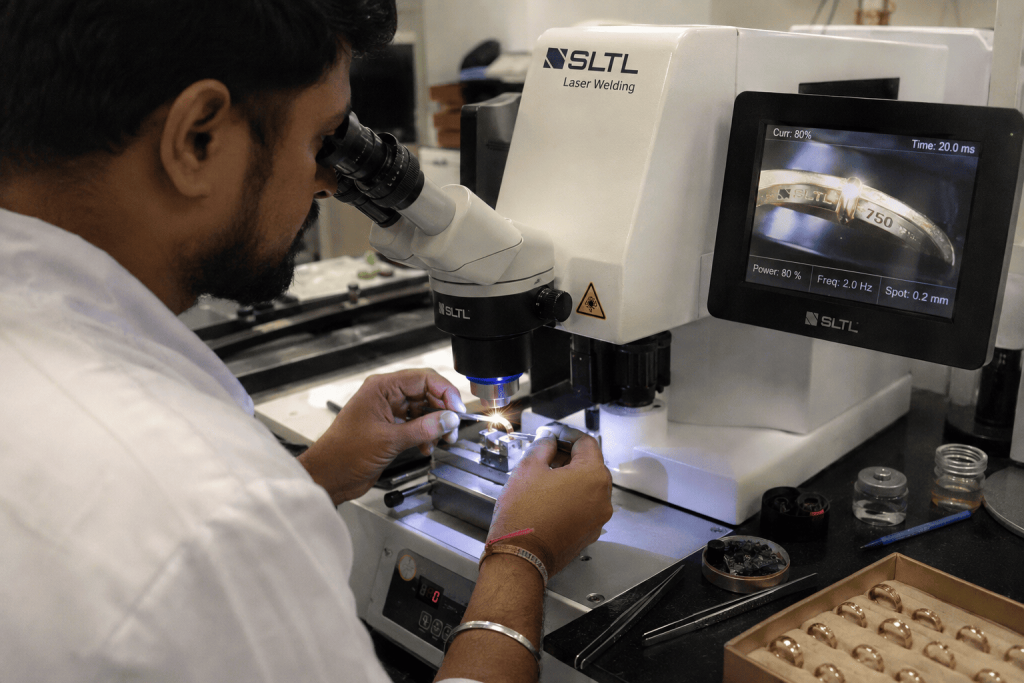
Precision is everything in jewelry manufacturing. Jewelry laser welding machine selection directly determines your workshop’s repair quality, production consistency, and finishing standards. Whether you handle fine welding on delicate chains, resize gold rings, or restore luxury jewelry pieces, the right laser welding machine makes a measurable difference. Modern jewelry laser welding technology has replaced traditional soldering across professional workshops worldwide. Additionally, advances in pulse control, microscope integration, and ergonomic workstation design have raised expectations for precision and operator comfort to an entirely new level.
Therefore, choosing the right machine is not simply a procurement decision. It is a long-term investment in your workshop’s quality, throughput, and reputation.
Why Jewelry Laser Welding Machine Selection Matters for Workshops
Precision Welding and Luxury Repair Requirements
Every jewelry piece that enters a repair workshop carries significant value. Moreover, the customer expects it to leave in better condition than it arrived. Fine welding applications demand extreme precision. A poorly chosen machine leads to burn marks, material distortion, and rework costs that erode margins quickly.
Furthermore, luxury brands impose strict quality standards on every repair and customization job. Therefore, workshop owners must select a jewelry laser welding machine that consistently meets those standards. A machine that delivers 0.1mm weld accuracy performs very differently from one limited to 0.5mm precision. Consequently, getting this selection right protects both your craftsmanship reputation and your customer relationships.
Workshop Productivity and Customer Satisfaction
Beyond precision, the right machine also supports faster turnarounds. Additionally, it reduces operator fatigue during long production hours. Workshops that invest in the correct jewelry laser welding machine selection see measurable improvements in output quality and daily job completion rates.
For example, a workshop handling ten ring repairs per day needs a different power configuration than one processing fifty pendant welds per shift. Similarly, a hallmarking center working on platinum requires different parameters than a goldsmith focusing on delicate chain repair. Understanding these differences is the foundation of smart jewelry laser welding machine selection.
Key Features to Consider in Jewelry Laser Welding Machine Selection
Not all laser welding machines deliver the same results. Therefore, understanding the key technical features helps buyers make informed decisions. Each feature directly affects welding quality, operator experience, and long-term production efficiency.
Laser Power and Pulse Control
Power range is the most fundamental selection criterion. Moreover, pulse duration and frequency control determine how energy interacts with the metal surface. Low-power systems suit delicate fine welding on thin gold and silver components. Higher-power systems handle deep penetration welding on platinum or thick stainless-steel pieces.
Additionally, fine pulse control allows operators to adjust heat input precisely. As a result, heat-sensitive stones and delicate settings remain protected during the welding process. Consequently, pulse control is a non-negotiable feature for any workshop handling luxury jewelry repair.
Spot Size Adjustment and Weld Accuracy
Spot size determines how focused the laser beam is on the target area. Therefore, machines with adjustable spot sizes offer greater flexibility across different jewelry types. For example, a small spot size suits micro-welding on filigree designs. A larger spot size supports faster filling on broader joint areas.
Furthermore, accurate spot placement prevents heat damage to surrounding gemstones and enamel work. This feature is particularly critical for high-value luxury repair applications where any surface damage is unacceptable.
Cooling Systems and Touchscreen Controls
Effective cooling prevents component overheating during extended production sessions. Moreover, modern laser welding systems use integrated water-cooling circuits to maintain consistent laser performance. As a result, output quality remains stable even during long working hours.
Touchscreen control panels simplify parameter adjustments. Additionally, digital interfaces allow operators to save preset programs for different metal types and joint configurations. Consequently, switching between gold welding and platinum repair jobs takes seconds rather than minutes.
Choosing the Right Power Range for Fine Jewelry Welding
Power selection is one of the most important steps in jewelry laser welding machine selection. Different metals and applications require very different energy levels. Therefore, understanding the material requirements before purchasing a machine prevents costly mismatches.
Low-Power Applications: Delicate Gold and Silver Welding
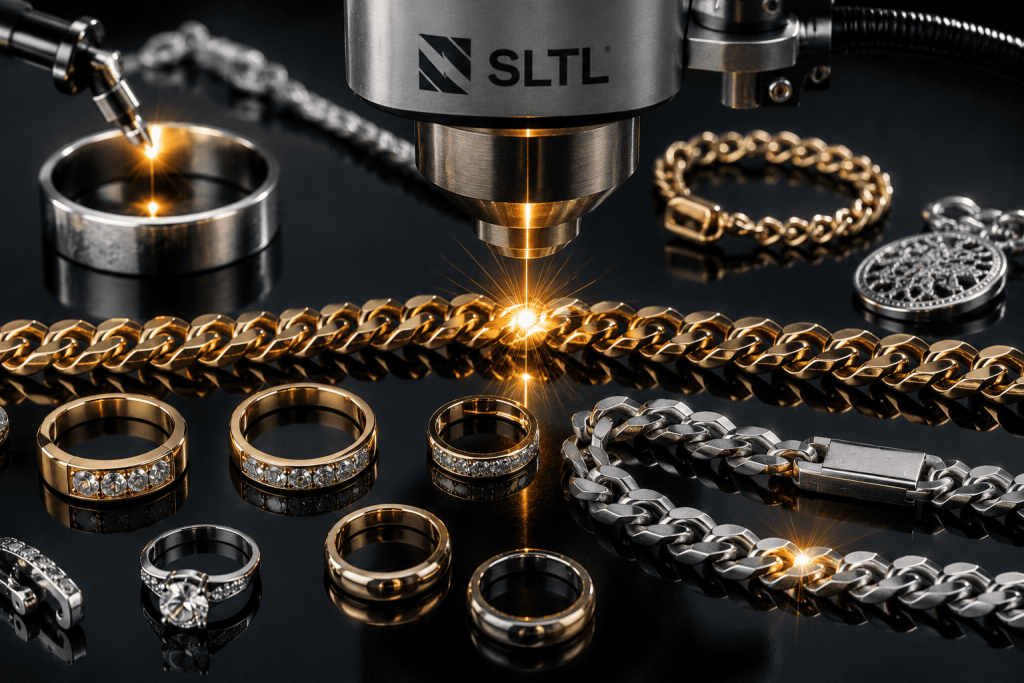
Low-power laser welding systems in the 80–200W range are ideal for delicate fine welding tasks. For example, they handle thin gold chain repair, silver pendant joining, and small ring resizing jobs. Furthermore, they protect heat-sensitive settings and minimize thermal distortion on fragile components.
Gold welding at low power produces clean, precise joins with minimal material loss. Similarly, silver welding benefits from controlled energy delivery that prevents discoloration and surface oxidation. Additionally, these systems are well-suited for jewelry customization work where cosmetic quality is paramount.
Medium to High-Power Applications: Platinum and Industrial Welding
Platinum requires higher energy input due to its higher melting point. Therefore, medium to high-power systems in the 200–500W range handle platinum repair applications effectively. Moreover, they support deep penetration welding on thicker gold bands and stainless-steel jewelry components.
Titanium welding similarly benefits from higher power settings. However, titanium also requires careful parameter control to prevent surface discoloration. Consequently, machines with fine pulse adjustment and precise power control deliver the best titanium welding results.
| Material | Power Range | Application | Key Requirement |
| Gold | 80–200W | Fine welding, ring repair | Low heat input |
| Silver | 80–200W | Chain repair, pendants | Oxidation control |
| Platinum | 200–500W | Luxury repair, deep joints | High energy input |
| Titanium | 150–400W | Modern jewelry welding | Pulse precision |
| Stainless Steel | 200–500W | Industrial jewelry parts | Deep penetration |
How Microscope and Operator Comfort Improve Jewelry Laser Welding
Technical specifications alone do not determine workshop performance. Furthermore, operator experience plays an equally important role in output quality. Microscope-integrated laser welding systems and ergonomic workstation designs are therefore essential considerations in any serious jewelry laser welding machine selection process.
Microscope Precision in Jewelry Laser Welding
Integrated microscopes allow operators to see the weld zone at 10x to 25x magnification. As a result, they can position the laser beam with sub-millimeter accuracy on very small jewelry components. Additionally, microscope optics reveal surface defects, misalignments, and joint gaps that are invisible to the naked eye.
For fine welding on rings with stone settings, this visibility is critical. Moreover, it prevents accidental damage to prongs, pavé settings, and channel-set gemstones. Consequently, microscope-equipped machines deliver significantly better repair quality and fewer post-weld corrections.
Operator Comfort and Long Production Hours
Jewelry welding is a precision task that demands sustained concentration. Therefore, operator fatigue directly impacts weld quality over long production shifts. Ergonomic workstations with adjustable arm rests, footrest pedals, and rotating worktables reduce physical strain significantly.
Furthermore, comfortable operators make fewer positioning errors. Additionally, intuitive touchscreen controls reduce the cognitive load on operators managing complex repair jobs. As a result, workshops with ergonomically designed laser welding stations see improved consistency and reduced rework rates across all shifts.
Besides ergonomics, argon gas shielding ports integrated into the workstation protect weld quality on oxidation-sensitive metals like titanium and platinum. Consequently, this feature adds both quality and operator safety to the production environment.
Applications of Jewelry Laser Welding in Luxury Manufacturing
Laser welding technology supports a wide range of jewelry production and repair applications. Moreover, it integrates seamlessly with other laser processes in a modern manufacturing workflow. Understanding these applications helps workshop owners justify the investment in advanced laser welding equipment.
Fine Welding for Rings and Small Jewelry Parts
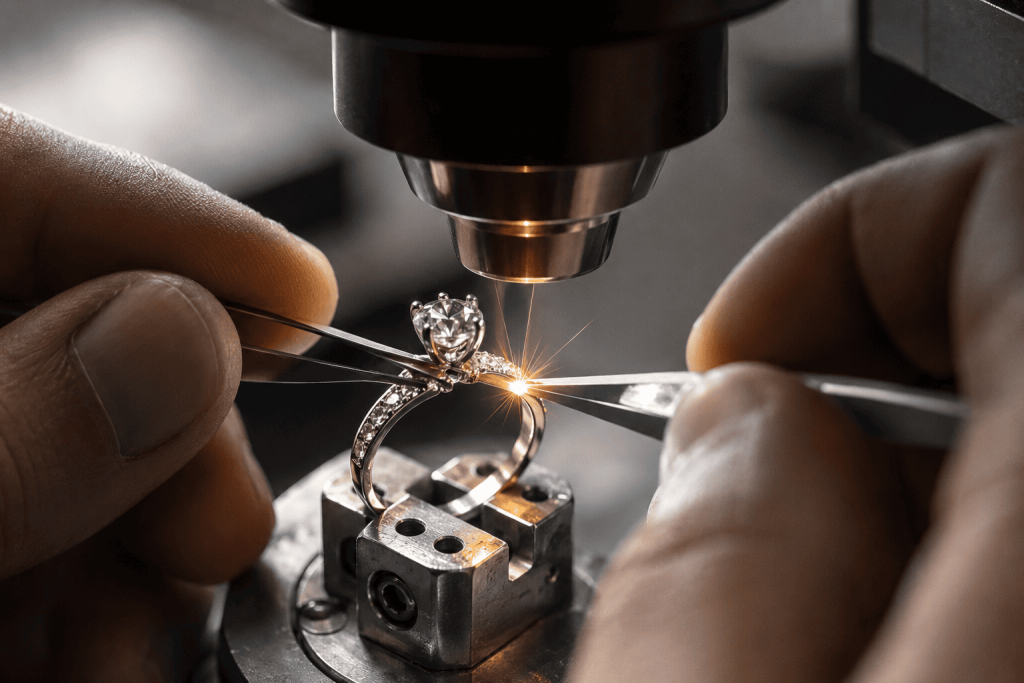
Ring repair is the most common laser welding application in jewelry workshops. Additionally, ring resizing requires precise metal joining without affecting the surrounding finish. Laser welding delivers invisible joins that require minimal post-weld polishing. Consequently, turnaround time on ring repairs reduces significantly compared to traditional soldering methods.
Fine welding samples demonstrate the exceptional joint quality achievable with modern laser systems. Furthermore, pendant welding, chain link repair, and clasp attachment all benefit from the non-contact precision that laser welding provides.
Smart Manufacturing and Integrated Laser Workflows
Modern jewelry manufacturing combines laser cutting, laser welding, and laser marking into a single integrated production line. For example, a ring blank is laser-cut to precise dimensions, laser-welded at the joint, and then laser-marked with hallmarks or branding in one seamless workflow. Understanding how laser welding improves jewelry repair and production quality is therefore essential for reading for any workshop owner planning to modernize their production process.
Additionally, color marking samples and name plate marking produced by laser marking systems complement laser-welded pieces in luxury jewelry packaging and presentation. Furthermore, logo marking and ring marking processes add brand value to every finished piece leaving the workshop.
For workshops that also handle precision jewelry laser engraving alongside welding, integrated systems eliminate material handling between stations. Consequently, this reduces production errors and improves overall quality control. Smart manufacturing setups using combined laser technologies also enable full traceability from raw material to finish product.
SLTL Jewelry Laser Welding Solutions for Luxury Manufacturing
SLTL Group engineers’ precision laser welding machines specifically designed for the jewelry manufacturing industry. Moreover, each system addresses distinct workshop requirements — from high-volume production to delicate fine welding repair. Therefore, every buyer can find a solution matched to their exact production needs.
Nova – 200–500W Fully Customized Laser Welding System
The Nova is SLTL’s flagship laser welding platform. It delivers 200 to 500 watts of power in a fully customized welding configuration. Furthermore, the Nova supports advanced jewelry manufacturing requirements including deep penetration platinum welding and high-throughput gold production. Additionally, its precision fine welding capability makes it ideal for luxury brands that demand exceptional finishing quality on every piece.
The Nova’s customizable parameter profiles allow workshops to save dedicated settings for different materials and joint configurations. As a result, operators switch between jobs faster while maintaining consistent output quality.
ENZO – Up to 200W Specialized Gold Welding Machine
The ENZO is purpose-built for gold welding and fine jewelry repair. It delivers up to 200 watts of power with exceptional pulse precision. Therefore, it suits workshops handling high volumes of gold ring repair, pendant joining, and luxury restoration work. Moreover, the ENZO’s compact footprint integrates easily into existing workshop layouts without requiring significant floor space.
Additionally, the ENZO’s high-precision optics and integrated microscope system make it an excellent choice for goldsmiths who prioritize weld accuracy above all else. Consequently, it is one of the most popular jewelry laser welding systems among fine jewelry workshops globally.
Hertz – Handheld Laser Welding Machine
The Hertz brings laser welding flexibility to applications where fixed workstations are impractical. It is a portable handheld laser welding machine designed for workshops requiring mobility across different work areas. Furthermore, the Hertz handles precision repair work on large jewelry pieces, display fixtures, and items that are difficult to position inside a standard welding chamber.
Moreover, its straightforward operation reduces training time for new operators. Additionally, the Hertz supports a range of jewelry metals including gold, silver, and stainless steel. As a result, it complements fixed laser welding stations by handling the jobs that standard systems cannot easily accommodate.
Upgrade Your Workshop with SLTL Laser Welding Technology
SLTL Group delivers complete laser solutions for modern jewelry workshops. Whether you need precision fine welding for delicate gold repairs or high-power platinum welding for luxury restoration, SLTL has a system engineered for your production goals.
SLTL jewelry laser welding machine selection benefits include:
- Precision jewelry repair with sub-millimeter weld accuracy
- Fine welding quality for delicate gold, silver, and platinum pieces
- Luxury finishing that meets premium brand quality standards
- Faster production throughput with consistent output quality
- Superior operator comfort through ergonomic workstation design
- Smart manufacturing integration with cutting and marking systems
- Reduced rework and lower scrap rates across all production shifts
Additionally, SLTL’s laser marking and laser cutting solutions integrate seamlessly with our welding systems. As a result, workshops can build a fully connected laser manufacturing workflow from a single supplier.
Contact SLTL Group today to explore fine welding solutions for jewelry and luxury jewelry laser welding systems designed for your workshop size, production volume, and material requirements. Request a live demonstration and experience the SLTL difference firsthand.
Frequently Asked Questions
1. What power range should I choose for gold jewelry laser welding?
For most gold welding applications, a laser welding machine in the 80–200W range delivers the best results. Furthermore, this power range provides precise pulse control that protects heat-sensitive settings and gemstones. The SLTL ENZO, for example, handles gold welding up to 200W with exceptional precision for fine jewelry repair work.
2. Is a microscope essential for jewelry laser welding?
Yes. An integrated microscope is a critical feature in jewelry laser welding machine selection. Moreover, it allows operators to position the laser with sub-millimeter accuracy on small components. Additionally, microscope magnification reveals surface defects and joint misalignments before welding, which significantly reduces post-weld corrections and material wastage.
3. Can laser welding machines handle platinum repair?
Yes. Platinum welding requires higher power input due to its elevated melting point. Therefore, machines in the 200–500W range, such as the SLTL Nova, handle platinum repair applications effectively. Furthermore, precise pulse control prevents heat damage to surrounding metal and settings during platinum welding.
4. How does operator comfort affect laser welding output quality?
Operator fatigue directly causes positioning errors and inconsistent weld quality. Therefore, ergonomic workstation design is a non-negotiable feature in any serious jewelry laser welding machine selection. Adjustable arm rests, foot pedal controls, and rotating worktables reduce physical strain. As a result, workshops with ergonomic systems maintain consistent weld quality across full production shifts.
5. Can a handheld laser welding machine match the precision of a fixed system?
Handheld laser welding machines like the SLTL Hertz deliver excellent precision for flexible repair applications. However, for micro-detail fine welding with microscope assistance, fixed systems offer superior accuracy. Therefore, many workshops use both types — fixed systems for detailed repair work and handheld units for larger items or mobile applications.
Conclusion
Getting jewelry laser welding machine selection right is one of the most impactful decisions a workshop owner can make. The correct machine improves fine welding precision, reduces rework, and elevates the quality of every repair and customization job leaving your workshop. Furthermore, microscope integration and ergonomic workstation design ensure that operators perform at their best across long production days.
Moreover, the future of jewelry manufacturing lies in integrated laser workflows. Laser cutting, welding, and marking systems working together create smarter, faster, and more consistent production lines. Additionally, workshops that invest in the right laser welding technology today build a competitive advantage that compounds over time.
SLTL Group offers a complete range of jewelry laser welding machine selection options designed for workshops of every size and production requirement. Therefore, whether you need the high-power Nova for advanced manufacturing, the precision-focused ENZO for gold welding, or the flexible Hertz for mobile repair applications, SLTL delivers the right solution for your goals.

