
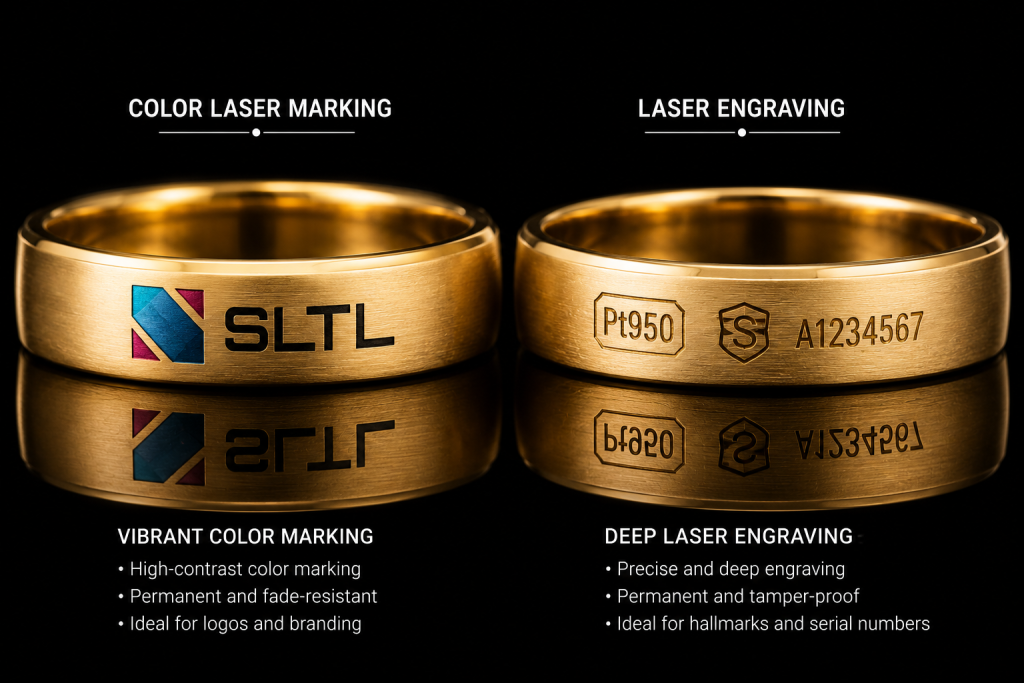
The global luxury jewelry market is growing faster than ever. Therefore, jewelry brands are investing heavily in premium presentation, product authentication, and advanced marking technologies. When it comes to color marking vs engraving jewelry, manufacturers face a critical choice. Both techniques use laser marking technology and serve very different branding goals. Choosing the right method directly impacts jewelry branding quality, production speed, and customer experience.
Today, laser-based marking solutions have replaced older chemical and mechanical methods. Additionally, they offer superior precision, faster cycle times, and better surface quality. Understanding the difference between color marking and engraving helps brands select the right process. Moreover, it ensures that the final product meets both visual and functional requirements.
Why Color Marking vs Engraving Jewelry Matters for Luxury Brands
Luxury jewelry brands invest significantly in their brand identity. Therefore, how a logo, hallmark, or design appears on a piece of jewelry matters enormously. Color marking vs engraving jewelry represents two distinct approaches to achieving that premium finish.
Brand Identity and Product Authentication
Every fine jewelry brand relies on consistent, high-quality marking. Moreover, hallmarking requirements across global markets make permanent identification mandatory. Laser engraving delivers deep, durable marks that authenticate a product permanently. Similarly, color marking adds a decorative contrast that elevates the product’s visual appeal.
Additionally, product traceability is becoming a core requirement for modern jewelry manufacturers. Serial numbers, batch codes, and QR codes can be applied using either technique. However, the choice depends on whether the mark needs to be visually decorative or strictly functional.
Premium Customer Experience and Customization
Customers purchasing luxury jewelry expect personalization. Furthermore, they expect the marking to look as refined as the piece itself. Color laser marking delivers vibrant, high-contrast branding that enhances perceived value. Meanwhile, laser engraving offers depth and permanence that speaks to craftsmanship.
Consequently, many premium brands now use both technologies together. They engrave permanent identification marks and use color marking for decorative logos and design elements. This integrated approach results in superior product presentation and stronger brand recognition.
Benefits of Color Laser Marking in Jewelry Branding
Color laser marking is a surface-level marking process. It uses controlled laser parameters to create high-contrast color changes on metal surfaces without removing material. As a result, the process is non-contact and causes minimal surface damage.
Color Laser Marking for Decorative Jewelry Branding
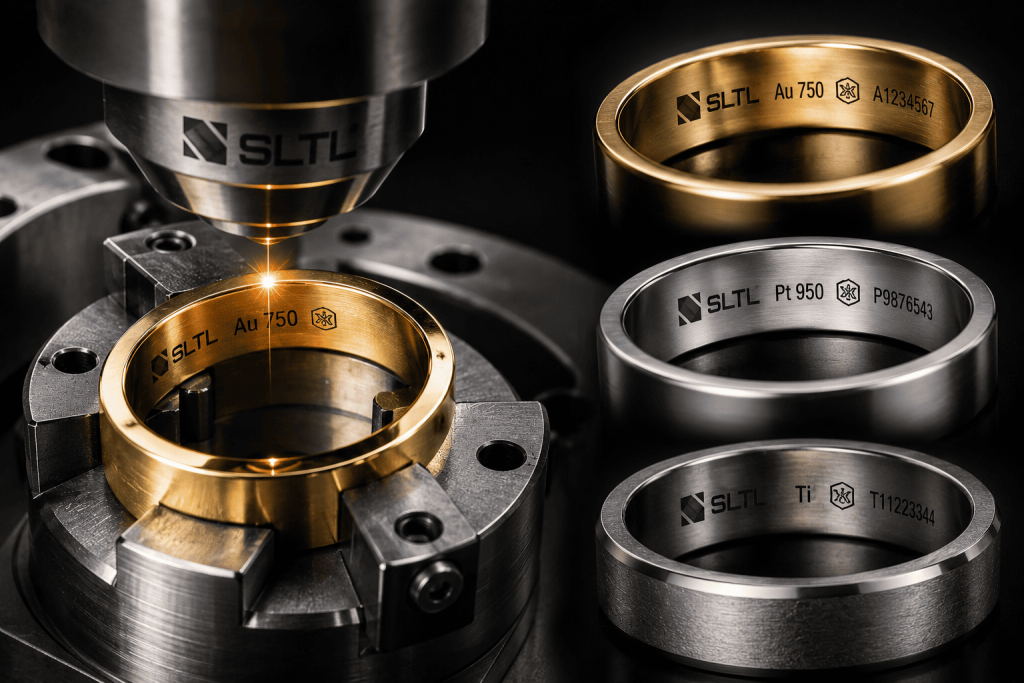
Color marking creates striking visual effects on gold, silver, platinum, stainless steel, and titanium. Furthermore, the process allows for gradient colors and intricate decorative patterns. This makes it ideal for luxury logo applications, decorative pendants, and branded ring surfaces.
Additionally, color laser marking is extremely fast. It does not require tooling changes or chemical processes. Therefore, production teams can mark high volumes without compromising quality. Moreover, since no material is removed, the structural integrity of the jewelry piece remains intact.
Key benefits of color laser marking include:
- High-contrast decorative branding on polished metal surfaces
- Non-contact processing that protects delicate jewelry finishes
- Fast production speed suitable for large-batch manufacturing
- Premium aesthetic quality ideal for luxury customization
- Compatibility with gold, silver, platinum, stainless steel, and titanium
- No consumables required, reducing ongoing production costs
Laser Engraving vs Color Marking for Permanent Identification
Understanding the technical difference between laser engraving and color marking is essential for choosing the right solution. Both techniques use laser energy, but their surface interaction and outcomes differ significantly.
How Laser Engraving Works
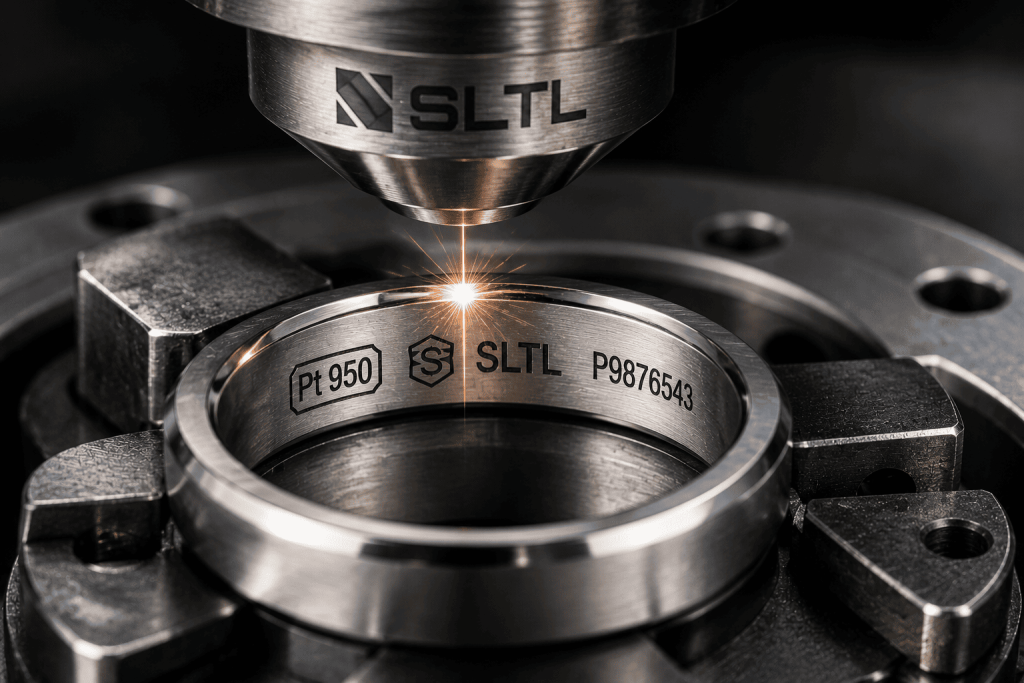
Laser engraving removes material from the surface using a focused laser beam. The beam ablates the top layer of metal, creating a recessed cavity. As a result, the mark is physically embedded into the material. This depth gives engraved marks exceptional durability and permanence.
Therefore, laser engraving is the preferred method for hallmarking, serial number application, and permanent product identification. Furthermore, engraved marks remain legible even after extended wear, polishing, and cleaning. This makes engraving essential for regulatory compliance in jewelry hallmarking centers.
How Color Marking Works
Color marking, in contrast, does not remove material from the surface. Instead, it uses controlled heat to create oxidation layers or surface color changes. Consequently, the mark remains flush with the jewelry surface. This results in a smooth, visually rich finish.
Additionally, color marking allows for multi-color designs on a single piece. It delivers superior decorative quality compared to standard engraving. However, it is generally not recommended for deep permanent marks that must survive heavy industrial processing.
Key Differences briefly
| Factor | Laser Engraving | Color Laser Marking |
| Process | Material removal (ablation) | Surface oxidation / color change |
| Mark Depth | Recessed (deep) | Flush with surface |
| Durability | Extremely high (permanent) | High (decorative use) |
| Best For | Hallmarking, serial numbers | Logos, decorative branding |
| Contrast | High (light mark on dark material) | Very high (vibrant color effects) |
| Material Compatibility | Gold, Silver, Platinum, Steel | Gold, Silver, Platinum, Steel, Titanium |
| Surface Damage | Minimal material removal | Non-contact, no material loss |
Applications of Color Marking vs Engraving Jewelry in Manufacturing
Both color marking and laser engraving serve distinct roles across different jewelry manufacturing applications. Understanding these roles helps production managers select the right machine for each task.
High-Contrast Jewelry Branding Applications
Color marking produces exceptional results for decorative ring surfaces, pendant logos, and name plate marking. Furthermore, it enables precise multi-tone branding on polished gold and silver pieces. Similarly, laser engraving delivers deep, precise marks for hallmarking centers that require regulatory compliance.
Ring marking is one of the most common applications in jewelry manufacturing. Additionally, logo marking on clasps, pendants, and bezels requires high precision and consistency. Color marking samples demonstrate vibrant finishes that are impossible to achieve with traditional engraving alone.
Name plate marking benefits significantly from color marking technology. Moreover, fine welding samples show how laser welding and marking technologies work together in a fully integrated jewelry production line.
Smart Manufacturing with Jewelry Laser Marking
Modern jewelry manufacturing combines cutting, welding, and marking in a seamless workflow. Laser welding, for example, plays a critical role in improving jewelry repair and production quality before the marking stage begins. Understanding how laser welding improves jewelry repair and production quality helps manufacturers appreciate the full value of integrated laser solutions.
Furthermore, laser traceability marking enables smart manufacturing by embedding QR codes, batch numbers, and serial codes. Consequently, manufacturers can track pieces throughout the entire production process. This reduces errors and improves quality control significantly.
For precision jewelry manufacturing, combining laser engraving with jewelry laser engraving systems that handle micro-detail work ensures consistent output across large production runs. Additionally, modern fiber laser systems offer real-time parameter adjustment, which further reduces scrap rates.
SLTL Laser Marking Solutions for Premium Jewelry Branding
SLTL Group offers a comprehensive range of industrial laser marking machines. Each system is engineered for specific jewelry manufacturing requirements. Moreover, every machine is designed to deliver consistent, high-quality results across decorative and permanent marking applications.
Choosing Between Color Marking and Engraving: SLTL Machine Range
REX – Diode Laser Marking System
The REX is a diode laser system designed specifically for traceability marking applications. Therefore, it is ideal for applying serial numbers, batch codes, and QR codes on jewelry pieces. Additionally, its compact footprint makes it suitable for integration into existing production lines.
ELITE – Fiber Laser Marking System
The ELITE fiber laser system is best suited for hallmarking applications. Furthermore, it delivers deep, precise engravings on gold, silver, and platinum. Consequently, hallmarking centers rely on ELITE for regulatory-compliant permanent identification marks.
Flexy – Movable Diode Laser Marking Machine
The Flexy is a portable diode laser marking machine. Therefore, it is ideal for marking difficult jewelry parts and complex geometries. Moreover, its mobility allows operators to bring the laser to the workpiece rather than moving delicate jewelry pieces.
NEO – Fiber Laser Marking Machine (20–60W)
The NEO fiber laser machine offers 20 to 60 watts of power. As a result, it handles multipurpose high-power marking applications efficiently. Additionally, the NEO supports both engraving and color marking workflows, making it a versatile choice for mid-scale jewelry manufacturers.
Ultra – Fiber Laser Marking Machine (20–120W)
The Ultra fiber laser system provides precision low-power marking at 20 to 120 watts of capacity. Therefore, it excels at fine detail work on small jewelry surfaces. Furthermore, it is compatible with a wide range of materials including gold, silver, platinum, and titanium.
OptiFly – CO2 Laser Marking Machine
The OptiFly is a CO2 laser marking machine designed for plastic marking in mass production environments. Consequently, it is ideal for packaging, branded inserts, and non-metallic components in luxury jewelry presentation boxes.
Carbon – CO2 Laser Marking System
The Carbon CO2 laser marking system handles CO2-based marking applications across a range of non-metallic materials. Therefore, it supports marking organic materials, leather jewelry cases, and branded packaging commonly used in the luxury segment.
Modernize Your Jewelry Production with SLTL Laser Technology
SLTL Group delivers end-to-end laser solutions for modern jewelry manufacturers. Whether you need color marking vs engraving jewelry solutions for decorative branding or permanent hallmarking, SLTL has a system engineered for your requirements.
Our industrial jewelry laser marking systems offer:
- Luxury branding with high-contrast color marking
- Deep, permanent engraving for hallmarking and serial number applications
- Decorative customization with premium visual finishing
- Faster production speeds with consistent output quality
- Smart manufacturing integration for full production traceability
- Precision jewelry finishing across gold, silver, platinum, and titanium
Additionally, SLTL laser cutting and laser welding solutions integrate seamlessly with our marking systems. As a result, manufacturers can streamline the entire production workflow from raw material to finished product.
Contact SLTL Group today to explore precision laser engraving technology and luxury jewelry branding solutions tailored to your production goals. Request a live demonstration and discover how SLTL laser systems can transform your manufacturing quality.
Frequently Asked Questions
1. What is the main difference between color marking and laser engraving for jewelry?
Color marking uses laser energy to create surface oxidation and color changes without removing material. Laser engraving, in contrast, ablates the metal surface to create a physically recessed mark. Therefore, engraving is more suitable for permanent identification, while color marking excels at decorative branding.
2. Which jewelry materials are compatible with color laser marking?
Color laser marking works effectively on gold, silver, platinum, stainless steel, and titanium. Furthermore, fiber laser systems from SLTL deliver consistent color marking results across all these materials without causing surface damage or structural weakening.
3. Is laser engraving durable enough for hallmarking applications?
Yes. Laser engraving creates deep, physically embedded marks that remain legible even after extended wear, repeated polishing, and cleaning. Consequently, it is the industry-standard method for hallmarking, regulatory identification, and serial number application in jewelry manufacturing.
4. How fast is color laser marking compared to traditional engraving methods?
Color laser marking is significantly faster than traditional mechanical engraving. Moreover, it requires no tooling changes or chemical processes. As a result, production teams can mark large volumes of jewelry pieces consistently and efficiently, reducing overall cycle time.
5. Can color marking and laser engraving be used together on a single jewelry piece?
Yes. Many luxury jewelry brands use both techniques on the same piece. For example, engraving applies permanent hallmarks and serial numbers while color marking creates decorative logos and branded design elements. This combination delivers both regulatory compliance and premium aesthetic quality.
Conclusion
The comparison of color marking vs engraving jewelry is not about choosing one over the other. Instead, it is about understanding which technology serves each specific application best. Laser engraving delivers permanent, deep identification marks essential for hallmarking and regulatory compliance. Color marking, furthermore, provides premium decorative branding that elevates luxury product presentation.
Moreover, the future of jewelry manufacturing lies in integrated laser solutions. Cutting, welding, and marking technologies working together create a smarter, faster, and more precise production process. Additionally, brands that invest in advanced jewelry laser marking systems today are better positioned for tomorrow’s competitive luxury market.
SLTL Group’s comprehensive range of laser systems supports every stage of this journey. Therefore, whether your priority is decorative for customization, permanent hallmarking, or smart production traceability, SLTL has the right solution for your needs.

