
Modern jewelry manufacturing demands a level of precision that traditional cutting methods simply cannot deliver. The laser cutting machine for jewelry materials has become the defining technology for workshops and production facilities that handle precious metal cutting, intricate decorative patterns, and luxury customization at scale. Whether the application involves jewelry material cutting thin gold sheets, complex pendant designs in platinum, or high-volume stainless steel component production, laser technology sets the quality benchmark. Furthermore, as luxury brands raise expectations for finishing precision and design complexity, the shift from mechanical cutting to laser processing is accelerating across the global jewelry industry.
Therefore, understanding what a laser cutting machine for jewelry materials can handle — in terms of thickness, material type, and design complexity — is essential before making a purchasing decision.
Why a Laser Cutting Machine for Jewelry Materials Matters in Manufacturing
Precision That Traditional Methods Cannot Match
Traditional cutting tools leave rough edges, require significant post-processing, and struggle with intricate designs. Moreover, they generate significant material wastage on expensive precious metals. A laser cutting machine for jewelry materials eliminates most of these problems in a single step.
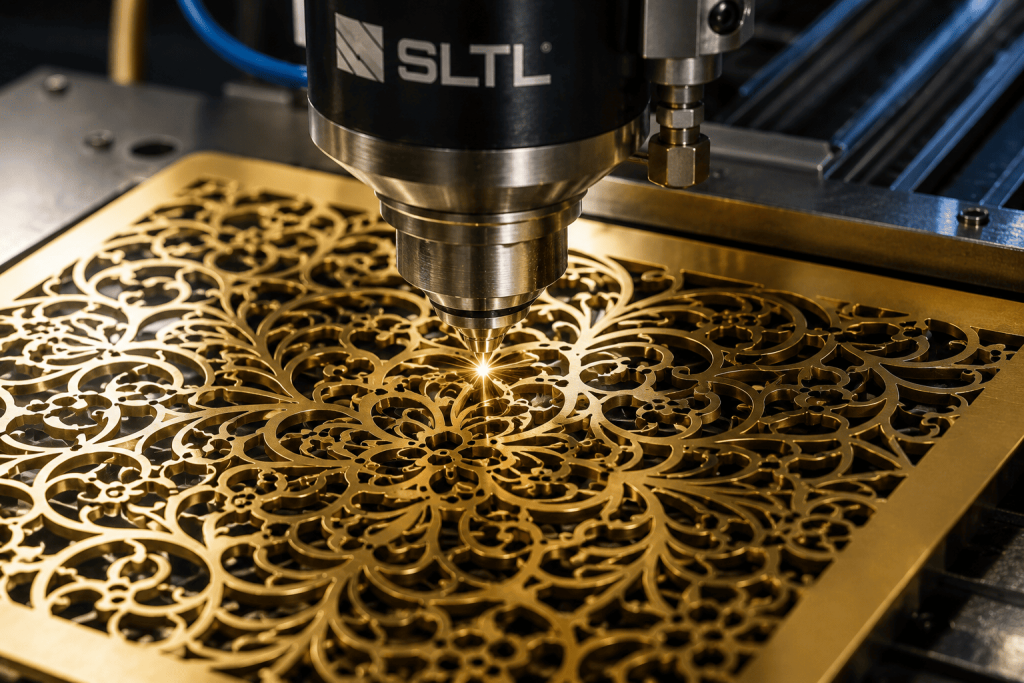
Laser cutting delivers cut edges with tolerances as tight as ±0.01mm. As a result, complex filigree patterns, geometric designs, and branded name plate shapes emerge from the cutting process with minimal finishing requirements. Furthermore, this level of repeatability is impossible to achieve consistently with manual or mechanical cutting tools.
Luxury Quality Expectations and Custom Manufacturing Trends
Luxury jewelry brands set strict standards for every production stage. Consequently, any cutting method that introduces surface scratches, material distortion, or uneven edges is simply unacceptable at this level. Laser cutting produces clean, burr-free edges that protect the visual integrity of high-value materials.
Additionally, the custom jewelry market is growing rapidly. Personalized designs, monograms, and unique decorative patterns require a cutting system that can handle digital files directly without tooling changes. Therefore, laser cutting systems integrate naturally into modern design-to-production workflows. As a result, custom orders reach the production floor faster with lower setup costs per job.
Reduced Material Wastage and Smart Production
Material efficiency is a critical factor when working with gold, platinum, and other precious metals. Furthermore, laser cutting allows for tighter nesting of design elements on metal sheets. Consequently, material wastage reduces significantly compared to traditional stamping or mechanical cutting methods. This directly lowers the cost per piece for high-volume production runs.
Common Materials Processed by a Laser Cutting Machine for Jewelry Materials
One of the most significant advantages of laser cutting technology is its broad material compatibility. Moreover, a single laser cutting machine for jewelry materials can handle multiple metal types across different applications. However, each material requires specific laser parameters to achieve optimal cut quality.
Precious Metal Cutting for Luxury Jewelry
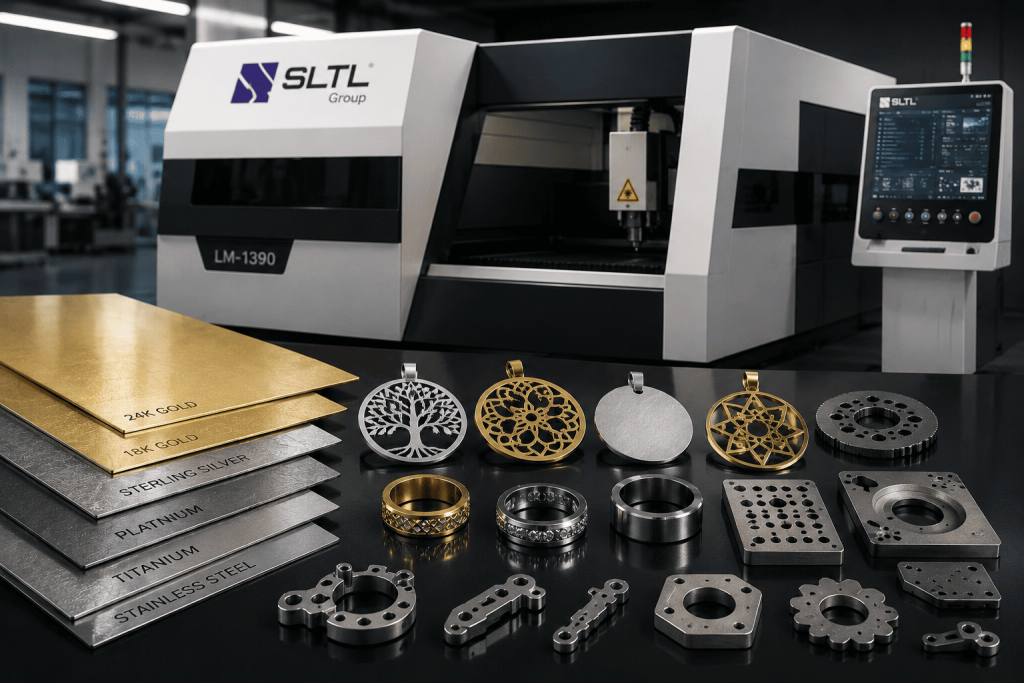
Gold is the most common precious metal processed in jewelry laser cutting applications. Furthermore, it responds exceptionally well to fiber laser cutting at low-to- medium power settings. The result is a clean, precise edge with minimal heat-affected zones. Additionally, yellow gold, white gold, and rose gold all respond similarly to laser processing, which simplifies parameter management across product lines.
Silver cutting requires slightly different parameters due to its higher reflectivity. However, modern fiber laser systems handle silver sheet cutting effectively with appropriate power and speed adjustments. Similarly, platinum cutting demands higher energy input due to its elevated melting point. Consequently, workshops on cutting platinum regularly should invest in higher-power laser systems to maintain production efficiency.
Titanium is increasingly popular in contemporary jewelry design. Moreover, it is significantly harder than gold or silver. Therefore, laser cutting is the most effective method for processing titanium jewelry components with the precision that modern designs require.
| Material | Laser Type | Typical Thickness | Key Consideration |
| Gold | Fiber | 0.3mm – 3.0mm | Low reflectivity, clean edges |
| Silver | Fiber | 0.3mm – 2.5mm | High reflectivity, speed control |
| Platinum | Fiber | 0.5mm – 2.0mm | High melting point, higher power |
| Titanium | Fiber | 0.5mm – 3.0mm | Hardness, oxidation prevention |
| Stainless Steel | Fiber | 0.5mm – 6.0mm | Industrial jewelry, deep cuts |
Thickness Capability and Precision in Jewelry Material Cutting
Understanding the thickness range that a laser cutting machine for jewelry materials can process is fundamental to selecting the right system. Furthermore, different jewelry product categories require very different cutting capabilities.
Laser Cutting for Thin Jewelry Sheets and Patterns
Most jewelry manufacturing involves thin sheet metal between 0.3mm and 3.0mm. Additionally, decorative applications such as earrings, pendant blanks, and ring components often use sheet thicknesses below 1.0mm. Laser cutting handles these thin materials with exceptional control, producing crisp edges and intricate pattern cuts that mechanical tools cannot replicate.
For example, a filigree pendant design with 0.2mm internal cutouts requires absolute precision in every laser pass. Furthermore, heat-affected zone control is critical at this scale. Modern fiber laser systems focus the beam to a spot size as small as 20 microns, which enables micro-level jewelry design processing with minimal thermal distortion.
Choosing the Right Laser Power for Jewelry Materials
Power selection directly determines cutting capability. Therefore, workshops must match laser power to the thickest material they regularly process. Low-power systems in the 500W–1000W range handle thin, precious metal sheets efficiently. Moreover, they produce excellent edge quality on gold and silver sheet components.
Medium-power systems from 1000W to 3000W process a broader range of thicknesses including platinum and titanium at standard jewelry production gauges. Additionally, high-power systems above 3000W handle thick stainless steel and industrial jewelry components. However, for luxury fine jewelry work, controlled power at lower settings generally delivers superior edge quality compared to high-power aggressive cutting.
Laser cutting delivers ideal results for rings, pendants, earrings, bracelets, decorative patterns, name plates, and luxury customization pieces. Furthermore, the digital workflow enables direct design file processing without tooling changes between jobs. Consequently, custom orders and limited-edition collections move from design to production significantly faster.
How Laser Cutting Supports Complex Jewelry Design Manufacturing
Design complexity is where laser cutting truly separates itself from every alternative technology. Moreover, the ability to process intricate patterns directly from digital design files eliminates the bottleneck that custom tooling creates in traditional manufacturing.
Complex Jewelry Design Processing with Precision Cutting
Geometric patterns, arabesque designs, custom monograms, and branded logo cutouts all emerge from laser cutting with clean edges and consistent dimensions. Furthermore, nested sheet layouts maximize material usage on precious metal sheets. As a result, manufacturers reduce scrap significantly on high-value materials.
Additionally, laser cutting produces components with minimal polishing requirements. The cut edges on gold and silver are smooth enough for most luxury applications directly off the machine. Consequently, post-processing time and labor costs decrease across the production line.
Smart Manufacturing with Jewelry Laser Cutting
Laser cutting integrates naturally into modern smart manufacturing workflows. Moreover, it connects directly with CAD and CAM software to process design files without intermediate steps. Therefore, design changes translate instantly into production updates without tooling lead times or retooling costs.
In a fully integrated jewelry production line, laser cutting works alongside laser welding and laser marking in a seamless workflow. For example, a pendant blank is laser-cut to shape, laser-welded at the bail attachment, and then laser-marked with a hallmark and brand logo — all in the same production session. Understanding how laser welding improves jewelry repair and production quality helps manufacturers appreciate the full value of building an integrated laser manufacturing environment.
Furthermore, color marking samples and name plate marking produced alongside laser-cut components demonstrate the full decorative capability of integrated laser systems. Additionally, logo marking and ring marking processes add brand value to each finished piece. Workshops that also invest in precision jewelry laser engraving alongside cutting create a fully capable luxury production facility that handles every finishing requirement in-house.
Smart manufacturing with laser cutting also reduces production errors significantly. Furthermore, automated nesting software optimizes sheet layouts before cutting begins. Consequently, material yields improve and scrap rates decrease across every production run.
SLTL Laser Cutting Solutions for Jewelry Manufacturing
SLTL Group designs and manufactures a complete range of laser cutting systems for jewelry production. Furthermore, each machine addresses specific production volumes, material types, and design complexity requirements. Therefore, every workshop can find an SLTL system matched to their exact needs.
Future X – Advanced Smart Laser Cutting Machine
The Future X is SLTL’s most advanced laser cutting platform. It combines high-precision cutting capability with smart automation features that give manufacturers a genuine competitive production edge. Furthermore, the Future X integrates intelligent nesting software, real-time parameter monitoring, and automated cutting path optimization. As a result, it is ideal for workshops that handle complex custom jewelry designs at high production volumes.
Additionally, the Future X supports a broad range of precious metal thicknesses. Consequently, it handles everything from thin gold sheet filigree work to medium-gauge platinum component cutting within a single machine configuration.
Infinity F1 – High-Power Heavy-Duty Laser Cutting Machine
The Infinity F1 delivers high-power laser cutting for heavy-duty jewelry manufacturing applications. Moreover, it handles thick metal cutting with high-speed production throughput that suits large-scale jewelry manufacturing operations. Therefore, workshops processing high volumes of stainless-steel components, titanium jewelry parts, or thicker, precious metal blanks benefit significantly from the Infinity F1’s output capacity.
Furthermore, the Infinity F1’s robust cutting head and high-speed servo motion system maintain consistent cut quality across long production runs. As a result, manufacturers achieve both high throughput and premium finishing standards simultaneously.
IntegreX – Affordable Precision Laser Cutting Solution
The IntegreX is a lower-power laser cutting machine designed to provide an affordable entry point into precision jewelry manufacturing. Moreover, it enhances workshop productivity without the capital investment required for high-power systems. Therefore, smaller workshops and custom jewelry businesses that need reliable precision cutting at manageable operating costs find the IntegreX an excellent fit.
Additionally, the IntegreX supports efficient jewelry fabrication across gold, silver, and stainless-steel applications. Consequently, it delivers consistent quality on standard jewelry sheet thicknesses while keeping production costs competitive.
X5 – 3D Laser Cutting Machine for Complex Jewelry Parts
The X5 is SLTL’s specialized 3D laser cutting machine. It is purpose-built for complex jewelry parts that require cutting across multiple axes and curved surfaces. Furthermore, the X5 handles three-dimensional cutting applications that flat-bed systems simply cannot process. Therefore, it is ideal for cutting pre-formed ring shanks, curved bracelet components, and three-dimensional jewelry structures.
Moreover, the X5 expands the design possibilities available to jewelry manufacturers significantly. As a result, workshops investing in the X5 can take on custom orders and luxury design projects that competitors using standard flat-bed cutting systems cannot fulfill.
Modernize Your Jewelry Production with SLTL Laser Cutting Technology
SLTL Group delivers precision laser cutting solutions engineered for the demands of modern jewelry manufacturing. Whether you process thin gold sheets for filigree designs or thick platinum blanks for luxury restoration, SLTL has a laser cutting machine for jewelry materials that fit your exact production requirements.
SLTL laser cutting solutions deliver:
- Precision jewelry cutting with tolerances as tight as ±0.01mm
- Faster production through digital design-to-cut workflows
- Luxury finishing quality with minimal post-processing requirements
- Reduced material wastage through intelligent sheet nesting
- Better customization capability for complex and bespoke designs
- Smart manufacturing integration with welding and marking systems
- Complex design processing capability across all precious metals
Additionally, SLTL laser welding and laser marking solutions integrate seamlessly with our cutting systems. As a result, manufacturers build a complete, connected jewelry production workflow from a single trusted supplier.
Contact SLTL Group today to explore precision jewelry cutting systems and luxury jewelry laser cutting technology tailored to your workshop size, material requirements, and production volume. Request a live demonstration and see exactly what SLTL laser systems can deliver for your manufacturing goals.
Frequently Asked Questions
1. What materials can a laser cutting machine for jewelry process?
A laser cutting machine for jewelry materials handles gold, silver, platinum, titanium, and stainless steel effectively. Furthermore, modern fiber laser systems process all these materials with precise edge quality and minimal heat-affected zones. Additionally, the machine settings adjust digitally for each material type, making multi-material workshops highly efficient.
2. What is the maximum thickness a jewelry laser cutting machine can handle?
Thickness capability depends on the laser power of the system. Moreover, low-power systems handle precious metal sheets up to approximately 2.0–3.0mm. High-power systems like the SLTL Infinity F1 process stainless steel and titanium components at thicknesses up to 6.0mm and beyond. Therefore, selecting the right power level for your typical production material is the most important first step in equipment selection.
3. How precise is laser cutting for intricate jewelry designs?
Laser cutting achieves tolerances as tight as ±0.01mm on thin jewelry sheet materials. Furthermore, spot sizes as small as 20 microns enable micro-level pattern cutting for filigree, lattice, and geometric jewelry designs. Consequently, the level of design complexity achievable with laser cutting far exceeds what any mechanical cutting method can produce consistently.
4. Does laser cut damage the surface finish of precious metals?
Modern fiber laser cutting systems produce minimal heat-affected zones on precious metal jewelry materials. Moreover, controlled cutting parameters ensure the surface finish adjacent to the cut edge remains undamaged. Additionally, cut edges on gold and silver sheets are typically smooth enough for luxury applications with minimal post-cut polishing required.
5. Can laser cutting handle custom jewelry designs without tooling changes?
Yes. Laser cutting processes design files directly from CAD and CAM software without any physical tooling. Therefore, custom designs, limited editions, and one-off bespoke pieces move from the design stage to production immediately. Furthermore, switching between different designs on the same production shift requires only a file change, not a machine setup change. As a result, custom jewelry businesses gain significant production flexibility and speed.
Conclusion
The laser cutting machine for jewelry materials has become an indispensable tool for any serious jewelry manufacturer. It handles precious metals, thin decorative sheets, and intricate custom designs with a level of precision and repeatability that traditional cutting methods simply cannot match. Furthermore, the ability to process gold, silver, platinum, titanium, and stainless steel within a single system gives workshops the flexibility to handle the full range of modern jewelry manufacturing requirements.
Moreover, the future of jewelry production is moving toward fully integrated laser workflows. Cutting, welding, and marking systems working together create smarter, faster, and more efficient production lines. Additionally, manufacturers that invest in the right laser cutting machine for jewelry materials today build a competitive advantage that drives quality and output for years to come.
SLTL Group offers a complete and well-matched range of laser cutting systems — from the smart automation of the Future X to the 3D cutting capability of the X5. Therefore, regardless of your workshop size, production volume, or material requirements, SLTL has the right solution to modernize your jewelry manufacturing operation.

