
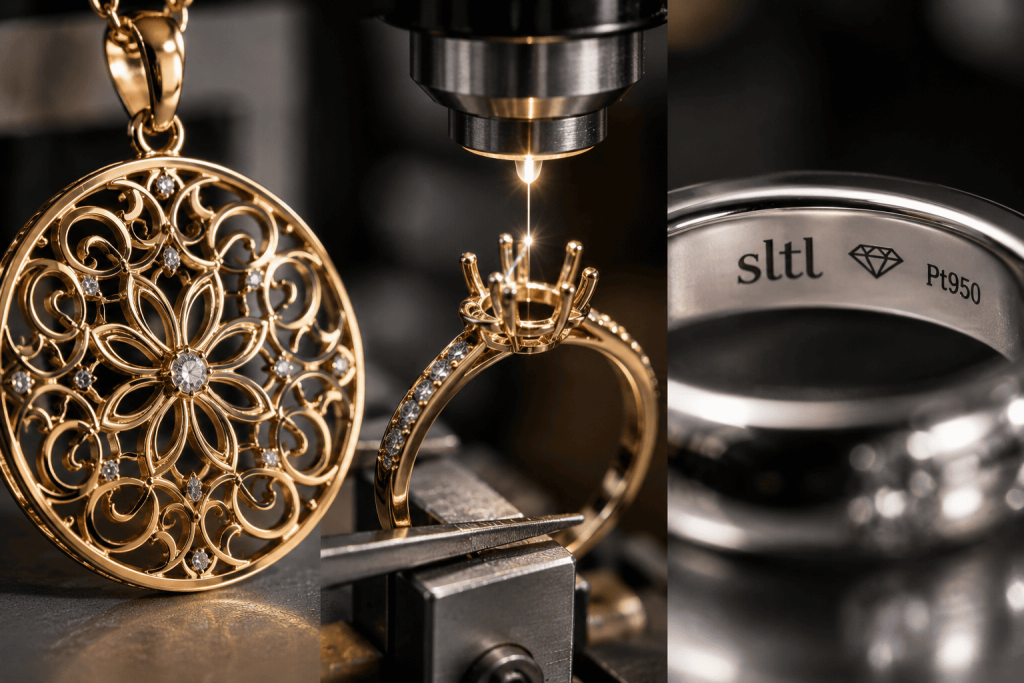
The global jewelry industry is undergoing a major transformation. Manufacturers are moving away from slow, manual production methods toward smart, laser-powered workflows. A complete jewelry laser machine setup — combining laser cutting, laser welding, and laser marking — is now the foundation of modern precision jewelry manufacturing. These three technologies work together to deliver unmatched accuracy, speed, and consistency at every production stage.
Today’s luxury buyers expect flawless craftsmanship. Therefore, jewelry brands must meet higher standards than ever before. Traditional hand tools cannot deliver the micron-level precision that modern laser systems achieve. Moreover, manual workflows slow production, increase errors, and limit customization options.
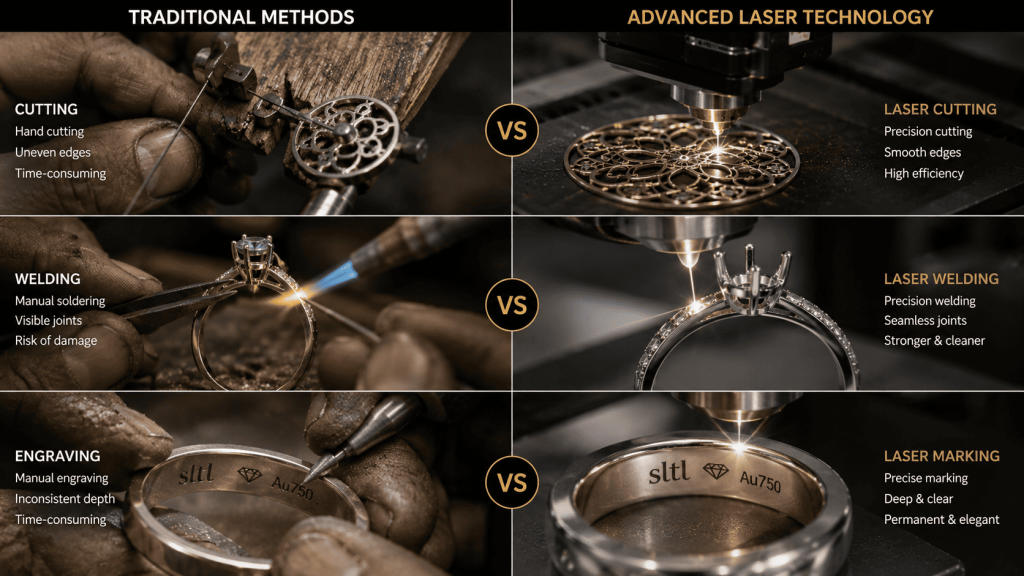
Integrated laser systems solve all of these challenges. Laser cutting produces intricate components with clean edges and zero material stress. Meanwhile, laser welding joins delicate jewelry parts without heat damage or discoloration. In addition, laser marking engraves permanent logos, hallmarks, and custom designs with fine detail and durability.
Furthermore, smart laser workflows reduce production time significantly. They also lower operational costs and improve overall workshop efficiency. Jewelry manufacturers can scale production without compromising quality. As a result, integrated laser setups are rapidly becoming the industry standard for high-end jewelry production.
This guide explains how to build a complete jewelry laser machine setup for your workshop. It covers the machines involved, their applications, and the smart manufacturing benefits they deliver. Additionally, it highlights SLTL’s advanced laser cutting, welding, and marking systems designed specifically for the jewelry industry.
Why a Jewelry Laser Machine Setup Matters in Modern Manufacturing
Jewelry manufacturing demands extreme precision. Even small errors can ruin a luxury piece and damage brand reputation. Therefore, manufacturers need tools that deliver consistent, high-quality results at every production stage.
An integrated jewelry laser machine setup addresses this need directly. It replaces multiple manual processes with smart, automated laser workflows. As a result, manufacturers achieve faster production, fewer errors, and better finishing quality.
Moreover, integrated laser setups improve customization capability. Jewelry brands can produce complex, personalized designs that manual methods cannot replicate. This is especially important in the luxury segment, where custom pieces command premium prices.
Additionally, smart laser workshops improve operational consistency. Every laser cut, weld, and mark is executed with identical parameters. Therefore, batch production maintains the same quality standards from the first piece to the last.
Finally, integrated setups improve scalability. Manufacturers can increase production volume without adding manual labor. This reduces operational costs and improves profitability over time.
Key benefits of an integrated jewelry laser machine setup include:
- Faster production cycles with automated laser workflows
- Reduced material waste due to high-precision cutting
- Improved luxury finishing standards for high-end jewelry
- Better customization capability for personalized designs
- Consistent batch production quality across all pieces
- Smart workshop scalability without additional manual labor
- Lower long-term operational costs through automation
Key Machines Required in a Jewelry Laser Machine Setup
A complete jewelry laser machine setup requires three core laser technologies. Each machine handles a specific stage of the production workflow. Together, they create a seamless, end-to-end manufacturing process.
Laser Cutting Systems
Laser cutting machines handle the precision cutting of metal sheets, components, and decorative patterns. They use high-powered laser beams to cut gold, silver, platinum, titanium, and stainless steel with micron-level accuracy.
Additionally, laser cutting systems support complex geometries that traditional cutting tools cannot achieve. Intricate filigree patterns, fine lattice structures, and custom shapes are all possible with advanced laser cutters.
Laser Welding Systems
Laser welding machines join jewelry components using concentrated laser pulses. They deliver precise heat to a tiny area, which minimizes thermal distortion and prevents damage to surrounding metal.
Moreover, laser welding systems support jewelry repair applications such as ring resizing, chain repair, and clasp replacement. They work on delicate luxury pieces without affecting stones, surface finishes, or engravings.
Laser Marking Systems
Laser marking machines engrave logos, hallmarks, serial numbers, and custom designs onto jewelry surfaces. They produce permanent, high-resolution marks that do not fade or wear over time.
Furthermore, laser marking supports brand traceability and compliance with hallmarking standards. Jewelry manufacturers can mark every piece with certification details for authenticity verification.
Smart Software Integration
Advanced jewelry laser machine setups also include smart CAD/CAM software. This software connects cutting, welding, and marking machines into a single digital workflow. As a result, manufacturers can design, simulate, and execute production plans with full precision control.
How Laser Cutting, Welding and Marking Work Together
Understanding how these three technologies integrate is essential for building an efficient jewelry laser machine setup. Each machine handles a specific role, but they share data, settings, and design files across a unified workflow.
Fine Cutting for Precision Jewelry Components
The production process typically begins with laser cutting. Metal sheets or rods are loaded into the cutting machine, which reads the digital design file and executes precise cuts automatically.
Laser cutting systems support complex patterns for rings, pendants, earrings, bracelets, and name plates. Moreover, they handle intricate decorative elements for luxury customization. Compatible materials include gold, silver, platinum, titanium, and stainless steel.
Additionally, fine laser cutting eliminates burrs and rough edges that manual cutting tools leave behind. Therefore, cut components require less finishing work before moving to the next production stage.
Precision Laser Welding for Jewelry Repair and Production
After cutting, components move to the laser welding station. Here, the welder joins cut pieces with precision laser pulses. This stage is critical for assembling rings, setting clasps, attaching bails, and completing complex multi-part jewelry designs. For more detail on how laser welding improves both production and repair quality, refer to our guide on How Laser Welding Improves Jewelry Repair and Production Quality, which covers advanced repair applications in depth.
Laser welding is also essential for jewelry repair workflows. Ring resizing, chain soldering, and prong re-tipping all benefit from the minimal heat input of laser welding. As a result, delicate gemstones and fine surface finishes remain undamaged throughout the repair process.
Luxury Branding with Laser Marking
Once components are welded and assembled, they move to the laser marking station. Here, the marking machine engraves permanent logos, hallmarks, serial numbers, and custom text with fine detail.
Laser marking supports ring marking, logo marking, name plate marking, color marking samples, and hallmark engraving. Moreover, it works on curved surfaces, flat sheets, and complex jewelry geometries with equal precision.
Additionally, permanent laser marks support brand traceability. Each piece carries a unique identifier that confirms its authenticity and origin. This is particularly valuable for luxury brands operating in global markets.
Smart Workflow Integration in Jewelry Manufacturing
The true power of an integrated jewelry laser machine setup lies in its connected workflow. CAD design files flow directly from design software to cutting, welding, and marking machines. Therefore, manual file transfers and setup errors are eliminated.
Furthermore, smart integration allows real-time monitoring of production parameters. Operators can track cut quality, weld strength, and mark depth from a central dashboard. This improves quality control and reduces production downtime significantly.
For manufacturers looking to expand their precision engraving capabilities, exploring advanced laser engraving for jewelry production provides additional insights into fine-detail marking applications for luxury and hallmarking workflows.
Best SLTL Machines for Your Jewelry Laser Machine Setup
SLTL Group offers a comprehensive range of laser cutting, welding, and marking machines designed for jewelry manufacturing. Each system delivers industrial-grade precision, smart automation features, and proven performance in luxury production environments.
SLTL Laser Cutting Machines for Jewelry Manufacturing
SLTL’s laser cutting range supports everything from fine jewelry component manufacturing to large-scale industrial sheet processing:
| Machine | Key Features |
| Future X | Most advanced laser cutting solution — high-speed precision manufacturing with full automation support. Ideal for high-volume luxury jewelry production. |
| Infinity F1 | Heavy-duty industrial laser cutter delivering high-performance cutting and industrial-grade precision for complex jewelry components. |
| Vector | Heavy-duty customizable manufacturing system with flexible production setup and high-efficiency cutting workflows for diverse jewelry applications. |
| IntegreX | Affordable, productivity-focused solution with efficient workshop integration and compact footprint. Ideal for growing jewelry workshops. |
| X5 | Specialized 3D cutting machine for complex jewelry structures requiring premium design capability and multi-axis precision. |
Ideal cutting applications include:
- Intricate pattern cutting for decorative jewelry elements
- Fine jewelry component manufacturing for rings and pendants
- Precision sheet processing for luxury metal applications
- Custom shape cutting for personalized jewelry design
SLTL Laser Marking Machines for Jewelry Branding
SLTL’s laser marking range covers diode, fiber, and CO2 technologies. Explore the full range at the SLTL Laser Marking Product Category.
| Machine | Key Features |
| REX | Diode laser marking system with traceability marking support. Suitable for entry-level jewelry identification and certification marking. |
| ELITE | Fiber laser system optimized for hallmarking and logo engraving. Delivers sharp, high-contrast marks on gold, silver, and platinum. |
| Flexy | Movable diode marking machine for flexible marking operations. Ideal for workshops needing portable marking capability. |
| NEO | Fiber laser marking machine (20–60W) for multipurpose industrial engraving. Supports a wide range of jewelry marking applications. |
| Ultra | Fiber laser marking machine (20–120W) for fine-detail luxury engraving. Produces ultra-sharp logos, hallmarks, and decorative marks. |
| OptiFly | CO2 laser marking machine for plastic packaging and mass production marking. Supports retail jewelry branding workflows. |
| Carbon | CO2 laser marking system for decorative and industrial marking applications. Ideal for branded jewelry packaging and accessories. |
Ideal marking applications include:
- Ring marking with hallmarks and certification details
- Logo marking for luxury brand identification
- Hallmark engraving for regulatory compliance
- Name plate marking for personalized jewelry gifts
- Color marking samples for decorative jewelry finishing
SLTL Laser Welding Machines for Jewelry Production
SLTL’s laser welding systems are built specifically for jewelry applications. Visit the SLTL Laser Welding Product Category to explore the full range.
| Machine | Key Features |
| Nova | 200–500W fully customized laser welding system for high-performance jewelry manufacturing. Supports complex assemblies and luxury production workflows. |
| ENZO | Up to 200W jewelry laser welding machine specialized for gold welding and jewelry repair. Delivers precise, clean welds with minimal heat input. |
| Hertz | Handheld laser welding machine offering flexible, portable repair capability. Ideal for repair workshops and on-site jewelry restoration. |
Ideal welding applications include:
- Ring resizing without damage to stones or surface finish
- Chain repair with precise, invisible weld joints
- Fine welding samples for quality assurance testing
- Luxury jewelry restoration for high-value repair projects
Smart Manufacturing Benefits of an Integrated Jewelry Laser Machine Setup
Building an integrated jewelry laser machine setup delivers measurable benefits across every area of jewelry production. These benefits extend beyond individual machine performance to transform the entire workshop operation.
Automation and Productivity in Jewelry Workshops
Integrated laser systems automate repetitive production tasks. Cutting, welding, and marking parameters are programmed once and repeated consistently across entire production runs. Therefore, operators spend less time on manual adjustments and more time on creative and quality-focused tasks.
Moreover, automation reduces the risk of human error at every production stage. Laser machines follow digital instructions precisely, which ensures every piece meets exact design specifications. As a result, rejection rates drop and first-pass quality improves significantly.
Additionally, integrated setups reduce production cycle times. Smart workflows eliminate unnecessary material handling between machines. Consequently, manufacturers can produce more pieces per shift without increasing labor costs.
Key smart manufacturing benefits include:
- Faster production cycles through automated laser workflows
- Improved quality control with real-time parameter monitoring
- Better traceability through laser-marked certification details
- Luxury customization at scale for personalized jewelry production
- Smart workshop scalability to handle growing order volumes
- Reduced operational cost through precision material usage
- Higher profit margins from improved production efficiency
Applications of Integrated Laser Technology in Jewelry Manufacturing
An integrated jewelry laser machine setup supports a wide range of applications across fine jewelry manufacturing, repair, and branding. Below are the key use cases that benefit most from combined laser technologies.
Fine Jewelry Cutting and Fabrication:
Laser cutting handles precision fabrication of rings, pendants, earrings, bracelets, and name plates. Moreover, it supports decorative elements such as filigree, lattice patterns, and custom design cutouts. Compatible materials include gold, silver, platinum, titanium, and stainless steel.
Precision Welding and Assembly:
Laser welding supports jewelry assembly and repair across all product types. Fine welding samples demonstrate the quality achievable with SLTL welding systems. Additionally, ring resizing, chain repair, and prong replacement all benefit from minimal heat input and precise energy delivery.
Luxury Logo and Hallmark Engraving:
Laser marking delivers permanent, high-resolution logos, hallmarks, and serial numbers on all jewelry types. Ring marking, name plate marking, logo marking, and color marking samples are all achievable with SLTL’s marking systems. Furthermore, hallmark engraving supports regulatory compliance for certified jewelry.
Smart Customization and Luxury Branding:
Integrated laser workflows enable luxury customization at scale. Manufacturers can produce personalized jewelry with custom engravings, unique patterns, and individual branding details. Consequently, they can serve the high-end custom jewelry market without compromising production efficiency.
Upgrade Your Workshop with SLTL Jewelry Laser Solutions
| ▶ Ready to build a complete jewelry laser machine setup? |
| SLTL Group offers advanced laser cutting, welding, and marking systems engineered specifically for jewelry manufacturers. Our integrated solutions deliver: |
| ✔ Micron-level precision cutting for intricate jewelry components |
| ✔ Damage-free laser welding for delicate luxury pieces |
| ✔ Permanent hallmarking and logo engraving for brand traceability |
| ✔ Smart automation for faster, more consistent production |
| ✔ Scalable setups to grow with your manufacturing needs |
| Contact SLTL today to discuss your jewelry laser machine setup requirements. |
| Get a customized solution matched to your production goals. |
Conclusion
The future of jewelry manufacturing belongs to smart, integrated laser workflows. A well-designed jewelry laser machine setup combining cutting, welding, and marking technologies delivers precision, speed, and luxury quality that traditional methods cannot match.
Laser cutting produces intricate components with clean edges and zero material stress. Meanwhile, laser welding joins those components with minimal heat and maximum precision. Additionally, laser marking adds permanent branding and traceability details that reinforce luxury standards and regulatory compliance.
Together, these technologies transform jewelry workshops into smart manufacturing environments. They reduce production errors, lower operational costs, and improve customization capability. Moreover, they position jewelry brands to meet the growing demand for personalized, high-quality luxury pieces.
SLTL’s advanced laser cutting, welding, and marking systems are designed for exactly this purpose. Each machine delivers industrial-grade performance and smart manufacturing integration. Therefore, building your jewelry laser machine setup with SLTL technology means investing in long-term production excellence.
Contact SLTL today to explore how integrated laser solutions can transform your jewelry manufacturing operation.
Frequently Asked Questions
1. What does a complete jewelry laser machine setup include?
A complete jewelry laser machine setup includes three core systems: a laser cutting machine for precision component fabrication, a laser welding machine for assembly and repair, and a laser marking machine for hallmarking and branding. Additionally, smart CAD/CAM software connects these systems into a unified production workflow.
2. How much does a jewelry laser machine setup cost?
The cost of a jewelry laser machine setup varies depending on the machines selected, their power ratings, and automation features. Entry-level systems such as the IntegreX cutter and ENZO welder are suitable for smaller workshops with budget considerations. Advanced configurations using the Future X cutter, Nova welder, and Ultra marking system are designed for high-volume luxury production. Contact SLTL for a customized quote based on your production requirements.
3. Are SLTL laser machines compatible with gold, silver, and platinum?
Yes. SLTL laser cutting, welding, and marking machines are fully compatible with gold, silver, platinum, titanium, and stainless steel. Each machine is engineered to handle the specific thermal and reflective properties of precious metals. Therefore, you can use SLTL systems across your entire jewelry material range without additional modifications.
4. Can an integrated laser setup improve luxury customization capability?
Absolutely. An integrated jewelry laser machine setup significantly improves customization capability. Laser cutting handles complex decorative patterns and unique shapes that manual tools cannot replicate. Meanwhile, laser marking engraves personalized text, logos, and designs with fine detail. As a result, manufacturers can offer luxury custom jewelry at scale without compromising production speed.
5. How do integrated laser workflows support smart manufacturing?
Integrated laser workflows support smart manufacturing by connecting cutting, welding, and marking machines through shared digital design files and centralized control systems. This eliminates manual file transfers and setup errors between machines. Moreover, smart integration enables real-time monitoring of production parameters, quality control tracking, and automated batch production. Consequently, manufacturers achieve consistent output quality with significantly lower operational overhead.

