


In the tool and mold manufacturing industry, precision, collaboration, and speed are everything. For decades, traditional CAD (Computer-Aided Design) software has been the bedrock of mold design. But as demands grow for faster cycles, better customization, and integrated production workflows, a new trend is gaining momentum: CAD to Cloud mold design
This blog explores how the transition from desktop-based CAD to cloud-powered design tools is transforming mold design, making processes smarter, more collaborative, and future-ready.
1. The Traditional CAD Landscape and Its Limits
Conventional CAD tools have long powered tool design, but they come with several limitations:
- Hardware Dependence: Heavy system requirements and compatibility issues
- Collaboration Delays: File-sharing via email or USB can slow development
- Version Control Chaos: Multiple versions of a design often lead to confusion
- Limited Integration: Difficulty linking with CAM, simulation, and ERP systems
In an era where mold manufacturers must meet tight deadlines and exacting standards, these issues are no longer acceptable.
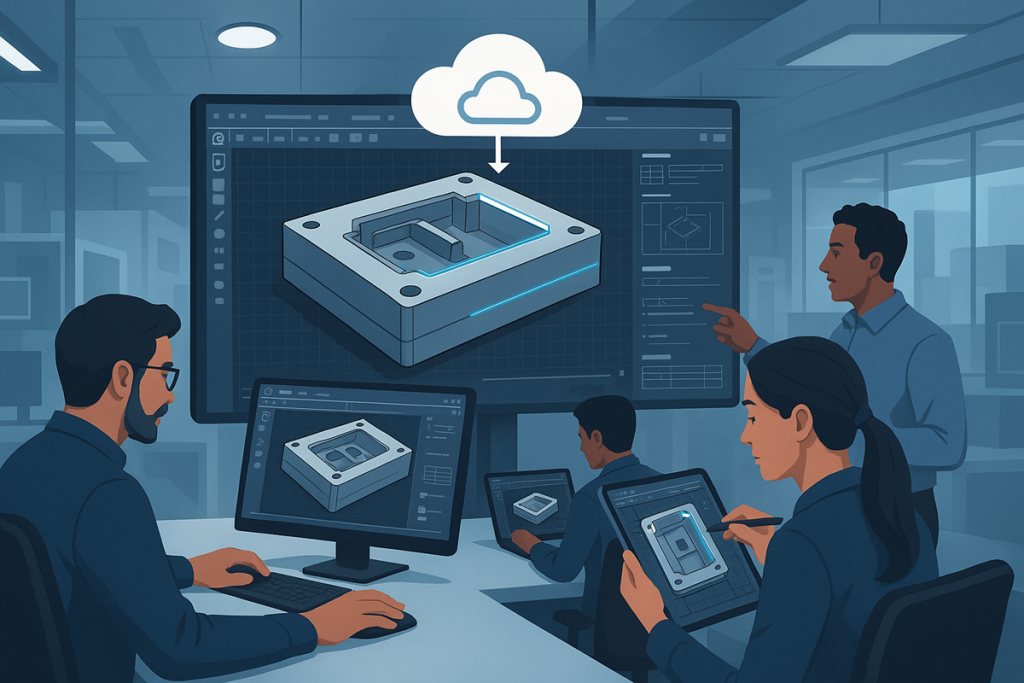
2. The Rise of Cloud-Based CAD in Mold Design
Cloud-based CAD platforms such as Onshape, Autodesk Fusion 360, and SolidWorks Cloud are changing the mold (literally and figuratively). These solutions are hosted on the cloud and accessed via web browsers, offering unmatched flexibility and real-time collaboration.
Key Benefits:
- Access Anytime, Anywhere: Engineers can log in and design from any device.
- Real-Time Collaboration: Multiple users can work on the same model simultaneously.
- Automatic Version Control: Every change is saved and tracked.
- Integrated Ecosystem: Easy connection to CAM, simulation, PLM, and data analytics.
3. Collaboration: The Game-Changer in Mold Development
Mold manufacturing is rarely a solo job. Designers, mold makers, QA specialists, and even customers need to review and tweak designs. Cloud-based CAD tools:
- Enable instant sharing and commenting on models.
- Reduce feedback loops from days to minutes.
- Allow customers or external partners to view designs live, without software installation.
For complex mold projects, this means fewer misunderstandings and faster decisions—critical for reducing lead times.
4. Shorter Lead Times with Cloud-Integrated Workflows
Time-to-market is crucial, especially in sectors like automotive, packaging, and electronics, where design updates happen rapidly. Cloud CAD tools streamline the entire design-to-production workflow by:
- Allowing instant export to CAM software for toolpath generation
- Syncing with ERP/MES systems to automate scheduling and inventory
- Offering real-time simulation integration to test mold flow or cooling efficiency
The result? Designs move faster from screen to shop floor, reducing delays and production costs.
5. Data Security & IP Protection: Is the Cloud Safe?
A valid concern among mold manufacturers is data confidentiality. Cloud platforms address this with:
- End-to-end encryption
- Two-factor authentication
- Granular access controls (e.g., view-only access for clients)
Plus, cloud backups reduce the risk of data loss due to hardware failure or cyberattacks—an important safeguard for high-value mold projects.
6. Scalability and Cost-Effectiveness
Unlike traditional software that demands high upfront costs for licenses and upgrades, cloud CAD tools are typically subscription-based, offering:
- Lower capital expenditure
- Automatic software updates
- Flexible user management, ideal for growing design teams or outsourcing work
For small to mid-sized tool rooms or contract mold manufacturers, this means high-end CAD capabilities without breaking the bank.
7. Real-World Applications: Who’s Using Cloud CAD Today?
Several leading-edge companies are already embracing the shift:
- Injection mold makers use cloud CAD to collaborate with clients across countries.
- Tool rooms in OEM supply chains design and review tooling components across time zones.
- Medical and packaging mold manufacturers use simulation-integrated cloud tools to iterate designs faster and reduce time to approval.
Even educational institutions are training the next generation of mold designers on cloud-native platforms—building a workforce ready for the future.
8. Future Outlook: What’s Next for Cloud-Based Mold Design?
Looking ahead, expect cloud CAD platforms to integrate even more deeply with:
- AI-assisted design suggestions
- Predictive mold performance modeling
- Smart manufacturing dashboards
- AR/VR-based mold reviews
This convergence of cloud, AI, and Industry 4.0 technologies could make tool and mold design not just faster—but intelligent and autonomous.
Conclusion
So, is the digital shift from CAD to cloud transforming mold design?
Absolutely.
From real-time collaboration to smart integrations and reduced time-to-market, cloud-based CAD platforms are paving the way for a more agile, connected, and efficient mold manufacturing ecosystem.
For tool and mold makers aiming to stay competitive in 2025 and beyond, embracing the cloud isn’t just an upgrade—it’s a strategic move.


