
The global luxury jewelry market is growing fast. Manufacturers and repair workshops need better tools to keep up with rising demand. Choosing the best laser welding machine for jewelry is no longer optional — it is a Essential investment. Whether you handle jewelry repair, ring resizing, or high-volume production, the right laser welding machine for jewelry determines the quality of every piece you deliver.
Traditional soldering methods are slow and generate too much heat. They cause discoloration, warping, and surface damage. Precision welding with laser technology solves these problems completely. Modern laser welding delivers clean, controlled heat input to the exact spot that needs it. As a result, manufacturers achieve stronger joints, better finishes, and faster turnaround times.
This guide explains what to look for in a jewelry laser welding system. It also introduces the top SLTL laser welding machines designed specifically for jewelry applications. If you are ready to modernize your workshop, this is the right starting point.
Today’s jewelry buyers expect flawless products. Prong repairs, chain links, pendant joints, and ring shanks must look perfect. Even minor visible defects reduce the perceived value of a luxury piece. Advanced laser welding systems give manufacturers the control needed to meet these high standards consistently.
Furthermore, smart manufacturing integration is becoming standard. Modern laser welding machines connect with production workflows, improve traceability, and reduce operator fatigue. This guide walks through every important factor to help you make the right decision to pursue.
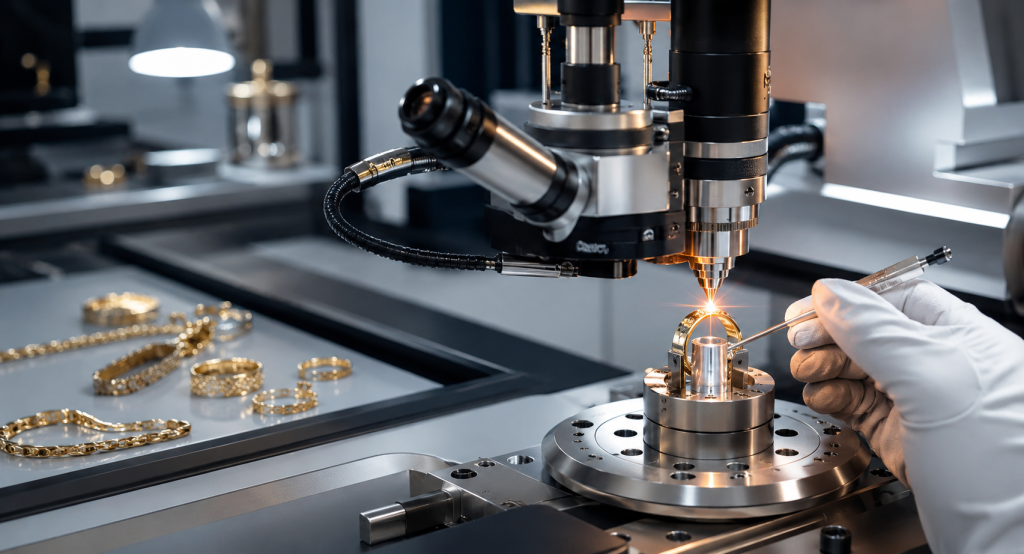
Why the Best Laser Welding Machine for Jewelry Matters in Manufacturing
Jewelry manufacturing is a high-precision, high-value business. Every weld affects the product’s final appearance and structural integrity. For this reason, choosing the best laser welding machine for jewelry is a critical business decision.
Modern luxury jewelry brands operate with strict quality standards. A poorly welded prong or chain link leads to product returns, rework costs, and brand damage. Furthermore, laser welding minimizes these risks by delivering controlled, localized heat with pinpoint accuracy.
Precision Welding for Gold and Silver Jewelry
Gold and silver are heat-sensitive metals. Traditional soldering can cause surface oxidation, color changes, and uneven joints. Laser welding avoids this. Short pulse durations and fine spot sizes allow the welder to deposit energy only where it is needed.
Additionally, precision welding produces stronger metallurgical bonds. The heat-affected zone remains extremely small. This means surrounding gemstones, engravings, and delicate structures are not damaged during the repair or joining process.
Moreover, laser welding improves production consistency. Every joint produced under the same parameters comes out of the same quality. This matters especially in high-volume environments where hundreds of pieces are processed daily.
Laser welding also reduces the need for post-weld polishing. Because the weld pool is so controlled, surface finishing is minimal. Therefore, manufacturers save both time and material costs on every production run.
Key Features to Look for in a Laser Welding Machine for Jewelry
Not all laser welding machines are equal. Jewelry applications demand specific capabilities that standard industrial welders cannot provide. Here are the most important features to evaluate before purchasing.
Laser Power and Pulse Control
Power range is the first factor to consider. Jewelry applications typically require systems between 50W and 500W. Lower power is suitable for fine repair work. Higher power supports heavy production welding on thick gold or platinum components.
Pulse control is equally important. Adjustable pulse duration allows operators to fine-tune the heat input. Shorter pulses reduce thermal damage. Longer pulses improve penetration on thicker metals. A good system gives full control over both parameters.
Microscope Quality and Spot Size Adjustment
Jewelry welding requires magnification. A high-quality binocular microscope allows operators to see weld spots clearly before firing out the laser. This is critical when working on fine chains, prong tips, or engraved surfaces.
Spot size adjustment is another essential feature. Fine spot sizes of 0.2 mm to 2.0 mm allow precise targeting. This flexibility lets the operator handle both micro-welding on delicate jewelry and broader joining on structural components.
Operator Comfort and Smart Manufacturing
Long working sessions demand ergonomic design. Systems with adjustable working heights, comfortable eyepiece positions, and easy-access controls reduce operator fatigue. This directly improves welding accuracy and productivity.
Additionally, touchscreen control panels simplify operation. Operators can switch between stored weld parameters instantly. This reduces setup time between different jobs and supports a more efficient workshop workflow.
Smart manufacturing compatibility is increasingly valuable. Systems with parameter memory, production logging, and connectivity support better quality management across the workshop.
Cooling systems also matter. Continuous-duty welding generates heat in the laser source. Efficient water or air cooling prevents overheating and ensures consistent performance during long production runs.
How Precision Welding Improves Jewelry Repair and Production
Laser welding has fundamentally changed jewelry repair workflows. Repair workshops that previously spent hours on a single job can now complete the same task in minutes. The reason is simple: precision welding eliminates guesswork and reduces rework.
For a deeper understanding of how this technology elevates jewelry quality, explore our detailed guide: How Laser Welding Improves Jewelry Repair and Production Quality. It covers advanced repair techniques, material compatibility, and weld quality benchmarks for luxury jewelry applications.
Fine Welding for Rings, Chains, and Pendants
Ring resizing is one of the most common jewelry repair operations. Laser welding makes it significantly easier. The welder can close the cut shank joint with precision, producing a seamless result that requires minimal finishing. Furthermore, no solder alloy is needed in many cases. This preserves the original metal purity.
Chain repair is another area where laser welding excels. Thin links require delicate heat control. A laser system delivers energy to a single link without affecting neighboring ones. As a result, the repaired chain looks indistinguishable from the original.
Pendant welding also benefits greatly. Bails, jump rings, and decorative elements need clean attachment welds. Laser systems produce virtually invisible joints on these small components.
Compatible Materials for Jewelry Laser Welding
Modern laser welding machines handle a wide range of jewelry metals. Compatible materials include:
- Gold (yellow, white, rose — all karats)
- Silver and sterling silver
- Platinum and palladium alloys
- Titanium
- Stainless steel
- Brass and bronze alloys
Each material requires different laser parameters. A good jewelry laser welding system provides pre-set parameter libraries for common metals. This reduces operator setup time and improves first-pass weld success rates.
Best SLTL Laser Welding Machines for Jewelry Manufacturers
SLTL Group is one of India’s leading manufacturers of industrial laser systems. Their jewelry-focused laser welding machines combine German-standard optics, advanced pulse control, and ergonomic workstation design. Here are their top systems for jewelry applications.
Explore the full range of best laser welding machine for jewelry solutions on the SLTL product page.
Nova — High-Power Precision Welding System
The Nova is SLTL’s flagship jewelry laser welding platform. It delivers 200W to 500W of laser power in a fully customized configuration. This makes it ideal for high-volume manufacturing environments and heavy jewelry production workflows.
The Nova supports fine-detail welding with precise spot size adjustment and advanced pulse control. Its robust cooling system ensures consistent performance during continuous production shifts. Luxury manufacturers who need maximum throughput without sacrificing weld quality choose the Nova.
Ideal Applications:
- High-volume gold and platinum jewelry production
- Heavy component welding in luxury manufacturing
- Precision repair in large-scale hallmarking centers
- Automated and semi-automated production lines
ENZO — Specialist Jewelry Repair Welding System
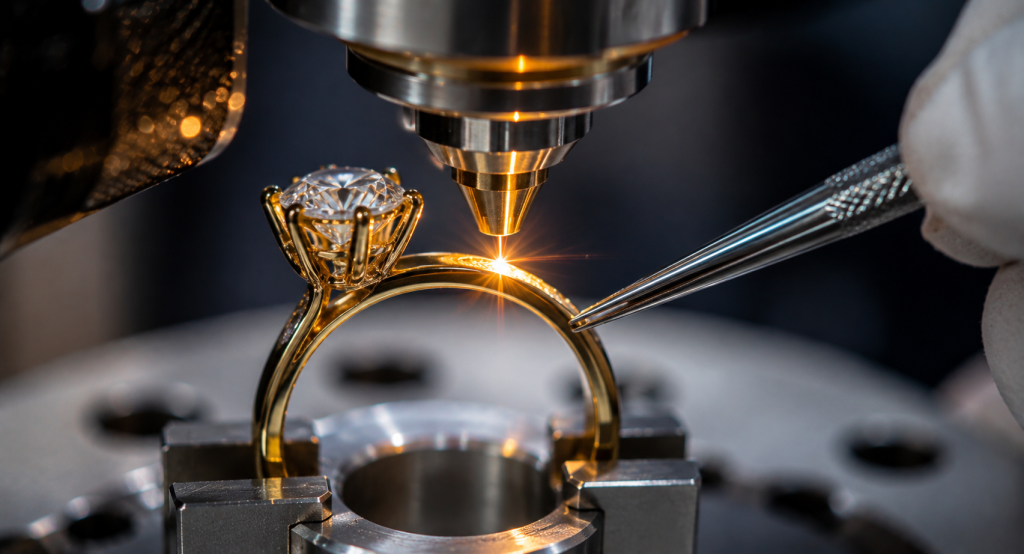
The ENZO is purpose-built for jewelry repair and fine production work. It operates at up to 200W and is optimized specifically for gold welding. Its high-resolution microscope, fine spot adjustment, and intuitive parameter controls make it an outstanding jewelry repair welding solution.
Moreover, the ENZO is designed for operator comfort during long repair sessions. Its ergonomic workstation, adjustable armrests, and low-fatigue eyepiece system allow technicians to work accurately for extended periods. For luxury repair workshops and fine jewelry ateliers, the ENZO is the preferred choice.
Ideal Applications:
- Gold jewelry repair and prong re-tipping
- Ring resizing and shank welding
- Fine chain link repair
- Pendant bail attachment and jump ring welding
- Luxury jewelry restoration
Learn more about SLTL’s jewelry repair welding systems including the ENZO and its full specification sheet.
Hertz — Handheld Laser Welding Machine for Flexible Operations
The Hertz is SLTL’s handheld laser welding solution. It provides portable, flexible welding capability for workshops that need to move the system between stations or handle large jewelry pieces that cannot be easily positioned under a stationary machine.
Moreover, the Hertz is lightweight and easy to operate. It integrates with existing workshop setups and supports quick repair applications without long setup procedures. Its smart manufacturing compatibility allows seamless integration into modern jewelry production environments.
Ideal Applications:
- Quick repair operations at the counter
- Small and mid-size jewelry workshops
- Flexible customization work on large or irregularly shaped pieces
- Mobile repair units within large production facilities
Applications of Jewelry Laser Welding in Modern Manufacturing
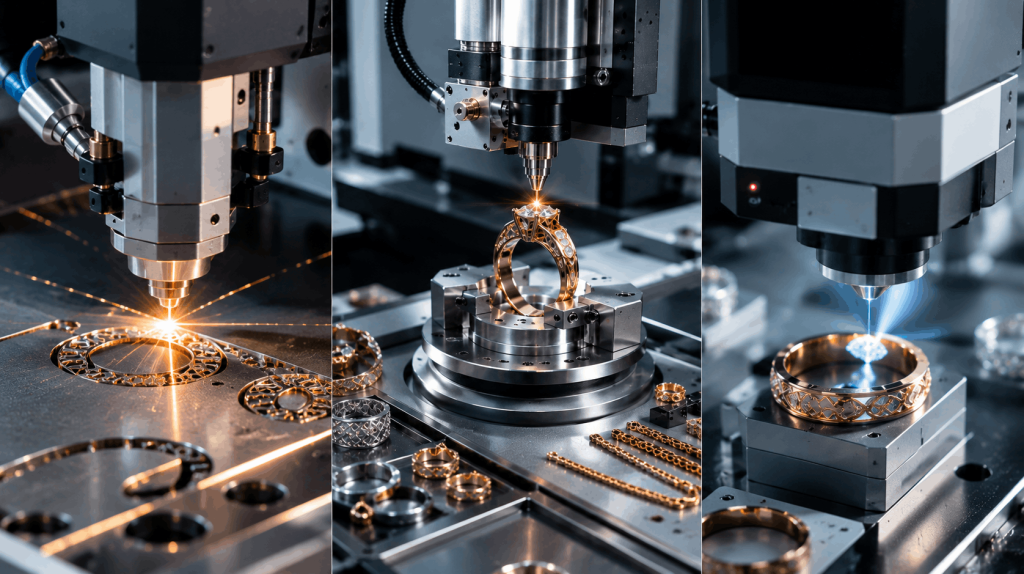
Laser welding is not used in isolation. Modern jewelry workshops integrate welding, cutting, and marking technologies together. This combination produces the highest quality output and supports advanced customization services.
Integrated Cutting, Welding, and Marking Workflows
Jewelry manufacturers increasingly use laser cutting to shape metal blanks with precision. After cutting, laser welding joins components without adding bulk or distortion. Finally, laser marking adds hallmarks, logos, engravings, and serial numbers to finished pieces.
For example, fine welding samples demonstrate how seamless joins on delicate bracelets, rings, and pendants are achieved. Alongside this, ring marking and logo marking capabilities allow workshops to brand every piece with professional precision. Name plate marking and color marking samples show the versatility of laser systems in luxury personalization workflows.
This three-technology integration — cutting, welding, and marking — gives jewelry manufacturers a complete production solution under one roof. It reduces outsourcing costs, shortens production cycles, and improves overall quality control.
To learn more about laser engraving and hallmarking capabilities for jewelry, explore SLTL’s laser marking solutions. These systems complement the welding machines and enable complete jewelry personalization workflows.
Smart Manufacturing in Jewelry Workshops
Smart manufacturing is changing how jewelry workshops operate. Modern laser welding systems support digital parameter storage, production tracking, and remote diagnostics. These features reduce downtime and improve consistency across shifts.
Additionally, smart systems allow workshop managers to monitor production quality in real time. Weld parameters, job counts, and error logs are stored automatically. Consequently, quality management becomes more proactive than reactive.
Furthermore, smart laser welding supports the growing demand for customized luxury jewelry. Workshops can switch between job parameters instantly, handling multiple product types in a single shift without manual recalibration.
Ready to Upgrade Your Jewelry Workshop?
SLTL Group offers a complete range of laser solutions for jewelry manufacturers. Whether you need a high-power production welder, a specialist repair system, or a portable handheld unit, SLTL has the right solution for your workshop.
Benefits of choosing SLTL laser technologies:
- Precision jewelry repair and production welding
- Luxury-quality finishing with minimal post-processing
- Faster production cycles and reduced rework rates
- Better operator comfort with ergonomic workstation design
- Smart manufacturing compatibility for modern workshops
- High-precision laser marking for hallmarking and personalization
- Integrated cutting, welding, and marking solutions
Contact SLTL today to discuss your jewelry production requirements. Our team of laser specialists will help you select the right system and configure it for your specific applications. Modernize your workshop with technology trusted by luxury jewelry manufacturers worldwide.
Conclusion
The jewelry industry is moving fast. Customer expectations are rising, competition is intensifying, and production standards are getting stricter. Choosing the best laser welding machine for jewelry is one of the most important investments a jewelry manufacturer or repair workshop can make today.
Precision welding delivers measurable improvements in quality, speed, and profitability. Laser systems eliminate the thermal damage caused by traditional soldering. They produce stronger joints, cleaner surfaces, and more consistent results across every batch.
SLTL’s Nova, ENZO, and Hertz laser welding machines represent the best of modern jewelry laser technology. Each system is engineered for specific jewelry applications — from high-volume luxury production to fine repair work and portable workshop use.
Furthermore, integrating laser welding with laser cutting and marking creates a complete smart manufacturing ecosystem. This combination gives jewelry workshops the tools to deliver world-class products efficiently and profitably.
The future of jewelry manufacturing belongs to workshops that invest in the right technology today. Explore SLTL’s laser welding, marking, and cutting solutions and take the next step toward precision, quality, and growth.
Frequently Asked Questions (FAQs)
1. Which laser power is best for jewelry welding?
Power selection depends on the type of jewelry work. For fine repair tasks like chain links and prong tips, systems up to 100W are sufficient. For ring resizing and heavier gold or platinum work, 100W to 200W is recommended. High-volume production environments benefit from 200W to 500W systems like the SLTL Nova.
2. Can a laser welding machine weld gold jewelry without damage?
Yes. Laser welding is specifically well suited for gold jewelry. The short pulse duration and precise spot targeting minimize heat input. As a result, surrounding areas of the jewelry piece, including gemstone settings and engraved surfaces, remain undamaged. Gold in all karats — yellow, white, and rose — is fully compatible with modern jewelry laser welding systems.
3. How precise is laser welding compared to traditional soldering?
Laser welding is significantly more precise than flame or torch soldering. Spot sizes as small as 0.2 mm allow targeted energy delivery. The heat-affected zone is minimal, which preserves metal structure and surface finish. Traditional soldering cannot achieve this level of control, especially delicate or gemstone-set jewelry.
4. Are handheld laser welding machines suitable for jewelry workshops?
Yes. Handheld laser welders like the SLTL Hertz are well-suited for small workshops and flexible repair operations. They allow operators to reach difficult positions on large or irregularly shaped pieces. However, stationary systems with microscopes, such as the ENZO, provide greater precision for fine detail work and are preferred for high-quality repair environments.
5. What is the difference between the SLTL Nova, ENZO, and Hertz for jewelry applications?
The Nova is a high-power system (200–500W) for industrial jewelry production. The ENZO is a specialized jewelry repair welding machine (up to 200W) optimized for gold welding, fine detail, and operator comfort. The Hertz is a portable handheld unit for flexible workshop use. Each system targets a different segment of the jewelry manufacturing and repair market.


