
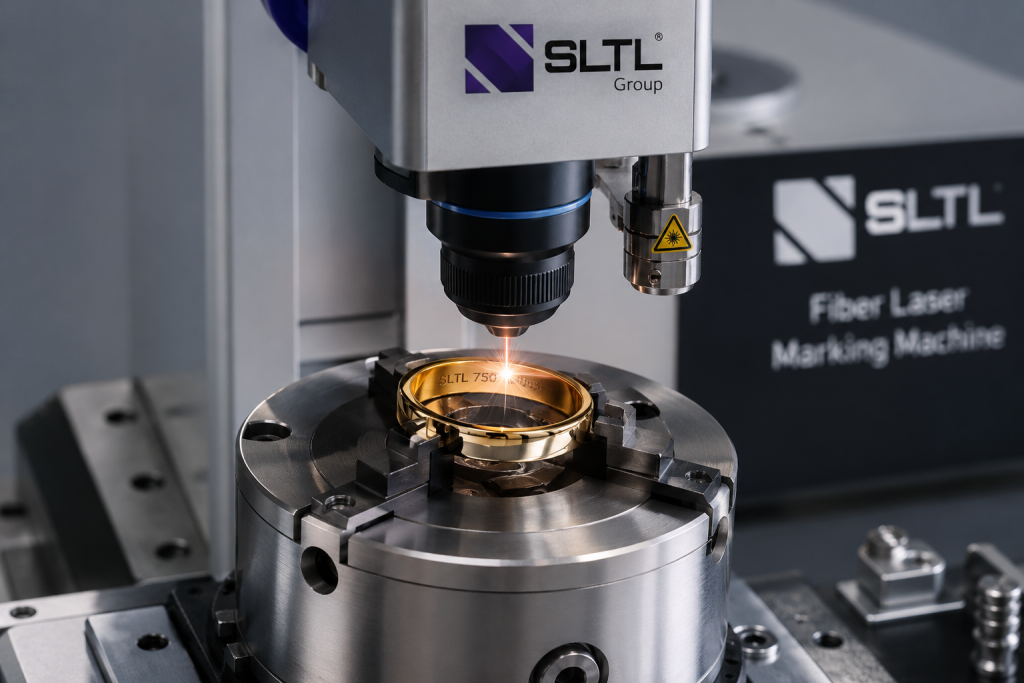
The jewelry industry is evolving fast. Consumers now demand personalized, traceable, and premium-branded pieces. As a result, precision marking has become a core requirement in modern jewelry manufacturing. Choosing the right laser marking machine for rings helps manufacturers meet these demands with speed, accuracy, and lasting quality.
Traditional engraving methods have long struggled to keep up. Rotary tools and chemical etching are inconsistent in small parts. They cause surface damage. They also limit the complexity of design. Laser marking, by contrast, delivers clean, permanent results on curved surfaces without contact.
This guide walks you through every key factor to consider. From fixture compatibility to spot size, from material support to automation, you will find everything needed to make the right purchasing decision.
Why Laser Marking Machine for Rings Is Important in Jewelry Manufacturing
The Shift from Traditional Engraving to Laser Marking
Traditional engraving has served the jewelry industry for centuries. However, it comes with serious limitations. Mechanical tools cannot achieve consistent depth on curved ring surfaces. They wear down over time. Additionally, they are simply too slow for modern production volumes.
A laser marking machine for rings solves all of these problems. Laser systems use focused light beams to mark metal surfaces with micron-level precision. There is no physical contact. Therefore, there is no surface stress, no tool wear, and no risk of damaging delicate pieces.
Ring Marking for Luxury Jewelry Branding
Luxury branding requires flawless results. A poorly engraved logo or blurred hallmark can damage a brand’s reputation instantly. Consequently, high-end jewelry manufacturers now rely on fiber laser systems to deliver sharp, consistent marks on gold, platinum, and silver rings.
Moreover, laser marking supports permanent identification. Serial numbers, brand logos, and hallmarks resist wear, polishing, and chemical exposure. This makes them ideal for luxury product authentication and anti-counterfeit protection.
Key reasons manufacturers choose laser ring marking:
- Permanent brand identity marking on gold and platinum
- Hallmarking compliance for regulatory standards
- Traceability through serial numbers and QR codes
- Anti-counterfeit protection for luxury pieces
- Custom personalization for client orders
- High-speed marking for production efficiency
Key Features to Check in a Laser Marking Machine for Rings
Selecting the right laser marking machine for rings requires careful evaluation of several technical factors that directly influence marking quality, production efficiency, and long-term performance. One of the most important considerations is spot size, which determines the fineness of the laser beam at its focal point. For intricate ring designs, hallmarks, and detailed engravings, a spot size between 20 and 50 microns is ideal. Smaller spot sizes produce sharper details, while larger spot sizes are better suited for bold logos and wider coverage but may reduce precision on delicate jewelry components.
Another critical factor is marking contrast and surface finish quality. High-quality laser systems should create clear, permanent markings with excellent visibility. Fiber laser machines are particularly effective for producing high-contrast engravings on gold, silver, platinum, and stainless steel, while CO₂ lasers are better suited for non-metallic materials. Requesting sample markings before purchasing helps ensure the desired finish and quality.
Fixture compatibility is equally essential because rings and pendants feature curved and irregular surfaces. Dedicated ring fixtures or rotary attachments allow consistent marking around the inner and outer ring bands, eliminating manual repositioning, reducing errors, and improving production speed. Pendants often require custom jigs or vacuum chucks to prevent movement during engraving and maintain marking accuracy.
Modern jewelry manufacturing also benefits from software integration and automation support. Machines that integrate with CAD software, ERP systems, and production management platforms streamline workflows and enable high-volume batch processing. Galvo scanner heads further enhance productivity by providing fast, precise marking and supporting variable data such as serial numbers and traceability codes.
Finally, material compatibility is crucial. Fiber lasers operating at 1064nm are ideal for gold, silver, platinum, titanium, and stainless steel, offering capabilities such as high-contrast etching, black annealing, and color marking. Choosing a machine that matches your primary materials and production requirements ensures reliable, high-quality results across all jewelry applications.
How Pendant Marking Improves Luxury Jewelry Branding
Smart Manufacturing with Jewelry Laser Marking
Luxury brands invest heavily in product identity. Every pendant, every ring, every small component must carry the brand’s mark clearly and permanently. Laser marking systems enable this at scale.
Premium logo marking on pendants creates an instant brand impression. Furthermore, serial number marking enables lifetime traceability. If a piece is ever lost or stolen, the serial number links it directly to the original buyer’s record.
Decorative marking adds another dimension. Laser systems can engrave intricate patterns, floral motifs, and geometric designs directly onto pendant surfaces. As a result, brands can offer truly unique, customized pieces without adding manual labor costs.
Integration with Laser Cutting and Welding in Jewelry Production
Modern jewelry manufacturing benefits from an integrated approach. Laser cutting shapes blanks with precision. Laser welding joins components cleanly without solder contamination. Finally, laser marking adds identity and branding to the finished piece.
This three-technology workflow reduces production errors significantly. Consequently, manufacturers achieve faster cycle times, lower material waste, and consistent luxury-quality output. Additionally, it supports small-batch and bespoke production models efficiently.
For jewelry designers and custom jewelers specifically, this integration enables rapid prototyping. A concept can move from CAD design to marked, finished piece within hours. Therefore, it accelerates the development of new collections and custom client pieces.
Also consider exploring jewelry laser engraving techniques and laser hallmarking capabilities to understand the full scope of precision marking applications in luxury jewelry production.
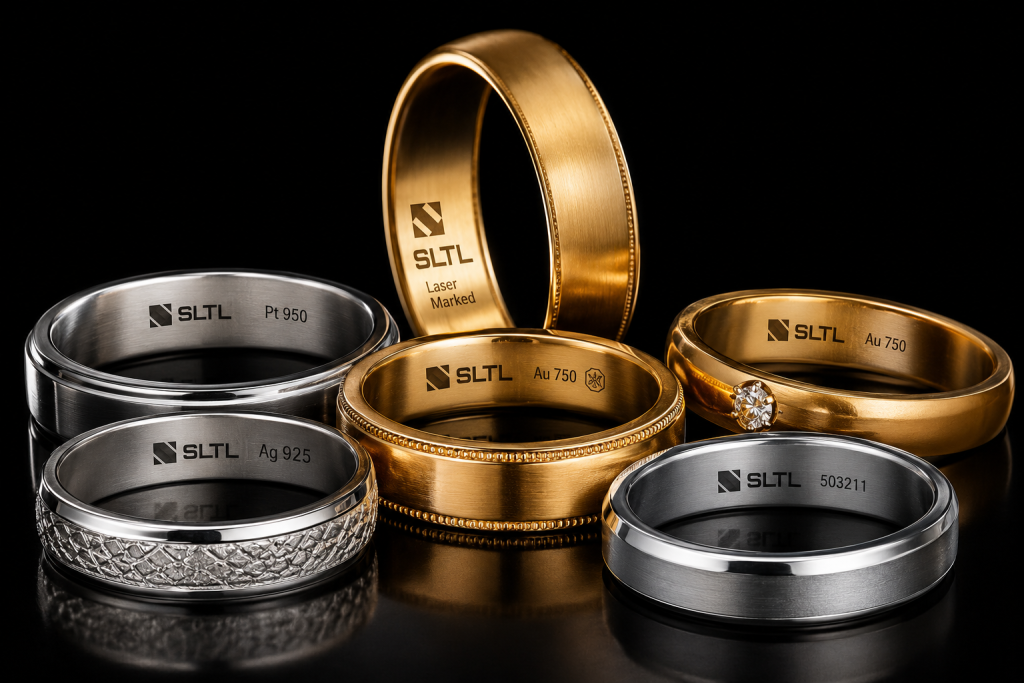
SLTL Laser Marking Machines for Jewelry Manufacturing
SLTL Group offers a complete range of laser marking systems designed for jewelry applications. Each machine addresses a specific production need. Together, they cover ring marking, pendant marking, hallmarking, and high-volume traceability applications.
| Model | Type | Power | Best For |
| REX | Diode Laser | Low | Traceability marking on rings and small jewelry parts |
| ELITE | Fiber Laser | Standard | Hallmarking applications with high accuracy |
| Flexy | Diode Laser (Movable) | Standard | Difficult-to-reach jewelry parts and curved surfaces |
| NEO | Fiber Laser | 20–60W | Multipurpose high-power ring and pendant marking |
| Ultra | Fiber Laser | 20–120W | Precision low-power engraving on luxury metals |
| OptiFly | CO2 Laser | Standard | Plastic marking for mass production |
| Carbon | CO2 Laser | Standard | CO2-based marking applications |
How SLTL Machines Support Ring and Pendant Marking
The ELITE fiber laser delivers the precision required for hallmarking. Its stable beam quality ensures consistent mark depth on gold and platinum rings. The REX diode system handles traceability marking on smaller components with excellent speed.
For difficult jewelry parts, the Flexy movable laser is particularly valuable. It can reach inner ring surfaces, pendant backs, and bracelet clasps that fixed-head systems cannot access. Moreover, the NEO and Ultra fiber systems handle high-power and precision low-power applications across the full jewelry product range.
The OptiFly and Carbon CO2 systems extend SLTL’s capability to packaging, plastic inserts, and non-metallic components commonly used in jewelry retail presentation.
Upgrade Your Jewelry Production with SLTL Laser Technology
SLTL’s laser marking, cutting, and welding solutions are engineered for the demands of modern jewelry manufacturing. Whether you need precision ring marking, high-contrast hallmarking, luxury pendant engraving, or full production automation, SLTL has the right system for you. ✔ Precision ring marking on gold, silver, and platinum ✔ High-contrast engraving for luxury branding ✔ Faster production with automation-ready systems ✔ Permanent hallmarking and traceability marking ✔ Integrated cutting, welding, and marking solutions ✔ Smart manufacturing for bespoke and high-volume production Contact SLTL today to request a live demonstration and sample marking on your jewelry materials.
Frequently Asked Questions
1. What is the best laser type for marking gold and platinum rings?
Fiber lasers operating at 1064nm wavelength are the best choice for gold and platinum. They deliver high contrast, precise marks without thermal damage. SLTL’s ELITE and NEO fiber laser systems are specifically suited for hallmarking and luxury branding on precious metals.
2. What spot size should I use for fine ring engraving?
For intricate ring engraving, a spot size between 20 and 50 microns is recommended. Smaller spot sizes deliver finer detail. However, they require more precise focusing and stable fixturing. Always verify spot size capability with your supplier before purchasing.
3. Do I need a rotary fixture for ring marking?
Yes. A rotary fixture is essential for marking inner and outer ring band surfaces evenly. Without it, the laser cannot maintain consistent focus across the curved surface. Most professional jewelry laser marking machines for rings include rotary attachment support as a standard feature.
4. Can laser marking be used for hallmarking compliance?
Absolutely. Laser marking produces permanent, clear hallmarks that meet regulatory requirements in most markets. Fiber laser systems like the SLTL ELITE are specifically designed for high-accuracy hallmarking applications on gold, silver, and platinum jewelry.
5. Which materials can a jewelry laser marking machine process?
A fiber laser marking machine for rings handles gold, silver, platinum, titanium, and stainless steel. CO2 laser systems add capability for non-metallic materials. SLTL’s range covers all primary jewelry metals and related materials across their machine lineup.
Conclusion
Choosing the right laser marking machine for rings is one of the most important decisions a jewelry manufacturer can make. The right machine ensures permanent, high-quality branding, fast production, and full hallmarking compliance.
Spot size, fixture compatibility, material support, and automation capability all influence the final marking result. Therefore, buyers must evaluate each factor carefully against their specific production requirements.
Additionally, the future of jewelry manufacturing lies in integrated laser solutions. Cutting, welding, and marking technologies working together reduce errors, improve customization, and accelerate production. SLTL’s full range of laser systems is designed to support this kind of modern, precision-focused jewelry operation.
Whether you are a goldsmith, a hallmarking center, or a luxury jewelry brand, investing in the right laser marking machine for rings will elevate your production quality and strengthen your brand identity for years to come.

