
Every jewelry repair and assembly decision comes down to a single question — how much heat, applied precisely, to how small an area? For decades, traditional soldering was the only practical answer. Today, the question of laser welding vs soldering jewelry has a clearer answer for manufacturers and repair workshops who need precision, consistency, and premium-quality finishing on every piece they produce.
The laser welding machine changes what is possible in jewelry repair and production. It concentrates energy onto a spot smaller than a millimeter, joins metal without flux, and leaves the surrounding surface and any mounted gemstones completely undisturbed. Soldering, by contrast, spreads heat across a zone, requires flux chemistry, and introduces solder alloys that must match the base metal color and karat — often imperfectly.
This blog compares both technologies directly — covering heat control, precision, finish quality, rework rates, and production efficiency — and explains why modern jewelry manufacturers are choosing laser welding for applications where quality is non-negotiable.
Laser Welding vs Soldering Jewelry: Key Differences
Understanding the difference between these two processes starts with understanding what each one does to the metal at the joint.
How Traditional Soldering Works
Traditional soldering uses a torch of flame to heat the joint area. The jeweler applies flux to prevent oxidation, positions solder wire or chip at the joint, and heats until the solder flows into the gap.
The process works. However, it distributes heat over a broad area — typically several centimeters around the join point. Furthermore, it requires a solder alloy that must be carefully matched to the base metal karat, color, and alloy composition. As a result, the join contains a different metal composition to the surrounding piece — visible as a color difference or a line under magnification if the match is imperfect.
How Laser Welding Works
A laser welding machine delivers a focused pulse of laser energy onto a spot typically 0.2–0.5 mm in diameter at the workpiece surface. The pulse duration is measured in milliseconds. The energy melts the base metal at the joint directly — often without any filler metal — and the joint forms through fusion of the base material.
The heat-affected zone is extremely narrow — typically 0.1–0.5 mm beyond the weld point. Consequently, surrounding metal, surface finishes, and mounted stones are unaffected. No flux is required. No solder alloys are introduced. The joint is base metal throughout.
Process Comparison Summary
| Factor | Traditional Soldering | Laser Welding |
| Heat zone | Wide — several centimeters | Narrow — fractions of a millimeter |
| Flux required | Yes | No |
| Solder alloy required | Usually | Optional — base metal fusion |
| Stone safety | Risk on heat-sensitive stones | Negligible heat at stone position |
| Surface finish impact | Yes — heat discoloration risk | Minimal — HAZ limited to weld point |
| Operator dependency | High | Low — digital parameter control |
| Consistency | Variable | Consistent — digitally controlled |
| Precision | Limited by torch control | Sub-millimeter beam positioning |
The laser welding vs soldering jewelry comparison is not a contest of traditional vs modern for its own sake. It is a practical assessment of which process delivers better outcomes on the applications where quality matters most — and on fine and luxury jewelry; laser welding wins on nearly every criterion.
Benefits of Laser Welding vs Soldering Jewelry Repair
The practical advantages of laser welding over soldering in jewelry repair are measurable and consistent across application types.
Minimal Heat-Affected Zone
The HAZ in laser welding is measured in fractions of a millimeter. In traditional soldering, the HAZ extends across several centimeters from the join point. This matters critically for repair work on pieces with mounted gemstones.
Heat-sensitive stones — emeralds, opals, tanzanite, treated diamonds, and many organic stones — can crack, cloud, or change color when exposed to soldering temperatures. Consequently, traditional soldering on set pieces requires protective compounds, heat sinks, and careful torch management that adds preparation time and does not eliminate the risk entirely.
Laser welding eliminates this risk. The heat stays at the weld point. The stone, the mount, and the surrounding finish remain at ambient temperature throughout the weld cycle.
Better Precision on Small Components
Fine jewelry components are small. A prong tip on a solitaire ring may be 0.5 mm wide. A chain link joint is often under 1 mm across. Traditional torch soldering on these components at this scale requires significant skill and introduces a realistic risk of damage to adjacent elements.
Laser welding handles these scales routinely. The microscope viewing system on a jewelry laser welder gives the operator magnified visibility of the joint area. Beam placement accuracy is consistent, and operator skill dependency is significantly lower than torch work at equivalent precision.
Cleaner Weld Joints — Less Post-Processing
Torch soldering leaves flux residue that requires cleaning. It frequently produces excess solder flow that requires filing and polishing. The heat discoloration around the joint requires additional polishing to restore the surface finish.
Laser welding produces a clean, minimal weld bead with no flux residue and no excess material. Furthermore, the narrow HAZ means the polished surface immediately adjacent to the weld remains undisturbed. Therefore, post-weld polishing requirements are significantly lower — reducing repair time and labor cost per piece.
Faster Repair Capability
A laser weld cycle on a ring shank crack or prong retip takes 3–8 minutes, including setup. The same repair by soldering takes 15–30 minutes when preparation (flux application, heat sink placement, protective compound), execution, quench, flux removal, and post-polish are included.
At repair workshop volumes, this time difference is significant. Moreover, the consistent quality of laser welding means fewer repair callbacks — pieces returned because the solder color-matched poorly, or a heat-weakened prong failed later.
Gemstone Safety Without Compromise
For a repair workshop, the ability to weld directly on a set piece without removing stones is a direct commercial advantage. Stone removal adds time, adds risk of damage during removal, and often requires the customer to be informed of and consent to the additional step.
Laser welding on set pieces — including heat-sensitive stones in most cases — eliminates the removal requirement. This makes the repair faster, lower-risk, and less disruptive for the customer.
How Laser Welding Improves Precision Jewelry Manufacturing
Beyond repair applications, laser welding vs soldering jewelry comparison extends into production manufacturing. For jewelry brands producing collections at volume, the case for laser welding is about consistency and quality control as much as individual piece quality.
Precision Jewelry Repair with Laser Welding Machine
A laser welding machine delivers the same weld parameters on the tenth piece as on the first. Digital programmed control sets out pulse energy, duration, frequency, and spot size — and these settings remain constant throughout the production run. Consequently, joint quality across a production batch is consistent in a way that torch soldering — dependent on individual operator technique — simply cannot match.
For luxury brands producing collections where every piece must match the same quality standard, this consistency is a production requirement, not a preference.
Focused Beam Technology — Non-Contact Welding
The laser beam is delivered through a microscope-assisted optical system. The operator views the joint area at magnification and positions the beam precisely before firing each pulse. There is no physical contact between the welding system and the workpiece during the welding.
Therefore, there is no risk of mechanical damage to delicate surface finishes, fine wire work, or filigree elements adjacent to the join. This is particularly significant in production welding on complex multi-element assemblies where torch access would require disassembling the piece.
Controlled Heat — Minimal Oxidation
Laser welding in a shielding gas environment — typically argon — prevents oxidation at the weld point during the weld cycle. Consequently, the weld surface emerges clean and bright, without the blackening or oxidation that torch welding on precious metals produces in air.
This further reduces post-weld finishing requirements. Moreover, white gold and platinum — metals where surface discoloration from heat is particularly visible — this clean weld output is a significant quality advantage.
Compatible Materials for Jewelry Laser Welding
A laser welding machine for jewelry handles all standard precious and specialty metals:
- Yellow, white, and rose gold — all karat grades, direct fusion without color-match solder concerns
- Sterling and fine silver — clean welds with good base metal fusion
- Platinum and palladium — excellent results due to high melting point and good laser absorption
- Titanium — contemporary and men’s jewelry, good weld quality in shielding gas
- Stainless steel — fashion and entry-level jewelry, fast weld cycles
Applications — Where Laser Welding Delivers in Production
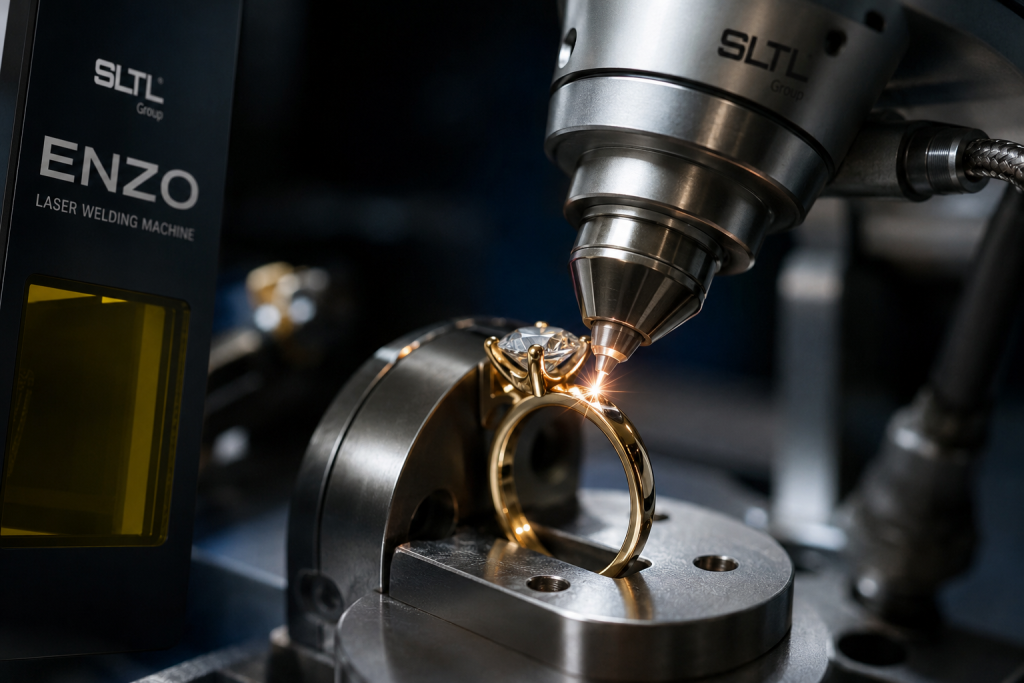
Ring repair and shank welding — crack repairs, sizing seams, and structural shank repairs on set pieces without stone removal.
Chain welding — precise link-to-link and clasp attachment welds at scales that the torch technique cannot handle consistently.
Prong retipping — adding weld metal to worn prong tips without heating the stone setting.
Bracelet assembly — joining link elements and clasp hardware in multi-element bracelet construction.
Bail and finding attachment — welding bails, jump rings, and ear posts to pendant and earring bodies with precision that avoids heating the main piece.
Fine welding samples — production test welds for quality validation before full collection runs.
It is also worth noting that laser welding does not operate in isolation in modern jewelry production. Cutting components — ring shanks, pendant profiles, earring elements — with precision laser cutting provides weld-ready parts with accurate joint geometry. After welding, laser marking applies to hallmarks, serial numbers, logo marks, and color marking samples that complete the piece’s brand identity and traceability record.
The full picture of how laser welding supports jewelry repair and production quality is explored in How Laser Welding Improves Jewelry Repair and Production Quality — essential reading for workshops and manufacturers evaluating a move to laser-based production.
Suggested videos embed here: A reel showing laser welding on a gold ring repair — prong retipping on a mounted stone, showing the focused weld point, no stone disturbance, and clean weld result. “Checkout the reels made by interns for posting on your blogs.”
Applications of Laser Welding in Jewelry Production
The laser welding vs soldering jewelry decision applies across a broader range of production applications than most workshops initially consider.
Luxury Jewelry Assembly
For luxury brands, every visible join is a quality statement. Laser welding produces joints that are virtually undetectable after light polishing — no color variation, no visible solder line, no mismatched surface finish. This is the assembly quality that luxury collections require, and that torch soldering rarely delivers consistently.
Hallmarking Support
After welding, pieces move to laser marking for hallmarking — applying legally compliant purity marks, maker marks, and serial numbers without mechanical contact or surface distortion. Furthermore, logo marking, ring interior branding, and name plate personalization complete the traceability and brand identity picture.
The combination of laser welding for assembly and laser marking for identification creates an integrated production workflow where every process step supports the quality and traceability of the finished piece. For jewelry brands evaluating laser marking alongside laser welding, the laser marking solutions for jewelry hallmarking and branding page covers the full range of marking options.
Custom and Bespoke Jewelry
Custom pieces often require assembly approaches that cannot be pre-planned. Laser welding flexibility — the ability to weld in tight spaces, at unusual angles, and on complex assemblies — makes it the natural tool for bespoke work where each piece presents unique joining challenges.
Rework Reduction in Production
In torch-based jewelry production, rework from soldering errors — solder flow into the wrong area. Joint failure from insufficient penetration, heat damage to adjacent elements — is a regular occurrence. Laser welding dramatically reduces the rework rate. Parameters are controlled. Heat stays at the weld point. Joints form consistently. Consequently, production rework costs fall, and throughput improves.
SLTL Laser Solutions for Jewelry Manufacturing
SLTL Group provides a complete range of laser processing systems for jewelry manufacturers — welding, cutting, and marking from a single solution provider with direct application engineering support.
Laser Welding Solutions
ENZO (up to 200W) — SLTL’s dedicated jewelry laser welding machine. Designed specifically for gold, silver, and platinum welding, with microscope-assisted viewing, precise pulse control, and shielding gas delivery. The right choice for jewelry workshops and repair studios where welding is the primary laser application.
Nova (200–500W) — Fully customizable laser welding platform for higher power requirements and specific production integration needs. Suitable for manufacturers with bespoke fixture requirements or higher-power welding applications.
Hertz — Handheld laser welding machine for repair work and applications where the workpiece cannot be brought to a fixed welding station. Portable, flexible, and suitable for on-bench repair environments.
Explore SLTL’s full range of laser welding machines for jewelry — from bench-top repair systems to production-integrated platforms.
Laser Cutting Solutions
Future X — Advanced laser cutting machine with smart automation features and precision cutting capability for premium jewelry component production. The right choice for manufacturers demanding maximum capability on complex designs.
Infinity F1 — High power laser cutting machine for heavy-duty metal processing and high-speed manufacturing. Suitable for thick jewelry material applications and mixed production environments.
IntegreX — Affordable laser cutting machine for small and medium jewelry manufacturers. Delivers precision cutting capability at an accessible acquisition cost — the practical entry point for workshops upgrading from mechanical cutting.
X5 — 3D laser cutting machine for complex three-dimensional jewelry parts and formed components where flat-plane cutting is insufficient.
Discover SLTL’s precision jewelry cutting solutions for fine component manufacturing.
Laser Marking Solutions
REX — Diode laser marking system for traceability marking applications. Compact and accessible for workshops, adding laser marking to existing production.
ELITE — Fiber laser system optimized for hallmarking applications. Produces legally compliant marks at consistent depth and geometry across production volume.
Flexy — Movable diode laser marking machine for difficult-to-fixture jewelry parts. Portable configuration brings the laser to the piece rather than the piece to the laser.
NEO — Fiber laser marking machine (20–60W) for multipurpose high-power marking — logo marks, serial numbers, Data Matrix codes — across all precious metal substrates.
Ultra — Fiber laser marking machine (20–120W) covering the full range of jewelry marking requirements from fine micro-text to high-power production marking on a single platform.
OptiFly — CO2 laser marking for plastic and packaging marking in jewelry accessories and presentation materials.
Carbon — CO2 laser marking system for alternative material marking applications within the jewelry production environment.
Upgrade Your Jewelry Production with SLTL Laser Technology
The laser welding vs soldering jewelry comparison has a clear answer for modern jewelry manufacturers. Laser welding delivers better precision, better finish quality, lower rework rates, and greater production consistency — on every application type where quality matters.
SLTL’s integrated laser welding, cutting, and marking solutions give jewelry manufacturers the complete production toolkit for premium manufacturing.
What SLTL laser welding delivers:
- Precision jewelry repair — sub-millimeter weld placement on rings, chains, prongs, and fine assemblies
- Cleaner weld quality — no flux residue, minimal HAZ, undisturbed adjacent surfaces
- Faster production — 3–8-minute repair cycles versus 15–30 minutes for equivalent torch work
- Luxury finish preservation — no heat discoloration, no solder color mismatch, no surface damage
- Better traceability — integrated marking for hallmarking and brand identification after welding
- Smart manufacturing — digital parameter control for consistent quality across production runs
- Reduced rework — consistent laser weld parameters eliminate the operator variability that torch soldering introduces
Contact SLTL today to discuss your jewelry welding application, request a sample weld on your specific metal, or identify the right machine for your workshop or production environment.
Conclusion
The laser welding vs soldering jewelry question comes down to what standard of quality, consistency, and efficiency a jewelry manufacturer needs from their joining process. Traditional soldering remains a practical skill for basic applications. However, for fine and luxury jewelry repair, production assembly, and any application where heat damage risk, solder color matching, or post-weld finishing time are production constraints, laser welding is the better technology by every measurable criterion.
Furthermore, laser welding delivers its full value as part of an integrated production system. Combined with precision laser cutting for component manufacture and laser marking for hallmarking, branding, and traceability, it supports the complete jewelry production workflow from raw precious metal to finished, marked, branded, luxury product.
SLTL’s laser welding, cutting, and marking solutions are built for this integrated approach — giving jewelry manufacturers the tools to produce at the quality level that luxury brands and discerning customers expect.
Frequently Asked Questions
Q1: Does laser welding damage gemstones in set jewelry?
When properly executed, laser welding does not damage gemstones. The heat-affected zone is extremely narrow and localized to the weld point. However, heat-sensitive stones — emeralds, opals, and treated stones — require careful beam placement away from the stone. The microscope viewing system on a jewelry laser welder allows precise positioning to ensure the beam stays on the metal, not the stone.
Q2: Is the weld quality from a laser welder as strong as a traditional solder joint?
Yes — and in most cases stronger. Laser welding produces base metal fusion at the joint, without introducing the solder alloy that torch soldering requires. The resulting joint has mechanical properties closer to the base metal than a solder joint, which always contains a lower-melting-point alloy that is typically weaker than the surrounding precious metal.
Q3: Can laser welding match gold color across different karat grades?
When welding without filler metal — direct base metal fusion — color matching is not a concern. The joint is the same metal as the piece. When filler wire is needed for gap-bridging or build-up applications, the wire is matched to the base metal alloy and karat. As a result, color matching in laser welding is inherently more accurate than the solder alloy selection required in torch soldering.
Q4: How long does a laser weld take on a standard ring repair?
A standard ring shank crack repair or prong retip typically takes 3–8 minutes under laser, including setup and finishing. The same repair by traditional soldering, including flux preparation, stone protection, execution, quench, cleaning, and post-polish, typically takes 15–30 minutes. The laser process is consistently faster with less preparation and post-processing.
Q5: Is laser welding cost-effective for small jewelry workshops?
Yes. SLTL’s ENZO provides an accessible entry point specifically designed for jewelry workshop environments. The key economic argument is speed — laser welding faster repair cycle means higher throughput on repair volume, directly improving revenue per hour. Furthermore, lower rework rates and eliminated consumables (flux, solder chips) reduce per-repair cost over time.

