
In today’s competitive manufacturing environment, precision, speed, and repeatability are essential. Traditional welding techniques like TIG and MIG have served industry for decades, but they often require high skill levels, generate excess heat, and involve significant post-processing time. This is where handheld laser welding machines are revolutionizing fabrication across sectors.
Whether you are a small fabrication shop or a large industrial manufacturer, understanding handheld laser welding technology can help you make smarter investment decisions and dramatically improve your manufacturing quality and efficiency.
What Is a Handheld Laser Welding Machine?
A handheld laser welding machine is a portable system that uses a highly focused laser beam to fuse metal parts together. Unlike stationary or CNC welding systems, the handheld laser welding machine gives operators the flexibility to weld complex assemblies, joints, and contours without fixed tooling.
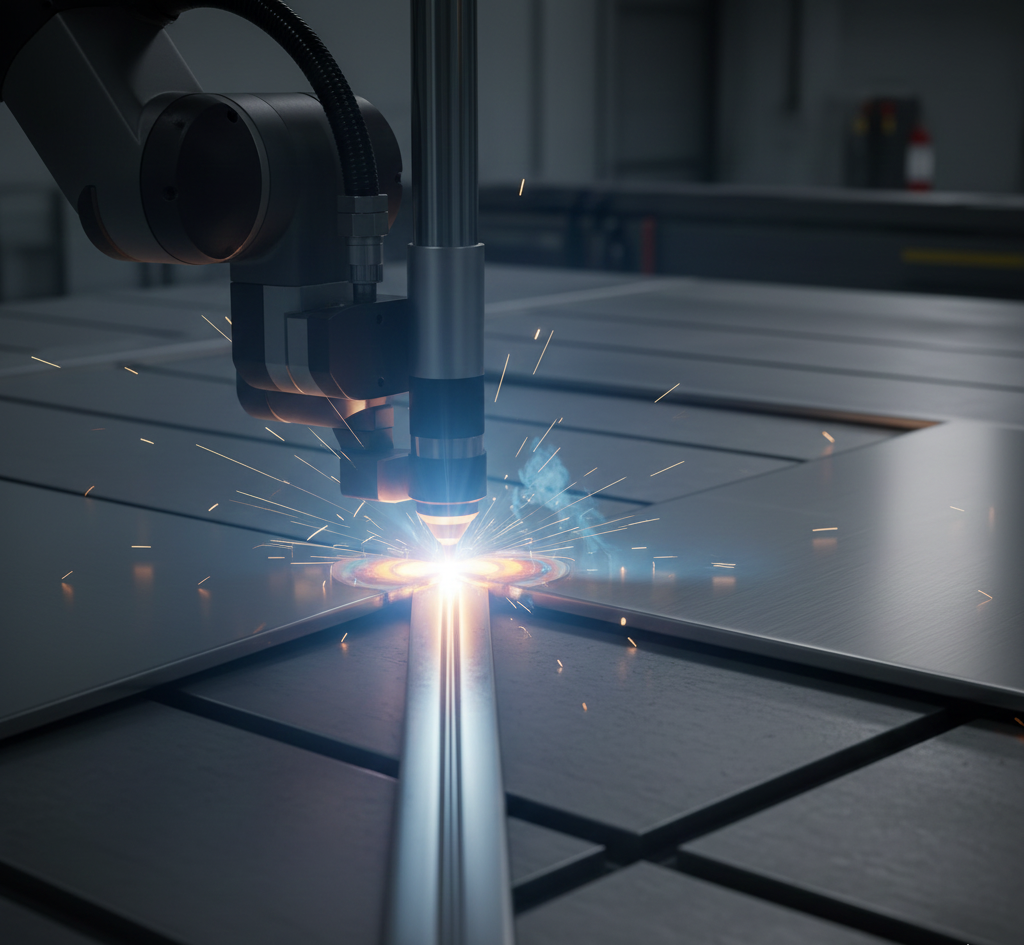
The key component in handheld systems is the laser welding head, which emits a concentrated beam of light that melts and fuses metal at the joint. This process is precise, fast, and produces minimal heat-affected zones (HAZ), making it suitable for a wide range of materials and fabrication tasks.
How Does Handheld Laser Welding Work?
Handheld laser welding operates on a simple but powerful principle — focusing a high-energy laser beam onto a small area of the metal surface to melt and join materials.
- Laser Generation:
A high-quality fiber laser source generates a coherent beam of near-infrared light. - Laser Delivery:
The laser beam is delivered to the handheld welding head via optical fiber or laser cable. - Beam Focusing:
The welding head focuses the beam into a tiny spot with high intensity. - Welding Action:
The focused beam melts metals at the joint where two pieces meet. Upon cooling, a strong weld is formed.
This precise energy delivery results in clean, strong, and consistent welds with minimal distortion and negligible spatter.
Why Choose a Handheld Laser Welding Machine?
Handheld laser welding machines are increasingly preferred over conventional welding for several reasons:
1. High Precision and Quality
Laser welding produces narrow weld seams with excellent fusion and minimal heat effect. This reduces the need for grinding, finishing, and rework.
2. Faster Welding Speed
Compared to TIG and MIG welding, laser welding is significantly faster, saving time and increasing throughput.
3. Reduced Heat-Affected Zone
The focused laser beam creates a small HAZ, reducing material distortion and improving dimensional stability.
4. Low Skill Barrier
Handheld laser systems are easy to operate, allowing semi-skilled operators to produce high-quality welds with minimal training.
5. Less Consumables
Laser welding eliminates the need for filler wires, flux, and large amounts of shielding gas, helping reduce operating costs.
6. Versatility
Handheld laser welders can join a wide range of metals: stainless steel, mild steel, aluminum, copper, brass, and even dissimilar metal combinations.
Common Materials Welded with Handheld Laser Welding Machines
Handheld laser welding machines are highly versatile and are used on:
- Stainless Steel: Automotive components, kitchen equipment, furniture
- Mild Steel (MS): Structural parts, fabrication, heavy metal assemblies
- Aluminum: Lightweight components, aerospace, automotive
- Copper & Brass: Electrical parts and decorative applications
- Galvanized Sheets: Sheet metal assemblies without burn-through
This broad capability makes them suitable for industries including automotive, aerospace, signage, heavy fabrication, electronics, and medical device manufacturing.
Typical Applications
Handheld laser welding machines add value to a wide array of manufacturing tasks:
- Automotive & EV Components: Battery trays, enclosures, brackets
- Sheet Metal Fabrication: Cabinets, racks, frames
- Furniture Manufacturing: Stainless steel structures, decorative joints
- Signage & Architectural Metalwork: Seamless curves and decorative panels
- Electrical Enclosures: Precise welds with minimal distortion
- Medical Devices: Small precision welds with superior quality
The flexibility and portability of handheld systems allow manufacturers to carry out complex welds directly on assemblies without repositioning or fixtures.
Safety Considerations
While handheld laser welding machines are safer than many traditional processes, proper safety measures are critical:
- Laser Safety Goggles: Protect operator eyes from laser exposure
- Shielding Curtains: Prevent stray beams in the workspace
- Ventilation: Extract fumes and particulates
- Operator Training: Ensure correct handling and movement
Handheld laser systems must comply with industry safety standards to ensure operator protection and production safety.
Advantages over Traditional Welding
Here’s how handheld laser welding compares to conventional welding processes:
| Feature | Handheld Laser Welding | TIG/MIG Welding |
|---|---|---|
| Weld Speed | High | Moderate to Slow |
| Heat-Affected Zone | Small | Large |
| Weld Finish | Smooth & Clean | Often Requires Grinding |
| Operator Skill | Moderate | High |
| Consumables | Minimal | High |
| Distortion | Low | Moderate to High |
This comparison shows why handheld laser welding machines are rapidly replacing traditional welding methods in industrial fabrication.
Integration with Automation
Many handheld laser welding systems can be combined with rotators, fixtures, and manipulators to improve consistency and reduce operator dependency for repetitive parts. This hybrid approach enables production units to maintain flexibility while adding speed and accuracy.
For high-volume manufacturing, handheld systems can be paired with robotic arms for automated motion control, further enhancing productivity.
Choosing the Right Handheld Laser Welding Machine
Selecting the right handheld laser welding machine involves evaluating:
1. Laser Power Requirement
Higher power units weld thicker materials faster, whereas lower power units are ideal for thin sheets and precision work.
2. Material Type
Different metals absorb laser energy differently. Ensure the machine supports all required material types.
3. Cooling System
Laser systems use air cooling or water cooling. Water-cooled units perform better under continuous use.
4. Service & Support
Choose a manufacturer with strong after-sales support, service availability, and technical training.
5. Total Cost of Ownership
Look beyond the initial price—consider consumables, energy efficiency, and long-term reliability.
Maintenance and Lifecycle
Handheld laser welding machines are designed for durability, but regular maintenance ensures optimal performance:
- Clean laser optics and protective windows
- Check cooling system regularly
- Inspect cables and welding head
- Keep software and firmware updated
A proactive maintenance plan increases uptime and reduces unexpected repairs.
Why SLTL Handheld Laser Welding Machines Are Trusted
SLTL Group is one of India’s most respected manufacturers of laser systems. The handheld laser welding machines offered by SLTL are:
- Built with industrial-grade fiber laser sources
- Engineered for Indian manufacturing conditions
- Backed by strong service and support across India
- Easy to operate with operator training included
SLTL machines ensure consistent weld quality and performance across diverse applications.
Conclusion
The handheld laser welding machine is a transformative tool for modern fabrication, offering speed, precision, and flexibility that traditional welding methods cannot match. Whether you are a small workshop, an MSME, or a large industrial manufacturer, handheld laser welding machines help streamline production, improve product quality, and reduce overall cost of ownership.
With the right configuration and support, handheld laser welding technology can elevate your manufacturing processes to a higher standard of efficiency and accuracy.