
In today’s fast-evolving industrial landscape, manufacturers are under immense pressure to deliver superior quality, faster production cycles, and higher precision while keeping operational costs in check. To meet these demands, many industries are transitioning from conventional welding processes—such as MIG, TIG, and arc welding—to advanced laser welding machines.
Laser welding is no longer a futuristic concept. It has become a mainstream technology across automotive, aerospace, fabrication, electronics, EV battery assembly, medical devices, and general engineering applications. The shift toward laser-based joining systems is driven by unmatched accuracy, higher productivity, minimal heat input, aesthetic weld quality, and significantly reduced post-processing.
This blog explores why laser welding machines are rapidly replacing traditional welding methods and why so many industries now prefer this cutting-edge technology.
1. Laser Welding Offers Unmatched Speed and Productivity
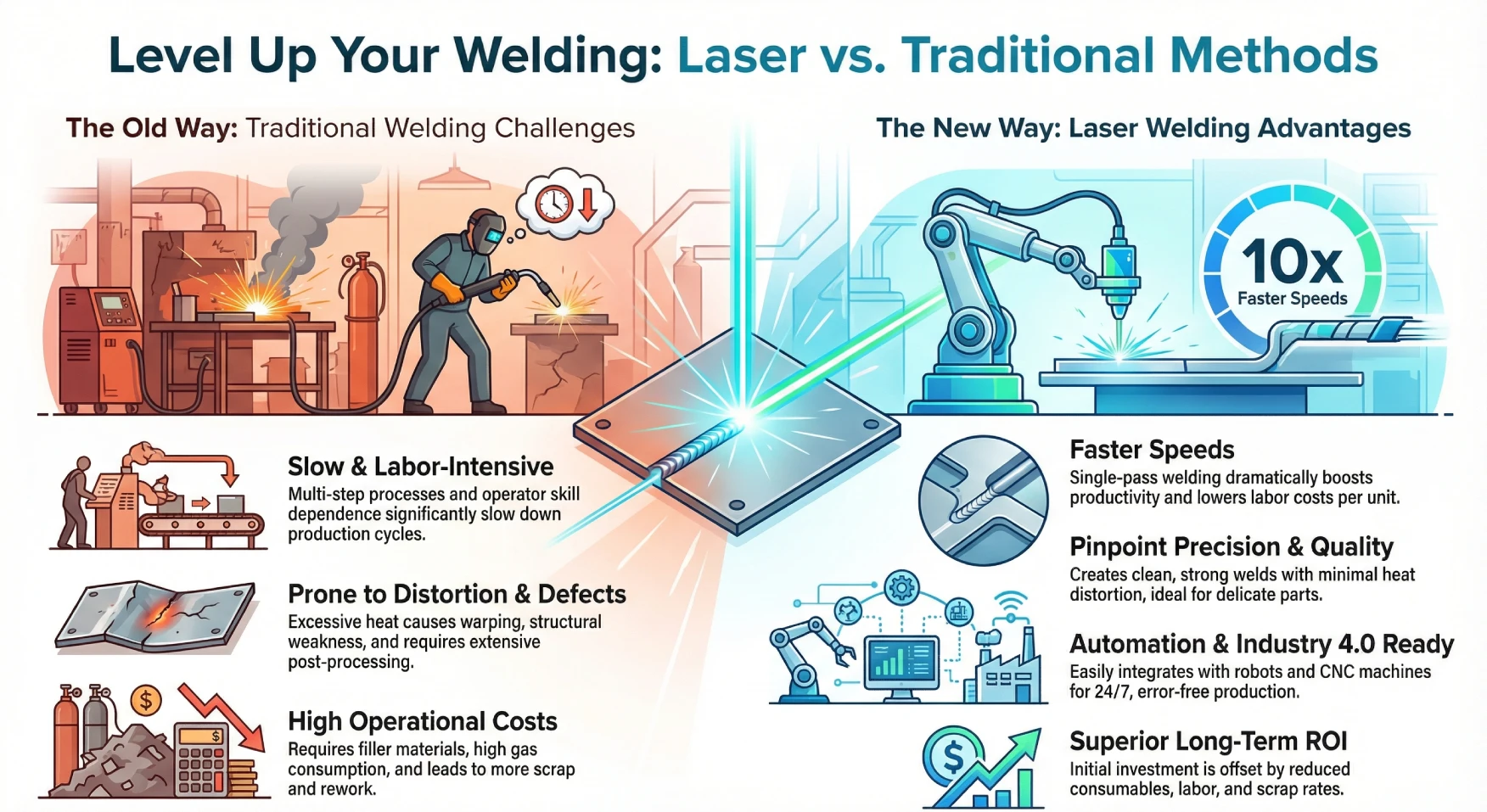
Traditional welding methods require multi-step processes such as edge preparation, filler material, penetration adjustments, and extensive finishing. These steps slow down production, especially in high-volume industrial settings.
A laser welding machine, however, delivers:
- Up to 4–10 times faster welding speeds than TIG/MIG
- Single-pass welding, even on thicker materials
- Minimal setup time
- High-cycle continuous welding without operator fatigue
Because laser energy is precisely concentrated, welding becomes extremely efficient. Manufacturers can process more components in less time, significantly improving throughput and lowering labor costs.
2. Precision and Accuracy That Traditional Welding Cannot Match
Laser welding produces highly focused heat, enabling pinpoint accuracy at micron-level precision. Unlike MIG or TIG welding, the laser beam does not spread out or deform surrounding areas.
This results in:
✔ Cleaner welds
✔ Narrower heat-affected zones (HAZ)
✔ Minimal distortion
✔ Perfectly consistent welds across batches
High-precision industries such as electronics, aerospace, EV batteries, and medical device manufacturing rely heavily on this accuracy to maintain strict quality standards.
3. Minimal Heat Input = Less Warping & Better Aesthetics
One of the biggest pain points of traditional welding is heat distortion. Excessive heat causes bending, warping, and structural weakness, especially in thin sheets and delicate components.
Laser welding applications benefit from:
- Very low heat input
- Faster heat dissipation
- Minimal thermal deformation
- Smooth, aesthetic weld seams
This eliminates expensive rework and reduces the need for grinding, polishing, and post-processing. Many industries choose laser welding because the final output is visually superior and structurally stronger.
4. Supports a Wide Range of Metals and Combinations
Traditional welding often struggles with reflective or dissimilar metals. In contrast, modern laser welding machines can join:
- Stainless steel
- Mild steel
- Aluminum
- Brass
- Copper
- Titanium
- Nickel alloys
- High-strength and thin materials
Laser welding is also ideal for dissimilar joints such as copper + aluminum, which is essential in EV batteries, motors, and electrical components.
This versatility is one of the reasons why manufacturers across all sectors are shifting to laser welding technology.
5. Reduced Material and Operational Costs
Although the laser welding machine price may seem higher than TIG or MIG equipment, the long-term operational savings far outweigh the initial investment. Key cost-saving advantages include:
✔ No filler material required
✔ Lower gas consumption
✔ Reduced post-processing
✔ Less scrap and rework
✔ Higher productivity per hour
✔ Lower manpower cost
✔ Longer equipment lifespan
Additionally, modern handheld laser welding machines require no complex fixtures or consumables, reducing ongoing expenses and improving overall profitability.
6. Laser Welding Is Perfect for Automation & Industry 4.0
Laser welding systems are easily integrated into:
- Robots
- CNC machines
- Production lines
- Automated fixtures
- Smart Industry 4.0 cells
Automation improves speed, consistency, and safety. Traditional welding, however, depends heavily on operator skill and experience, making it harder to scale.
With laser welding, manufacturers achieve:
✔ Consistent quality
✔ Zero human error
✔ Continuous 24×7 production
✔ Real-time monitoring and analytics
This ability to automate welding processes is a major reason industries are replacing conventional welding setups.
7. Better Safety and Operator Comfort
Traditional welding methods expose operators to:
- High-intensity arc light
- Harmful fumes
- Excessive heat
- Spatter and sparks
- Complex PPE requirements
A laser welding machine, especially handheld models, provides:
- Controlled, directional heat
- No sparks or excessive fumes
- Lower risk of burns
- Easier operation
- Safer working conditions
With less strain and fewer hazards, operators experience improved comfort and efficiency.
8. Ideal for EV Battery and Advanced Manufacturing
Modern industries like EV and aerospace have extremely strict welding standards. Laser welding is preferred for:
- EV battery trays
- Battery busbars
- Aluminum housings
- Motor parts
- Fuel cells
- Aerospace brackets
- Precision electrical components
Traditional welding cannot match the speed, accuracy, and low heat distortion required for these parts.
Laser welding machines offer:
✔ Micro-precision welding
✔ Clean seam appearance
✔ Low heat input
✔ High repeatability
This makes them indispensable in next-generation manufacturing.
9. Long-Term ROI That Outperforms Traditional Welding
Despite the initial laser welding machine price, manufacturers enjoy:
- Fast return on investment
- Higher productivity
- Dramatically lower rejection rates
- Reduced labor dependency
- Better-quality output
- Lower consumable expenses
Within months, companies often recoup their investment due to improved efficiency and reduced operational costs.
10. Laser Welding Machines Are Easier to Learn and Use
Unlike TIG welding, which requires years of skill and practice, modern handheld laser welding machines are simple and intuitive.
A new operator can master the machine in just a few hours.
This lowers training costs and ensures consistent output, even with inexperienced operators.
Conclusion: Laser Welding Is the Future of Industrial Fabrication
As industries move toward automation, precision, and higher productivity, it’s clear why the laser welding machine has become the preferred welding technology across sectors. Its ability to deliver fast, clean, accurate, and consistent welds with minimal effort has revolutionized manufacturing.
Whether you’re in automotive, aerospace, fabrication, electronics, or EV battery production, investing in a laser welding solution can dramatically enhance efficiency and profitability.
Yes, the laser welding machine price is higher compared to traditional methods, but the long-term gains—reduced labor, faster production, lower scrap rates, and exceptional weld quality—make it an investment worth every penny.
Laser welding isn’t just replacing traditional welding.
It is redefining the future of fabrication.