
The pharmaceutical industry is standing at the crossroads of innovation and necessity. As global demand for medicines grows and regulatory pressure intensifies, pharma manufacturers are embracing the transformative power of IoT, AI, and laser technology to meet evolving expectations.
This fusion of digital and hardware innovation is not just about upgrading machines—it’s about building a smarter, faster, and more compliant ecosystem. Welcome to the age of Pharma Industry 4.0.
Why the Pharma Industry Needs a Tech Overhaul
Let’s be honest—traditional pharma manufacturing systems were not built for today’s pace. Batch processes, manual documentation, and reactive maintenance models can no longer keep up with rising complexity, especially when precision, traceability, and speed are mission-critical.
Compliance frameworks like US DSCSA and EU FMD demand traceability in pharma—right from raw material to the consumer’s hand. Add the challenge of product recalls, temperature-sensitive logistics, and zero-tolerance for error, and the need for pharmaceutical automation becomes undeniable.
IoT in Pharmaceutical Industry: Real-Time Visibility & Predictive Control
Ever wondered how pharma factories could “talk” to operators?
Thanks to the Internet of Things (IoT), manufacturing lines are now embedded with smart sensors and cloud-connected devices that continuously monitor and report production parameters. Whether it’s tracking ambient temperature for a sensitive drug or real-time logging of machine efficiency, connected pharma systems offer manufacturers unparalleled control.
Key benefits include:
- Predictive maintenance (fix before it breaks)
- Energy optimization
- Real-time data dashboards
- Inventory automation and asset tracking
IoT-enabled environments aren’t just efficient—they’re compliance-ready by design.
Artificial Intelligence in Pharma: From Automation to Optimization
Data is everywhere in a pharmaceutical plant—but are you using it to your advantage?
AI in pharma manufacturing is no longer a concept—it’s a competitive edge. From controlling micro-dosing accuracy to detecting anomalies in tablet coating, machine learning in pharmaceutical production is improving output quality and minimizing wastage.
Real-world applications include:
- Defect detection using computer vision
- AI-assisted process design and formulation modeling
- Batch forecasting and inventory planning
- Smart alerts for deviation management
Pair AI with IoT, and you unlock a dynamic duo—one senses, the other analyzes.
Laser Technology in Pharma: Precision Marking, Cutting & Quality Assurance
Think lasers are just for industrial metal cutting? Think again.
In pharma, laser technology has revolutionized everything from packaging to compliance. One of the most critical applications is laser marking for medicines—a process that permanently marks blister packs, vials, and cartons with QR codes, barcodes, and batch numbers. This enables true serialization in pharmaceuticals—a must-have for anti-counterfeit compliance.
Why are laser marking systems preferred?
- Contactless & hygienic
- Permanent & tamper-proof
- Zero consumables (unlike inkjet)
- High-speed integration on on-the-fly production lines
And it’s not just about marking. Laser cutting technology is also being used in the precision fabrication of medical device housings and cleanroom-safe packaging.
The Intersection: Smart, Compliant & Scalable Pharma Factories
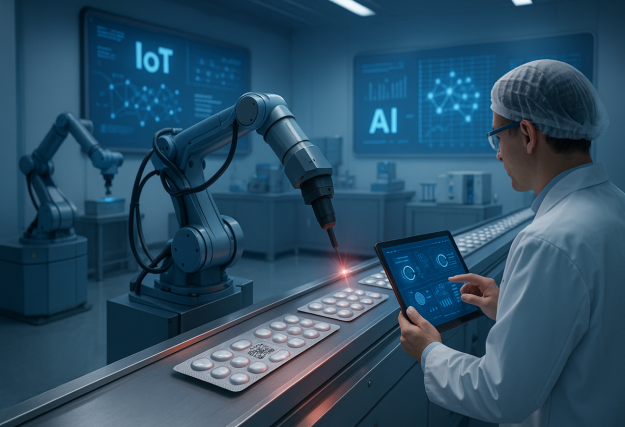
Here’s where the magic happens: when IoT, AI, and laser technology come together, you get an intelligent manufacturing ecosystem that’s self-aware, adaptive, and compliant.
Imagine a laser machine on the shop floor that can:
- Self-adjust based on real-time sensor data
- Alert you of wear before breakdown
- Integrate with ERP/MES to auto-log data for audits
- Seamlessly encode serialization data on each unit
This is not the future—it’s happening today in factories embracing Pharma 4.0.
Such a setup supports:
- Digital twins of the production floor
- Closed-loop feedback systems
- Remote monitoring and control
- Scalability across geographies
Real-World Implementation: What It Takes
Of course, this shift doesn’t happen overnight.
It starts with investing in future-ready equipment—modular systems that support laser integration, cloud connectivity, and AI-ready controls. It also requires collaboration with vendors who understand the specific compliance needs of pharmaceutical production.
Key considerations:
- Validation-ready automation tools
- Machines built for 21 CFR Part 11 compliance
- Integration with LIMS, SCADA, and ERP
- User-friendly dashboards for shop-floor operators
Most importantly, companies are opting for customizable laser and automation systems that can grow with their facility.
A Smarter, Safer, Scalable Tomorrow
Pharma manufacturing is no longer just about churning out pills—it’s about producing precision-driven, traceable, and quality-assured products at scale.
By blending IoT, AI, and laser technology, modern manufacturers are building factories that think, adapt, and deliver with excellence.
The question is—are you ready to step into the future of pharmaceutical manufacturing, or will you be left behind?