
In today’s fast-evolving maritime industry, building a ship is no longer just about steel and sweat—it’s about precision, speed, and technology. From initial design to open-sea maintenance, laser technology is transforming how vessels are built, assembled, and maintained. Whether you’re managing a bustling shipyard or operating a global shipping fleet, lasers are now a vital tool across the entire ship lifecycle.
Let’s dive into how laser systems power every stage of the journey—from yard to sea.
Precision at the Blueprint Stage: Design & Planning
Before the first plate is cut, shipbuilding begins with planning—and lasers are helping get it right from the start.
3D laser scanning captures detailed layouts of existing ship structures and docks. These scans are fed into CAD/CAM software to create highly accurate digital models. This ensures that every cut, bend, or weld planned during pre-production is based on real-world dimensions—minimizing human error and optimizing material usage.
High-Precision Cutting: Fabrication in the Shipyard
One of the most visible uses of laser technology in shipbuilding is in laser cutting, where sheets of steel or aluminum are sliced with extreme precision.
Unlike plasma or flame cutting, fiber laser cutting machines offer:
- Cleaner edges without post-processing
- Minimal thermal distortion
- Faster cutting speeds
- Lower material wastage
Applications include cutting hull panels, bulkheads, stiffeners, and even pipe ends—all of which require high structural integrity.
Seamless Integration: Laser Welding & Assembly
Welding is the backbone of ship construction—and laser welding is pushing the boundaries of what’s possible.
Laser welding creates deep, narrow welds with minimal heat input. This reduces thermal damage and distortion, making it ideal for:
- Joining curved surfaces and thin sections
- Automation through robotic laser welding systems
- Working in confined areas in ship interiors or double hulls
Compared to traditional MIG/TIG welding, laser systems deliver faster throughput, especially in repetitive assembly tasks.
Permanent Traceability: Laser Marking for Compliance & Control
Every ship component must be traceable—not just for quality, but also for compliance with maritime standards and after-sales support.
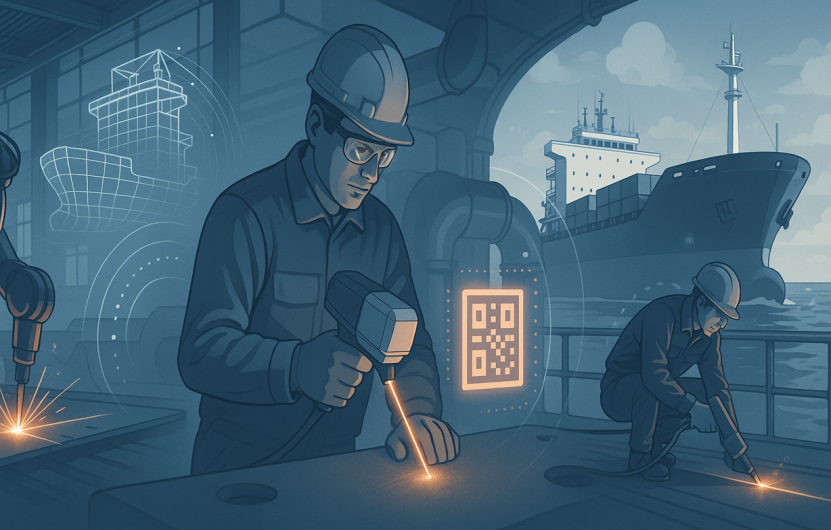
Laser marking offers a fast, non-contact method to engrave:
- Part numbers
- QR codes
- Serial IDs
- Certification tags
Because these marks are permanent, corrosion-resistant, and readable even after years of exposure to harsh marine environments, they’re perfect for ship components, engine parts, and even electrical panels.
Maintenance at Sea or in Dock: Laser Cleaning & Mobile Repair
Ship maintenance is often costly and time-consuming, especially during dry dock. Handheld laser cleaners now offer a faster, safer way to remove:
- Rust
- Old coatings
- Grease and oil layers
Laser systems can also support in-situ marking and micro-cutting during emergency repairs—whether on deck or below.
Benefits include:
- No use of chemicals or abrasives
- Reduced manpower and time
- Less waste generation
A Greener Future: Sustainability and Waste Reduction
Laser systems are inherently more energy-efficient and waste-reducing than many conventional shipbuilding methods. Here’s how:
- Optimized nesting software with laser cutters minimizes material waste
- Clean energy usage supports green certification goals
- No consumables like electrodes or cutting gases
For shipyards moving toward sustainable manufacturing and retrofitting older vessels, laser technology is a key enabler.
Sailing into the Future with Laser Technology
From the blueprint table to the open sea, laser technology has become indispensable in modern shipbuilding. It brings precision, durability, and cost-efficiency to every phase of the ship lifecycle.
As the industry continues to evolve with smart shipyards and digital twins, lasers will be at the core—driving innovation, reducing risks, and delivering better ships, faster.
If you’re in the shipbuilding business, it’s time to think laser. Because building ships isn’t just about steel anymore—it’s about precision from yard to sea.