

I. Introduction:
Traditional mold-making techniques, like CNC machining and casting, have long been the backbone of the manufacturing industry. However, these processes can be time-consuming, wasteful, and limited when it comes to producing complex geometries. As market demands shift toward customization, speed, and precision, manufacturers are exploring more advanced approaches. Enter hybrid manufacturing—a powerful blend of 3D printing (additive manufacturing) and CNC machining (subtractive manufacturing). This combined method is quickly gaining traction in the mold-making industry for its ability to streamline production, enhance precision, and reduce costs. In a landscape where innovation defines success, embracing hybrid manufacturing is becoming essential for those seeking a competitive edge.
II. Understanding Hybrid Manufacturing:
At its core, hybrid manufacturing is the strategic integration of two complementary technologies:
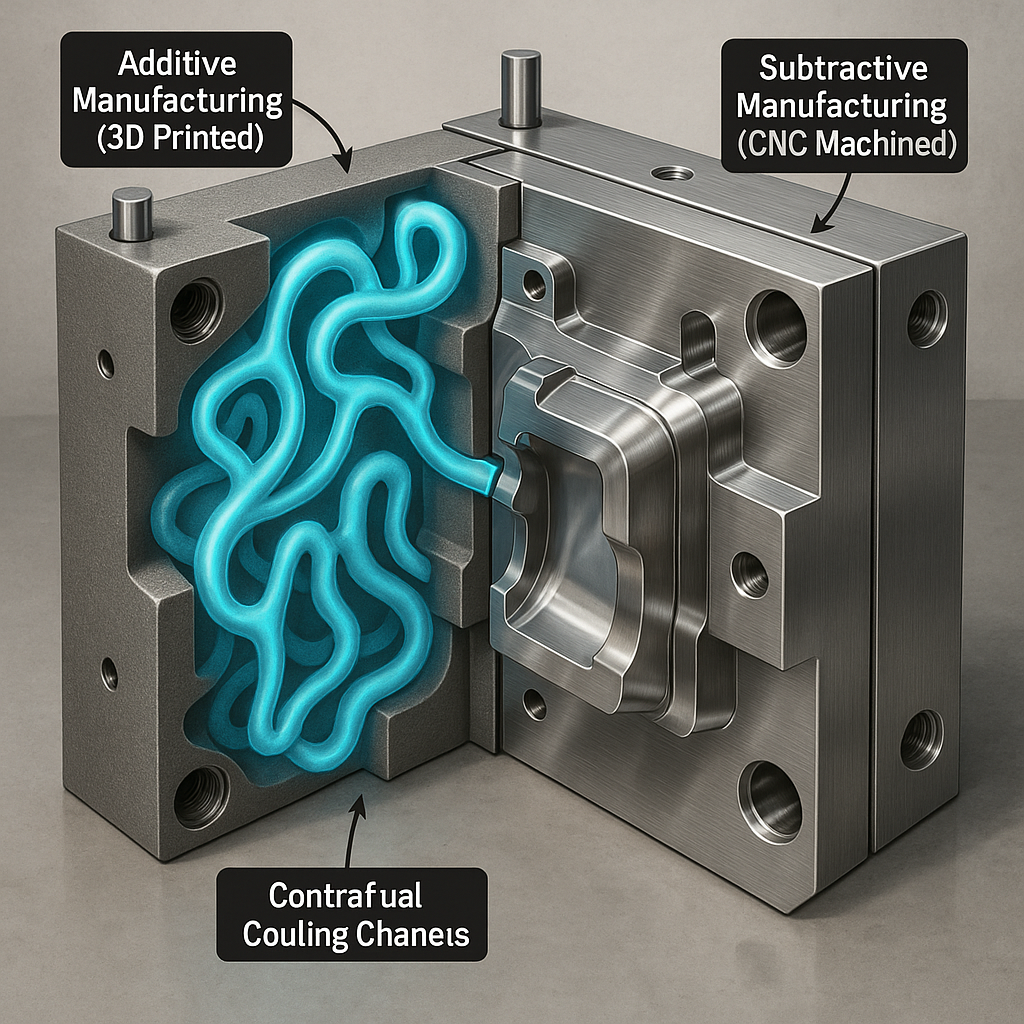
- Additive Manufacturing (3D Printing): This process builds objects layer by layer from a digital model, allowing manufacturers to produce complex internal features and customized components with less material waste.
- Subtractive Manufacturing (CNC Machining): A traditional technique that removes material from a solid block to achieve tight tolerances and superior surface finishes.
By merging these two technologies, hybrid manufacturing combines the best of both worlds—complex geometry and high precision. This synergy unlocks new design possibilities while maintaining the mechanical strength and finish required in production-grade molds. Notably, this method enables manufacturers to overcome the limitations of each standalone technique by leveraging their individual strengths within a single streamlined process.
III. Advantages of Hybrid Manufacturing:
For Mold Making Hybrid manufacturing brings a range of benefits that directly address the challenges in traditional mold-making:
- Design Flexibility: 3D printing enables the creation of intricate internal geometries like conformal cooling channels, which are impossible to machine using traditional methods. This allows for better thermal management and improved product quality.
- Precision and Surface Finish: After printing the basic geometry, CNC machining can be used to refine the mold surfaces to tight tolerances and a high-quality finish, ensuring they meet functional and aesthetic requirements.
- Time Efficiency: Hybrid manufacturing significantly reduces the total lead time for mold production by consolidating steps, especially for prototyping and custom runs. Design iterations can be tested and finalized in a shorter time frame.
- Material Optimization: Additive processes use material only where needed, minimizing waste. CNC machining then polishes and refines only necessary surfaces. This targeted approach results in a more sustainable and cost-effective production process.
- Cost Benefits: While upfront investment in hybrid equipment might be higher, overall tooling and iteration costs are reduced due to faster turnaround and less manual labor. Additionally, less reliance on multiple machines and tooling setups translates into lower overhead costs.
IV. Workflow: How 3D Printing and CNC Machining:
Work Together The hybrid manufacturing workflow typically follows these steps:
- CAD Design: The mold is designed digitally, taking into account both additive and subtractive manufacturing constraints. The integration of design for manufacturing (DFM) principles ensures optimal geometry and structural integrity.
- 3D Printing: A metal 3D printer builds the base structure, including complex features such as internal channels. Depending on the design, either Directed Energy Deposition (DED) or Powder Bed Fusion (PBF) techniques may be used.
- CNC Machining: The part is then transferred to a CNC machine to mill surfaces, ensure dimensional accuracy, and refine fine details. This stage ensures that the mold meets critical tolerances for operational use.
- Post-Processing: Additional steps such as heat treatment, surface polishing, stress relief, or coating may follow, depending on the final application.
- Digital Integration: CAM software manages toolpaths and process transitions, ensuring seamless execution. Integration with digital manufacturing platforms allows for real-time monitoring, feedback, and process optimization.
This integrated process allows for efficient production of molds that are both functionally superior and cost-effective, enabling faster go-to-market cycles.
V. Applications in Next-Gen Mold Making Hybrid manufacturing :
It is being adopted across various sectors for its adaptability and performance. Key applications include:
- Injection Molds with Conformal Cooling: Improve cooling efficiency, reduce cycle time, and enhance product quality. These molds support consistent temperature control, reducing defects and warpage in plastic parts.
- Aerospace and Automotive Tooling: Ideal for creating strong, lightweight, and complex molds used in demanding environments. The ability to produce robust yet intricate parts reduces fuel consumption and boosts performance.
- Rapid Tooling and Bridge Production: Facilitates the fast creation of prototype molds and short-run production tools, reducing time-to-market for new products. This is especially critical in industries like consumer electronics and medical devices.
- Customized Mold Inserts: Enables mold makers to fabricate tailored inserts for multi-cavity tools or multi-material applications.
VI. Challenges and Considerations:
Despite its advantages, hybrid manufacturing also comes with certain challenges:
- Equipment Investment and Training: Requires purchasing hybrid-capable machines and upskilling staff to operate both 3D printing and CNC tools effectively.
- Workflow Compatibility: Seamless data and process integration between additive and subtractive stages is crucial. Incompatibilities in software, hardware, or design workflows can cause bottlenecks.
- Material Constraints: Not all materials are suited for hybrid processes, and some may require specific post-processing to meet application standards. Understanding material behavior during additive and subtractive phases is essential.
- Process Validation: Hybrid methods may need new quality control strategies and certifications, especially in regulated industries like aerospace and healthcare.
Manufacturers must carefully evaluate these factors and develop a phased adoption strategy that includes training, pilot projects, and ROI analysis.
VII. Future Outlook:
The future of hybrid manufacturing is bright, with advancements expected in several key areas:
- AI and Automation: AI-powered CAM software will further optimize hybrid operations, reducing human error and setup time. Predictive algorithms can anticipate wear, recommend tool changes, and optimize part orientation.
- Evolving Materials: New metal powders and composites tailored for hybrid use will expand possibilities, enabling parts with higher performance, thermal resistance, and corrosion protection.
- Fully Integrated Systems: The emergence of autonomous hybrid cells—machines capable of both printing and machining in a single setup—will dramatically increase productivity and consistency. These systems will also offer advanced sensors and in-process quality assurance.
- Digital Twin Integration: Connecting hybrid manufacturing systems with digital twins will enable real-time simulation, performance monitoring, and lifecycle forecasting for molds and tools.
As these innovations mature, hybrid manufacturing will become more accessible and transformative, empowering manufacturers to operate smarter and faster.
VIII. Conclusion:
Hybrid manufacturing represents a powerful evolution in mold-making. By harnessing the strengths of both 3D printing and CNC machining, manufacturers can produce high-performance, precision molds faster and more affordably. From design flexibility and enhanced cooling to reduced lead times and costs, the benefits are compelling. Real-world applications across industries—from automotive to medical—demonstrate that this approach is not just experimental but commercially viable.
As industries push toward smarter, faster, and more customized production, hybrid manufacturing offers a future-proof path for mold makers ready to lead the next wave of innovation. Those who invest today in hybrid technologies are not only solving current challenges but also laying the groundwork for a more agile and competitive manufacturing ecosystem.


