
Why Does Mold Manufacturing Matter in Aerospace?
In the high-stakes world of aviation and spaceflight, every gram of weight and every micron of tolerance counts. That’s why aerospace mold manufacturing has emerged as a vital field. Molds are no longer just tools—they are precision engineering assets that directly influence aircraft performance, cost, and safety. As airframes evolve and space exploration intensifies, aerospace companies are making significant investments in advanced tooling to stay competitive.
1. What Challenges Are Driving Tooling Innovation in Aerospace?
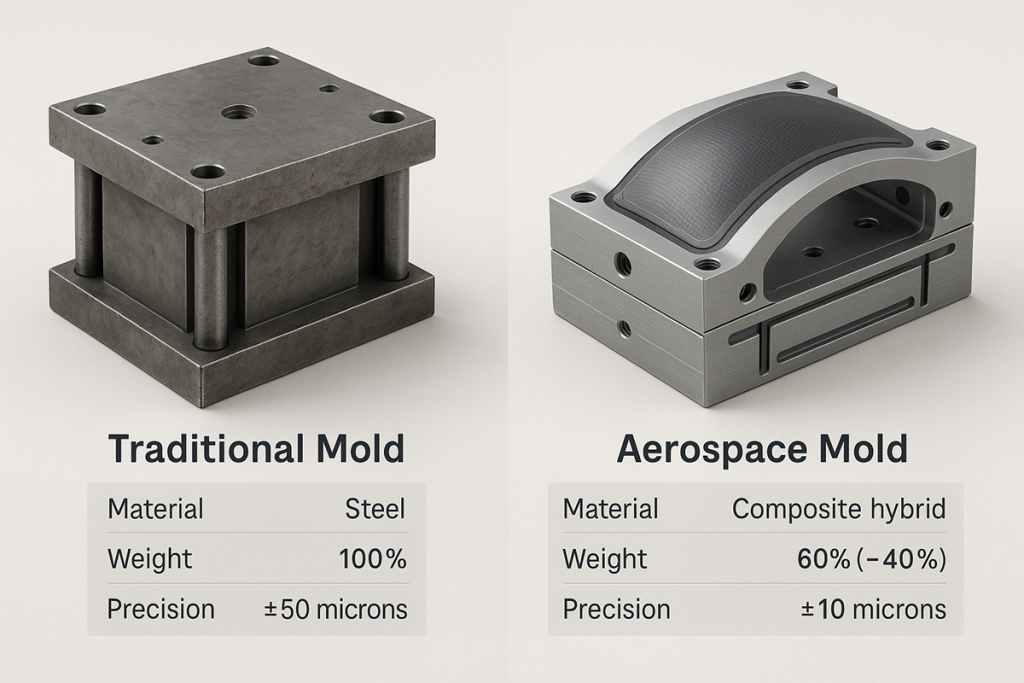
Modern aerospace components demand lightweight construction, exceptional strength, and flawless accuracy. Traditional metal molds, while strong, often fail to meet the requirements for the newest materials and complex geometries. Today, mold manufacturers must innovate to meet demands for reduced weight, increased thermal stability, and intricate detail replication.
High-precision in aerospace isn’t just about tight tolerances; it’s about ensuring perfect fitment in systems where even the smallest defect can cause catastrophic failure. As a result, mold tooling must deliver both ultra-fine detail and consistency at scale.
2. Why Are Composites Becoming the New Standard?
Aerospace industries are increasingly relying on composite materials for aircraft and space vehicle parts. Carbon fiber-reinforced polymers (CFRP), fiberglass, and Kevlar are some of the most commonly used composite materials. They offer a superior strength-to-weight ratio, resistance to corrosion, and enhanced fatigue performance.
This shift has major implications for mold design. Composite tooling for aircraft must accommodate the unique curing processes, heat cycles, and pressure requirements of these materials. In many cases, traditional mold materials can’t withstand the thermal expansion or chemical interaction with composites, leading to the rise of specialized mold solutions.
3. How Are Mold Manufacturers Achieving High Precision and Low Weight?
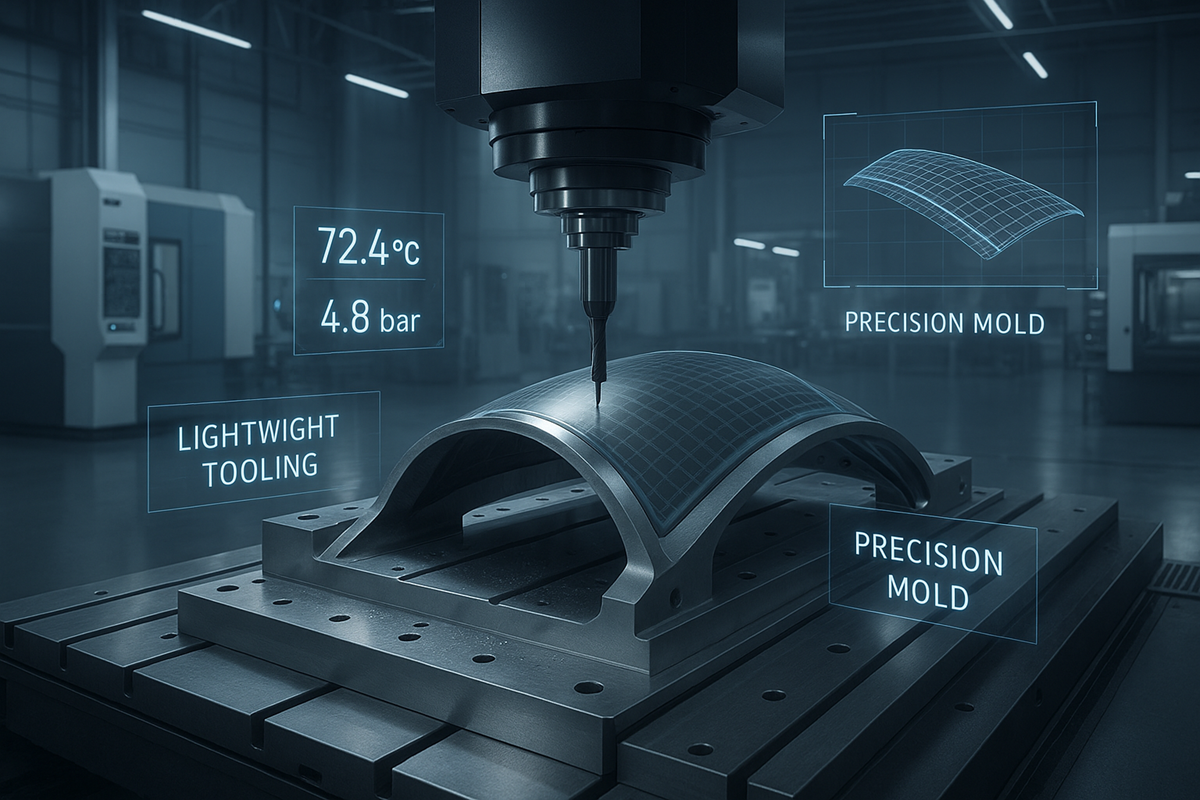
To meet aerospace standards, manufacturers are embracing advanced CNC machining and 5-axis milling. These technologies allow for the creation of complex geometries with extreme precision, often down to a few microns. CNC systems integrated with CAD/CAM platforms enable digital control over every tool path, ensuring consistency and repeatability.
In addition, additive manufacturing (AM), or 3D printing, is playing a growing role in mold production.AM allows for the design of conformal cooling channels and lightweight inserts, which would be unachievable through subtractive techniques. For prototyping or short-run aerospace tooling, 3D-printed molds can save time and material.
4. What Are Hybrid Molds—and Why Are They Gaining Popularity?
Hybrid molds combine multiple materials, such as aluminum alloys and ceramic coatings or steel and carbon composites, to optimize performance. These molds are engineered to handle the extreme heat, pressure, and complex part geometries required in aerospace manufacturing.
By combining lightweight materials with high-strength elements, hybrid molds achieve the durability of traditional molds without the associated weight. Their ability to maintain dimensional stability under rapid thermal cycling makes them ideal for producing composite parts used in high-speed or high-altitude environments.
5. How Are Boeing and SpaceX Leveraging New Mold Technologies?
Major aerospace firms like Boeing and SpaceX are already investing heavily in next-generation mold tooling. Boeing’s suppliers are adopting hybrid mold systems to improve turnaround times and part quality. SpaceX, with its rapid development cycles, benefits from molds produced via additive manufacturing and automated CNC.
Both companies are also exploring smart mold technology—molds embedded with sensors that monitor temperature, pressure, and curing cycles in real time. This allows for immediate adjustments and quality control, reducing defect rates and increasing throughput.
6. What Obstacles Do Mold Makers Face in Aerospace Applications?
Despite the promise of new technologies, aerospace mold manufacturing remains complex and costly. Each mold must often be certified for specific applications, and quality assurance processes are rigorous. Tolerances are tighter, testing is more frequent, and documentation is exhaustive.
Moreover, aerospace components are often produced in low volumes, making cost amortization difficult. The need for specialized materials, such as Invar or high-performance polymers, further raises production expenses. Certification standards from organizations like the FAA or ESA add layers of compliance that manufacturers must navigate.
7. What’s Next for Aerospace Mold Manufacturing?
The aerospace tooling of future will be through digital transformation. AI-driven mold design is becoming more widespread, allowing engineers to simulate material flow, heat distribution, and stress points before production even begins. This significantly reduces trial-and-error and speeds up time-to-market.
Digital twins—virtual replicas of molds—are now used to predict mold behavior over time, aiding in preventive maintenance. Meanwhile, IoT-enabled smart molds are already beginning to transform aerospace production lines by feeding real-time data to factory control systems, enabling adaptive manufacturing and predictive analytics.
Conclusion: How Can Manufacturers Prepare for the Future of Aerospace Tooling?
To stay competitive in the evolving aerospace landscape, mold manufacturers must embrace innovation. Investing in high-precision CNC systems, exploring composite and hybrid mold materials, and integrating smart technologies are no longer optional—they are essential.
Key takeaways include:
- Aerospace mold manufacturing is vital for ensuring the performance and safety of modern aircraft and spacecraft.
- Composite tooling for aircraft is redefining how molds are designed and used.
- The benefits of composite molds for aircraft parts include weight reduction, increased strength, and better fatigue resistance.
- Hybrid molds and additive manufacturing are creating new standards in mold efficiency and flexibility.
By adapting to these trends and aligning with aerospace quality standards, mold makers can play a critical role in shaping the future of flight—both in our skies and beyond.