
1. Introduction: Why Hybrid Manufacturing in Tooling Matters Today
In today’s rapidly evolving manufacturing landscape, tool and mold making must meet increasing demands for precision, faster lead times, and cost-efficient repairability. Traditional tooling techniques are often too rigid or time-consuming to keep up. As a result, forward-thinking manufacturers are embracing Hybrid Manufacturing in tooling, a technology that merges Additive and Subtractive Manufacturing to achieve previously unthinkable efficiency and flexibility.
Toolmakers face immense pressure to reduce downtime while delivering high-quality parts. Replacing worn-out tools is expensive and time-consuming. Even minor tool degradation can halt production lines and disrupt supply chains. Hence, a smarter approach is needed—one that not only builds new tools but also repairs and modifies them with pinpoint accuracy. This is where Hybrid Manufacturing takes center stage.
This blog explores how Hybrid Manufacturing, particularly through laser cladding and CNC milling, is revolutionizing the way molds and tools are produced, maintained, and repaired.
2. What Is Hybrid Manufacturing in the Context of Tooling?
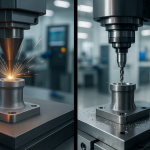
Hybrid Manufacturing refers to the integration of both additive (material-building) and subtractive (material-removing) processes into a single workflow. In the tooling industry, this typically combines laser cladding to add material where needed, and CNC milling to remove excess material and achieve high-precision surfaces.
Laser cladding is a technique where a laser beam melts a metallic powder or wire, depositing it onto a substrate. It is widely used for adding wear-resistant layers or rebuilding damaged tool surfaces. CNC milling, on the other hand, sculpts the part to its final shape and dimensions with extreme accuracy.
This combination allows manufacturers to:
- Repair tools instead of replacing them—a major cost-saving factor.
- Create complex geometries that would be difficult using only one process.
- Improve turnaround time by merging build and finish operations.
- Handle high-hardness materials while maintaining dimensional accuracy.
Compared to standalone processes, Hybrid Manufacturing ensures faster cycle times, enhanced part performance, and reduced production costs. It brings the best of both worlds to mold and tool production.

3. SLTL’s Hybrid System: How It Works
At SLTL Group, we’ve developed an integrated Hybrid Manufacturing platform that brings together laser cladding and CNC milling under one smart, automated system. Engineers have specifically designed this hybrid system for tool rooms and mold-making environments where reliability and performance matter most.
Step-by-Step Workflow:
- Scanning and Inspection: The damaged tool or mold is first scanned using high-resolution 3D scanners. This captures wear, cracks, or dimensional deviations.
- Laser Cladding: Using additive manufacturing, technicians deposit metal layer by layer only in the required areas. They select the material based on the base alloy and the operational requirements of the tool.
- CNC Milling: After adding the material, CNC machines precisely restore the original dimensions and tolerances. After this Operators refine the surface finish and edges to meet production standards.
Intelligent software controls drive this process and ensure perfect alignment between the additive and subtractive stages. The system automatically calibrates the machine, generates toolpaths, and applies thermal compensation to maintain a seamless workflow.
4. Applications in Advanced Mold and Tool Production
SLTL’s hybrid platform provides applications in different tooling scenarios, especially in sectors that demand high accuracy and durability:
- Refurbishment of injection molds used in plastics manufacturing.
- Rebuilding forging dies and press tools used in heavy machinery and sheet metal industries.
- Modifying or upgrading existing tools for design changes or performance improvements.
In aerospace, where components operate under high stress, hybrid repair extends tool life while ensuring safety. In automotive manufacturing, downtime due to tool failure is a costly affair—hybrid systems solve this by enabling same-day restoration. Medical device production provides hybrid precision supports the stringent quality requirements of implants and surgical instruments.
5. Key Benefits of SLTL’s Hybrid Approach
By adopting SLTL’s hybrid tooling technology, manufacturers can realize the following benefits:
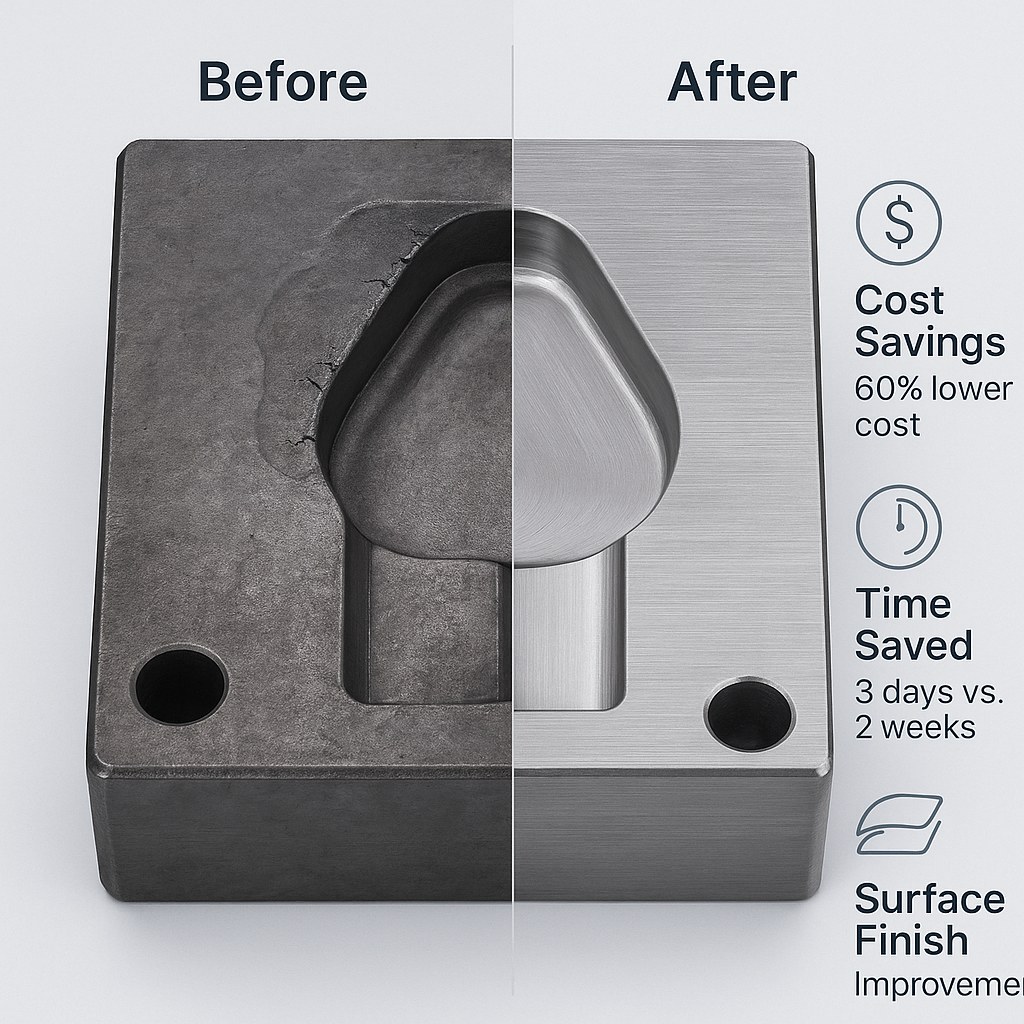
- Precision restoration: With this approach, manufacturers can restore tools and molds to their original specifications without replacing them.
- Cost-effective maintenance: Reworking parts instead of scrapping them reduces material costs and labor.
- Superior metallurgical bonding: Laser cladding forms a strong bond with the base metal, ensuring tool durability.
- Reduced downtime: Quick repair turnaround means tools are back in production faster.
- Lower inventory costs: Instead of storing backup tools, facilities can rely on on-demand repair.
These advantages directly impact productivity and profitability for manufacturers.
6. The Future of Smart Tool Rooms with Hybrid Systems
SLTL’s hybrid solutions are built for the Industry 4.0 era. These machines are equipped with sensors, machine learning algorithms, and IoT integration, making them ideal for smart factory ecosystems.
Future-ready features include:
- Predictive maintenance using real-time tool condition monitoring.
- Integration with digital twin environments to simulate wear and restoration in advance.
- Automated scheduling and tracking of repair cycles.
This paves the way for smart tool rooms where machine tools are always ready, efficient, and reliable—driven by data, not guesswork.
7. Conclusion: Why Manufacturers Should Embrace Hybrid Tooling Technology
As demands in tooling and mold making intensify, Hybrid Manufacturing emerges as the most agile and intelligent solution. By fusing Additive and Subtractive Manufacturing, companies can ensure faster delivery, greater precision, and longer-lasting tools. It not only reduces waste and cost but also aligns with sustainability and lean manufacturing goals.
SLTL Group stands at the forefront of this transformation, providing a fully integrated, customizable hybrid platform. Our systems are designed to meet the future of advanced tool making—intelligent, efficient, and adaptable.
If you’re aiming for sustainable, high-performance tooling, the future is hybrid—and SLTL is your trusted partner.