


In the world of manufacturing, traditional mold design often presents a series of challenges—multiple design iterations, high prototyping costs, long lead times, and the risk of producing defective parts. Accuracy, efficiency, and cost optimization are no longer optional—they are essential to stay competitive in today’s fast-paced industry.
This is where mold simulation software comes into play. Acting as a powerful game-changer, it allows manufacturers to visualize, test, and refine mold designs in a virtual environment before any material is used. Let’s explore how this technology is transforming the mold design process.
1. What Is Mold Simulation Software?
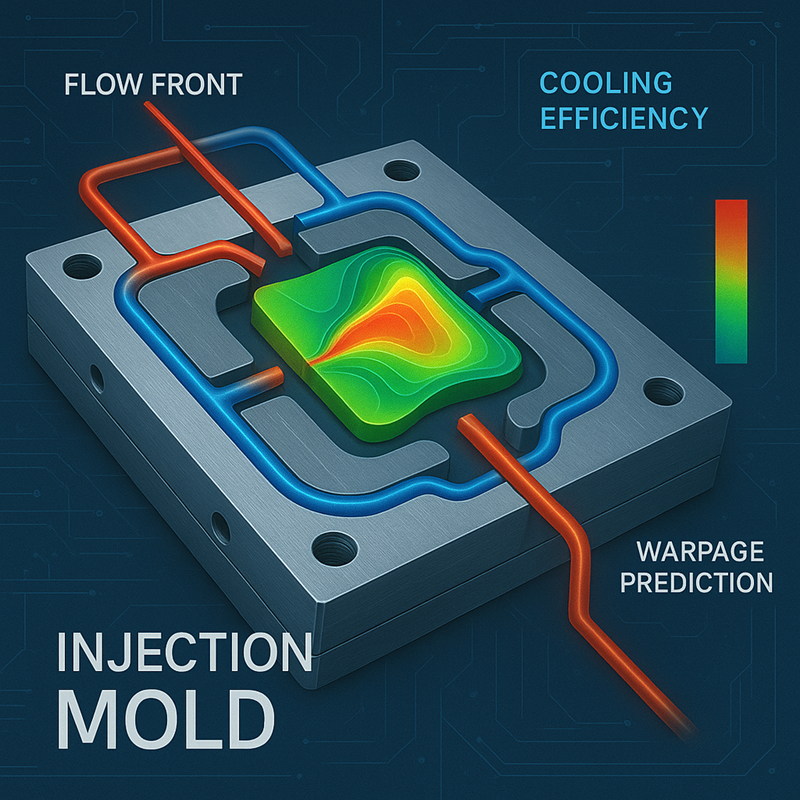
Mold simulation software is a digital tool that enables engineers to replicate and study how molten plastic or metal flows inside a mold. The goal is to predict outcomes and optimize the process before production begins.
There are different types of simulation tools:
- Injection molding simulation: Analyzes how the material fills the mold, helping avoid issues like short shots or air traps.
- Cooling simulation: Evaluates heat dissipation and cycle time.
- Warpage prediction: Identifies potential deformation after cooling.
- Shrinkage analysis: Helps in adjusting the design to maintain dimensional accuracy.
Some of the most widely used software platforms in the industry include Autodesk Moldflow, Moldex3D, and SIGMASOFT.
2. Advantages of Using Simulation in Mold Design
Incorporating simulation into the mold design process offers numerous benefits:
- Fewer design iterations: Instead of multiple physical prototypes, simulation helps detect issues early.
- Lower prototyping costs: Virtual testing reduces material waste and machining time.
- Better cooling and shorter cycles: Cooling simulations lead to efficient channel layouts that reduce cycle times.
- Enhanced part quality: Defects like weld lines, voids, or sink marks can be minimized or eliminated.
- Improved structural performance: The tool can simulate how parts behave under load, ensuring strength and durability.
3. Applications of Simulation in Mold Optimization
Simulation tools play a crucial role in various stages of mold optimization:
- Flow analysis: Predicts how the material will move through the mold cavity, highlighting areas of turbulence, hesitation, or air entrapment.
- Cooling channel design: Tools can optimize traditional and conformal cooling designs to improve heat removal.
- Warp and shrinkage prediction: Mimics warpage after cooling for tighter tolerance.
- Material behavior analysis: Different materials react differently under heat and pressure. Simulation lets you compare and choose the right material for the job.
4. Real-World Use Cases and Success Stories
Automotive industry: A leading car manufacturer used Moldex3D to redesign an air intake manifold. Simulation identified flow unbalances and cooling inefficiencies, enabling engineers to address the mold design early on. The result was a 25% reduction in cycle time and a major cut in scrap rate.
Medical device manufacturing: In a case involving a high-precision surgical component, warpage prediction using Moldflow prevented a costly tooling error. The savings in rework and recalls were substantial.
Consumer electronics: A smartphone case design was optimized through cooling and shrinkage simulation, reducing surface defects and improving cosmetic quality.
5. Integration with Industry 4.0 and Digital Twin Technology
Simulation software is a key enabler of smart manufacturing and Industry 4.0 strategies. When paired with IoT devices and smart molds, simulation extends beyond design into production monitoring.
- Digital Twin: By creating a virtual replica of the mold and part, manufacturers can simulate performance throughout the product lifecycle.
- Virtual testing: Run multiple “what-if” scenarios to prepare for real-world conditions without making physical changes.
- Predictive maintenance: Simulations integrated with sensor data help anticipate wear and tear, allowing for scheduled upkeep before failures occur.
6. Limitations and Considerations
While powerful, mold simulation software comes with its own set of considerations:
- Initial cost: High-end software licenses and computing requirements can be expensive.
- Training needs: Users must develop specialized skills to extract accurate and useful insights.
- Data quality: Output only as good as the input. Garbage in, Garbage out- meaning inaccurate data can produce misleading predictions.
However, the return on investment in terms of time saved, scrap reduced, and quality improved often outweighs these challenges.
7. Future Trends in Mold Simulation Technology
As technology advances, simulation tools are becoming even more intelligent and accessible:
- AI and Machine Learning: These technologies are helping automate simulation setup, interpret results, and suggest design modifications.
- Cloud-based platforms: Simulations can now be run on the cloud, reducing hardware dependency and enabling team collaboration.
- Real-time feedback: Smart molds equipped with sensors feed live data back into simulation models, improving accuracy and control.
Conclusion
Mold simulation software is not an isolated design tool—it’s a strategic asset. By predicting outcomes, reducing costs, and improving quality, it plays a central role in modern mold making. For manufacturers looking to enhance productivity and foster innovation, adopting simulation tools is a clear step forward.
Whether you’re designing automotive parts or consumer products, now is the time to embrace simulation as an integral part of your mold design workflow.


