

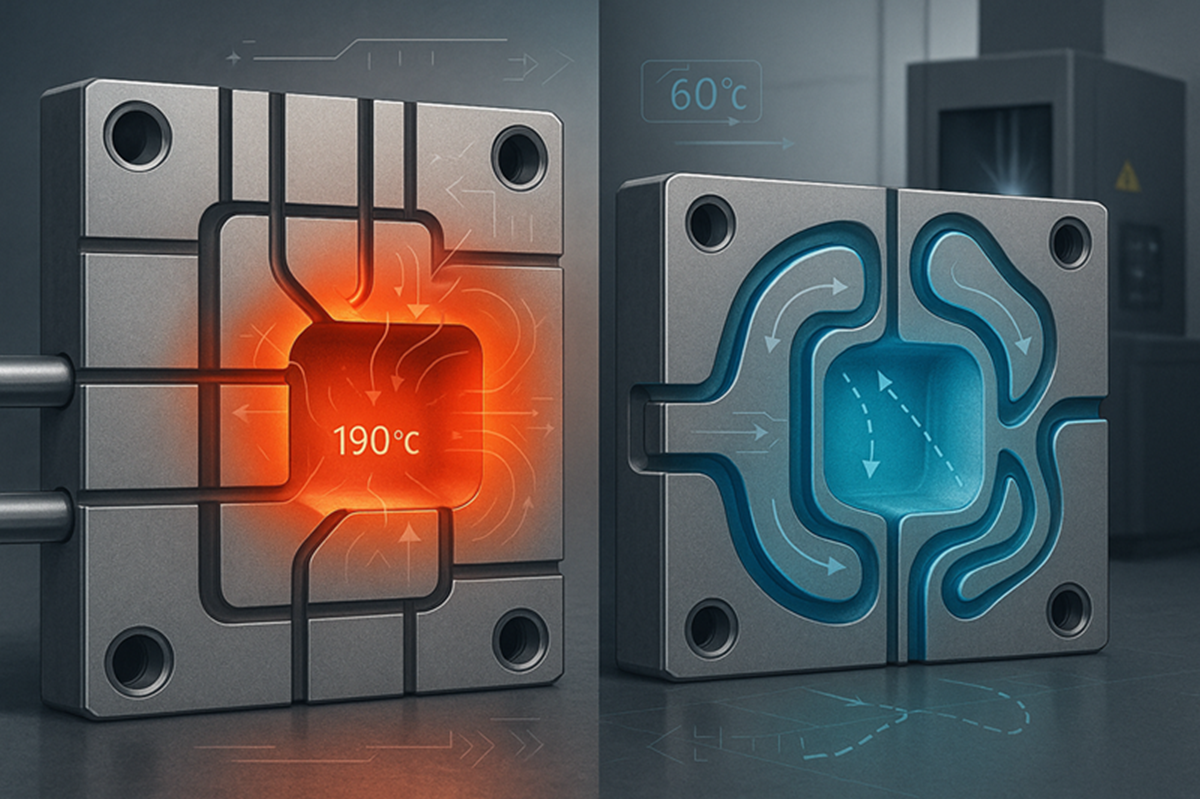
In the world of injection molding, cooling is more than just a step in the process—it’s a make-or-break factor for productivity, quality, and profitability. Traditional cooling methods, while long relied upon, often fail to meet the growing demands of modern manufacturing. Enter conformal cooling, a breakthrough that’s reshaping how molds are designed and manufactured. This blog explores what conformal cooling is, why it’s such a game-changer, and how it is setting new benchmarks in injection mold cooling performance and efficiency and understand the Benefits of conformal cooling in mold design?
Understanding Conformal Cooling
Conformal cooling refers to the use of cooling channels that follow the complex contours of a mold cavity, maintaining a uniform distance from the mold surface. Unlike conventional cooling systems, which use straight-line drilled channels, conformal cooling channels curve and flow around the part geometry.
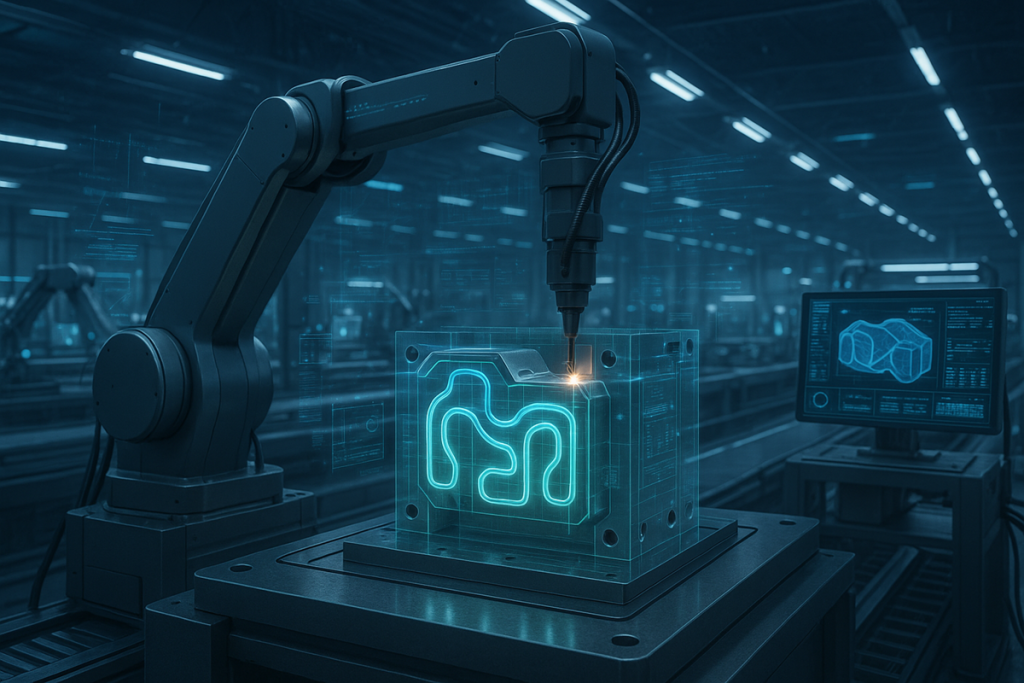
This design significantly improves thermal management, especially for parts with intricate or non-linear shapes. The technology became viable with the rise of additive manufacturing, particularly 3D metal printing methods like Direct Metal Laser Sintering (DMLS) and Selective Laser Melting (SLM). These techniques make it possible to create channels that would be impossible to drill using traditional methods.
Key Advantages of Conformal Cooling in Mold Making
1. Enhanced Cooling Efficiency
The most immediate benefit of conformal cooling is improved heat removal. Because the channels are closer and more consistently aligned with the mold surfaces, heat is extracted more evenly and effectively.
- Closer Proximity to Mold Surfaces: This proximity allows rapid heat transfer, preventing hotspots and thermal gradients.
- Uniform Temperature Control: This ensures consistent material flow, minimizing stress and improving molding reliability.
2. Faster Production Cycles
One of the top bottlenecks in injection molding is the cooling phase, often accounting for up to 60% of the total cycle time. Conformal cooling dramatically reduces this.
- Reduced Cooling Times: Faster thermal dissipation shortens the cycle.
- Increased Output Without Compromising Quality: Manufacturers can produce more parts in less time while maintaining or even improving quality standards.
3. Superior Part Quality
Poor cooling leads to visible and structural defects such as warping or sink marks. With conformal cooling:
- Minimized Warping, Sink Marks, and Stress: Better temperature regulation means fewer internal stresses in the molded parts.
- Improved Dimensional Accuracy: Especially important for high-tolerance applications like medical and automotive components.
4. Energy and Cost Savings
While the initial setup cost is higher, the operational benefits are substantial.
- Reduced Scrap Rates: Better part quality means fewer rejections and less waste.
- Lower Energy Consumption: Efficient cooling requires less power and less cycle time, directly reducing operating costs.
Design and Implementation
To fully harness the benefits of conformal cooling in mold design, engineers use specialized CAD and simulation tools.
- CAD/CAE Software: Tools like Moldflow and Siemens NX help in simulating thermal behavior and optimizing cooling path geometry before the mold is even built.
- Additive Manufacturing Techniques: DMLS and SLM allow the physical creation of these intricate channel designs with high precision.
- Integration Into Existing Workflows: Although it requires a shift in mindset, conformal cooling can be integrated into traditional mold design processes with the right planning and expertise.
These are the benefits of conformal cooling in mold design that helps in the coming years.
Real-World Use Cases
Conformal cooling has moved beyond prototypes and niche applications. It’s now proving its worth in full-scale production across industries:
- Automotive: Ideal for engine components and lighting systems where complex geometries demand consistent cooling.
- Consumer Electronics: For sleek, precision housings that require zero warpage and dimensional accuracy.
- Medical Devices: Parts like syringes or surgical instruments benefit from high repeatability and cleanliness.
- Multi-Cavity Molds: High-volume molds with multiple cavities gain uniform cooling across all parts, avoiding imbalance issues.
Challenges and Considerations
Despite the advantages, conformal cooling comes with some hurdles:
- Higher Initial Costs: Designing and printing molds with conformal channels is more expensive than conventional methods.
- Maintenance Complexity: Intricate channels can be harder to clean and maintain, especially over long-term production runs.
- Skill and Knowledge Gap: Implementing conformal cooling requires skilled design engineers and a deep understanding of simulation-driven design.
Still, the long-term gains in productivity and quality usually outweigh these challenges.
The Future of Mold Making with Conformal Cooling
As demand for faster, more precise, and energy-efficient manufacturing grows, conformal cooling is expected to become a standard practice rather than an advanced technique.
- From Niche to Mainstream: Once limited to premium applications, conformal cooling is now accessible even for mid-range production.
- Advances in 3D Printing and Simulation: New materials, better printing speeds, and more accurate simulations are making implementation smoother and more cost-effective.
- Global Push for Sustainability: Energy savings and waste reduction align well with environmental goals, giving manufacturers another reason to adopt this technology.
Conclusion
Conformal cooling is not just a trend—it’s a transformational innovation for the mold-making industry. By enabling precise, faster, and more energy-efficient cooling, it addresses many of the pain points of traditional mold production.
For mold makers, embracing conformal cooling can mean unlocking a new level of performance, quality, and competitiveness. As digital manufacturing continues to evolve, this technology is poised to become a cornerstone of high-performance injection molding.
Now is the time for manufacturers to explore this game-changing innovation and prepare for a future where speed, precision, and sustainability go hand-in-hand.


