
Introduction
Additive manufacturing, commonly known as 3D printing, has emerged as a transformative force in the tool and mold manufacturing industry. By enabling the creation of complex geometries, reducing lead times, and enhancing sustainability, 3D printing is revolutionizing how molds and tools are designed, produced, and utilized. This blog explores the impact of additive manufacturing on tool and mold making, delving into its applications, benefits, challenges, and future potential in a 2000-word deep dive.
What is Additive Manufacturing?
Additive manufacturing (AM) refers to a range of technologies that build three-dimensional objects by adding material layer by layer, guided by digital models. Unlike traditional subtractive methods, which remove material from a solid block, AM offers unparalleled flexibility in creating intricate designs. In tool and mold manufacturing, AM technologies such as stereolithography (SLA), selective laser sintering (SLS), and metal 3D printing (e.g., direct metal laser sintering, DMLS) are used to produce molds, dies, and tooling components with precision and efficiency.
The adoption of 3D printing in this sector is driven by its ability to address longstanding challenges, such as long lead times, high costs, and design limitations. From prototyping to producing functional molds, AM is reshaping workflows and enabling innovation across industries like automotive, aerospace, medical, and consumer goods.
Applications in Tool and Mold Manufacturing
1. Rapid Prototyping
One of the earliest and most significant applications of 3D printing in tool and mold making is rapid prototyping. Manufacturers can create mold prototypes quickly and cost-effectively, allowing for iterative testing and refinement before committing to expensive production processes. For example, SLA printers can produce high-resolution plastic prototypes to validate mold designs, while SLS can create durable prototypes for functional testing.
Rapid prototyping reduces the time from concept to testing, enabling manufacturers to identify design flaws early. This is particularly valuable in industries like automotive, where molds for components like dashboards or bumpers require extensive validation.
2. Conformal Cooling Channels
Conformal cooling is a game-changer in injection molding, and 3D printing makes it possible. Traditional molds rely on straight cooling channels drilled into the mold, which can lead to uneven cooling and longer cycle times. AM allows for the creation of complex, curved cooling channels that follow the mold’s contours, improving heat dissipation and reducing cycle times by up to 30%, according to industry studies.
For instance, metal 3D printing technologies like DMLS can produce molds with intricate cooling networks that enhance part quality and reduce warping. This is especially beneficial for high-volume production, where efficiency directly impacts profitability.
3. Hybrid Tooling
Hybrid tooling combines traditional manufacturing with 3D-printed components to create molds that leverage the strengths of both approaches. For example, a mold base can be machined conventionally, while complex inserts or cores are 3D-printed. This approach reduces costs and lead times while maintaining the durability of traditional molds.
Hybrid tooling is particularly useful for low-volume production or custom molds, where the cost of fully machined molds would be prohibitive. It also allows manufacturers to experiment with innovative designs without overhauling their existing processes.
4. Production of End-Use Molds
While 3D printing was initially used for prototyping, advancements in materials and printer capabilities now enable the production of end-use molds. Metal AM technologies, such as binder jetting and DMLS, can create durable steel or aluminum molds capable of withstanding thousands of injection molding cycles. These molds are ideal for small-batch production or applications requiring frequent design changes.
Plastic 3D-printed molds, made from high-performance resins, are also gaining traction for low-volume runs or soft tooling. These molds are cost-effective for producing hundreds of parts, particularly in industries like medical device manufacturing.
5. Repair and Maintenance
AM is also used to repair and maintain existing molds. Instead of replacing a damaged mold, manufacturers can 3D-print replacement components or use directed energy deposition (DED) to add material to worn areas. This extends the lifespan of molds, reduces downtime, and lowers maintenance costs.
For example, a mold with a cracked insert can be repaired by printing a new insert that matches the original specifications, saving time and resources compared to machining a new one.
Benefits of Additive Manufacturing in Tool and Mold Making
1. Reduced Lead Times
Traditional mold making is a time-intensive process, often taking weeks or months due to complex machining and finishing steps. 3D printing drastically reduces lead times by enabling direct production from digital designs. For instance, a mold that might take six weeks to machine can be 3D-printed in days, accelerating time-to-market.
2. Cost Efficiency for Low Volumes
For small-batch production or custom molds, traditional manufacturing can be prohibitively expensive due to setup costs and material waste. AM eliminates the need for extensive tooling setups, making it cost-effective for low-volume runs or one-off molds. This is particularly advantageous for industries requiring bespoke solutions, such as medical implants or custom automotive parts.
3. Design Freedom
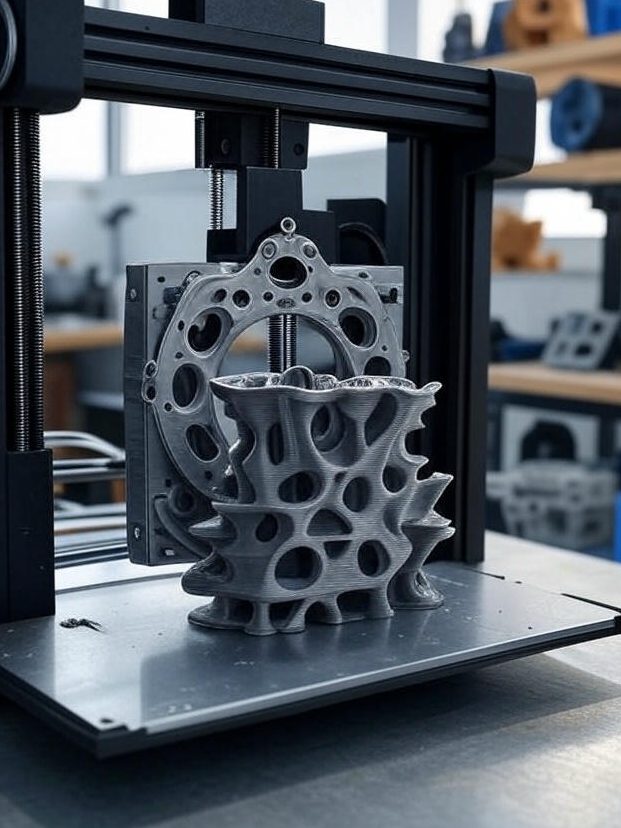
AM enables the creation of complex geometries that are impossible or impractical with traditional methods. This includes intricate lattice structures, lightweight designs, and conformal cooling channels. Such design freedom allows manufacturers to optimize mold performance, reduce material usage, and improve part quality.
4. Sustainability
Additive manufacturing is inherently more sustainable than subtractive methods, as it minimizes material waste by only using what’s needed to build the part. Additionally, 3D-printed molds with optimized cooling can reduce energy consumption during production, aligning with the industry’s push toward eco-friendly practices.
5. Customization and Flexibility
AM supports rapid design iterations and customization, enabling manufacturers to tailor molds to specific applications. This is critical in industries like aerospace, where molds must meet stringent performance requirements, or in consumer electronics, where frequent design updates are common.
Challenges and Limitations
Despite its advantages, additive manufacturing in tool and mold making faces several challenges:
1. Material Limitations
While AM offers a range of materials, including metals, plastics, and ceramics, not all are suitable for high-volume production or demanding applications. For example, 3D-printed plastic molds may not withstand the pressures and temperatures of high-volume injection molding, limiting their use to prototyping or low-volume runs.
2. Surface Finish and Precision
3D-printed molds often require post-processing, such as polishing or machining, to achieve the surface finish and dimensional accuracy required for high-precision applications. This can add time and cost to the process, partially offsetting AM’s benefits.
3. Cost of Equipment and Materials
Industrial 3D printers, especially those for metal AM, are expensive, with costs ranging from $100,000 to over $1 million. High-performance materials, such as titanium or high-strength polymers, also come with a premium price tag, making AM less viable for some manufacturers.
4. Scalability
While AM excels in prototyping and low-volume production, it is not yet cost-competitive for high-volume mold manufacturing compared to traditional methods. The speed of 3D printing and the durability of printed molds need further improvement to compete with conventional processes in large-scale production.
5. Skill Gaps
Adopting AM requires expertise in digital design, printer operation, and post-processing. Many manufacturers face a shortage of skilled personnel, necessitating investment in training and upskilling to fully leverage AM technologies.
Case Studies
1. Automotive Industry: Conformal Cooling
A leading automotive supplier used metal 3D printing to create injection molds with conformal cooling channels for producing car bumpers. The optimized cooling reduced cycle times by 25% and improved part quality, resulting in significant cost savings and faster production.
2. Medical Devices: Micro-Molding
A medical device manufacturer employed SLA 3D printing to produce prototype molds for micro-molded surgical components. The ability to iterate designs quickly allowed the company to meet strict regulatory requirements and bring the product to market in half the time compared to traditional methods.
3. Consumer Goods: Custom Packaging
A packaging company used binder jetting to create custom molds for limited-edition product containers. The flexibility of AM enabled rapid production of unique mold designs, allowing the company to meet customer demands for personalized packaging without incurring high tooling costs.
Future Trends in Additive Manufacturing for Tool and Mold Making
1. Advancements in Materials
Ongoing research is expanding the range of materials suitable for AM, including high-strength composites and bioresorbable polymers. These materials will enable 3D-printed molds to handle more demanding applications, such as high-volume injection molding or extreme temperature environments.
2. Integration with Industry 4.0
The convergence of AM with Industry 4.0 technologies, such as IoT, AI, and digital twins, is set to enhance mold manufacturing. Digital twins can simulate mold performance in real-time, while AI can optimize designs and predict maintenance needs, further improving efficiency and reducing costs.
3. Hybrid Manufacturing Systems
Hybrid systems that combine AM with subtractive methods, such as CNC machining, are gaining traction. These systems offer the best of both worlds: the design freedom of 3D printing and the precision of traditional machining, enabling the production of high-quality molds at scale.
4. Sustainability Initiatives
As sustainability becomes a priority, AM will play a key role in reducing waste and energy consumption. Innovations like recycled feedstocks and energy-efficient printers will align mold manufacturing with global environmental goals.
5. Micro-Molding and Nanotechnology
The growing demand for miniaturized components in electronics and medical devices is driving advancements in micro-molding. AM technologies are evolving to produce molds with nanoscale precision, opening new possibilities for cutting-edge applications.
Getting Started with Additive Manufacturing
For manufacturers looking to adopt AM in tool and mold making, here are some practical steps:
- Assess Needs: Identify whether AM is suitable for prototyping, low-volume production, or specific applications like conformal cooling.
- Invest in Equipment: Choose a 3D printer based on material requirements (e.g., SLA for plastics, DMLS for metals) and budget constraints.
- Train Staff: Provide training on AM technologies, CAD software, and post-processing to ensure successful implementation.
- Partner with Experts: Collaborate with AM service providers or consultants to navigate the learning curve and optimize workflows.
- Start Small: Begin with pilot projects, such as prototyping or hybrid tooling, to build confidence and expertise before scaling up.
Conclusion
Additive manufacturing and 3D printing are reshaping the tool and mold manufacturing industry by offering unprecedented design freedom, faster lead times, and sustainable solutions. While challenges like material limitations and equipment costs persist, ongoing advancements are making AM increasingly viable for a wide range of applications. From conformal cooling to micro-molding, the technology is enabling manufacturers to innovate, reduce costs, and meet the demands of a rapidly evolving market.
As industries like automotive, medical, and consumer goods continue to embrace AM, its role in tool and mold making will only grow. By staying ahead of the curve and investing in the right technologies and skills, manufacturers can unlock the full potential of additive manufacturing and secure a competitive edge in 2025 and beyond.